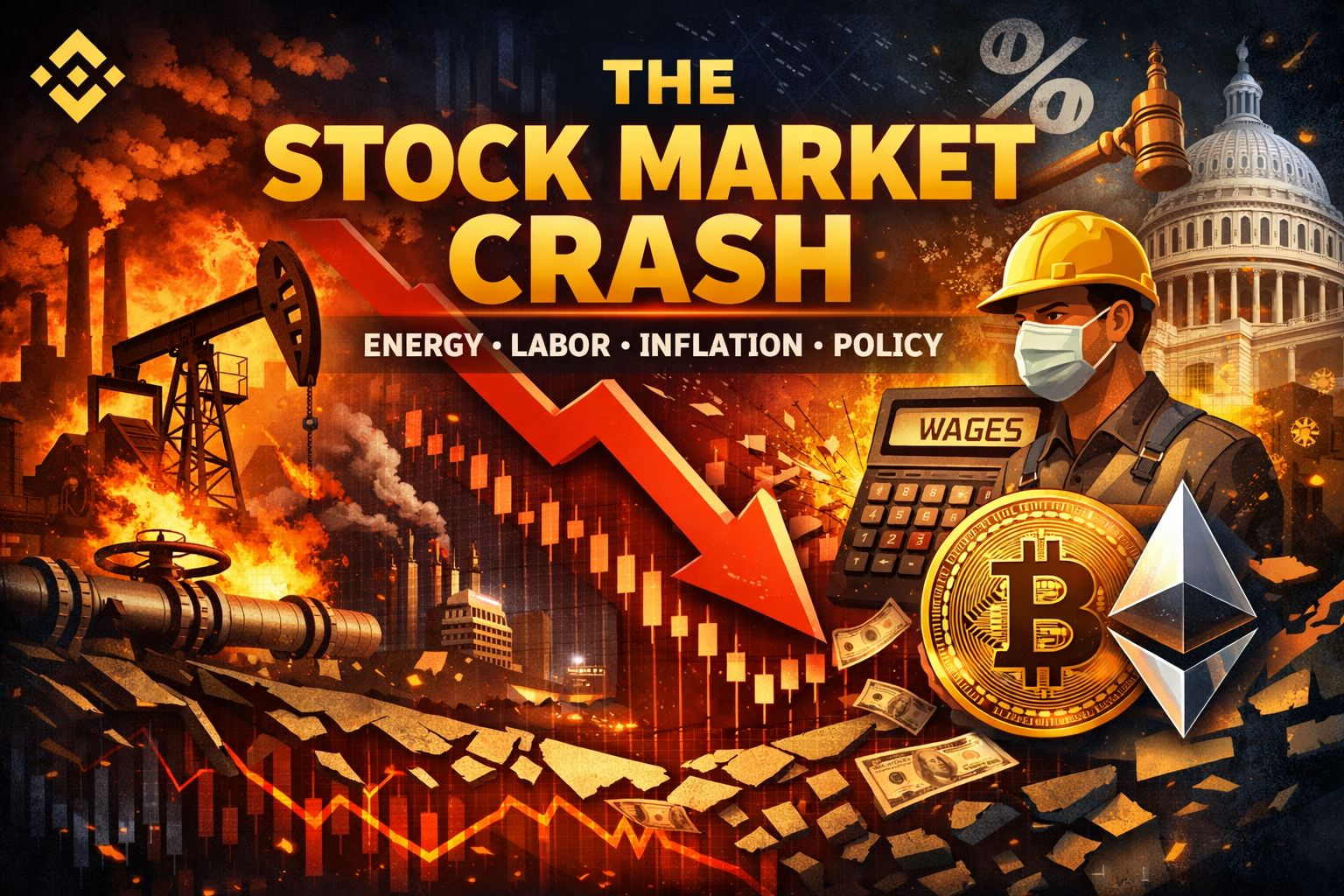
Global financial markets rarely move because of a single trigger. Most major sell-offs are the result of multiple economic pressures building at the same time. The recent stock market crash reflects exactly that — a convergence of stress across energy markets, labor costs, inflation, and government policy. When these forces collide, investor confidence weakens, liquidity tightens, and markets react sharply.
Understanding these underlying pressures helps investors better interpret market volatility and anticipate how capital may flow between traditional markets and digital assets such as Bitcoin and Ethereum.
Energy Prices: The Hidden Driver of Market Stress
Energy remains the backbone of the global economy. When oil, gas, and electricity prices rise sharply, the impact spreads across nearly every sector.
Higher energy costs increase the operational expenses of manufacturing, transportation, logistics, and agriculture. Companies face shrinking profit margins as they struggle to absorb these costs without passing them on to consumers.
For investors, rising energy prices signal:
Higher production costs
Lower corporate earnings
Reduced consumer spending
These factors often translate into declining valuations across major indices like the S&P 500 and other global benchmarks. Energy shocks also tend to amplify inflation, which leads to the next major pressure on markets.
Labor Costs and Wage Pressure
Labor markets in many developed economies remain tight. Companies are competing for workers, driving wages higher across industries.
While rising wages are beneficial for workers, they create challenges for businesses:
Increased payroll expenses
Higher operating costs
Pressure on profit margins
This dynamic creates a difficult balancing act for corporations. If wages rise too quickly, companies either raise prices (fueling inflation) or accept lower earnings — both outcomes are viewed negatively by investors.
When corporate earnings expectations fall, stock prices typically follow.
Persistent Inflation and Investor Anxiety
Inflation has been one of the defining economic themes of recent years. Even as inflation slows from its peak levels, it remains elevated enough to concern policymakers and markets.
High inflation affects the market in several ways:
Reduced consumer purchasing power
Higher borrowing costs
Lower corporate profitability
Investors also begin to rotate away from risk assets when inflation remains unpredictable. Historically, prolonged inflationary periods have led to more volatile equity markets and increased demand for alternative assets.
This is one reason why digital assets like Bitcoin are often discussed as potential hedges against monetary instability.
Policy Tightening and Interest Rates
Perhaps the most direct pressure on markets comes from monetary policy. Central banks, particularly the Federal Reserve, use interest rates to control inflation.
When inflation rises too quickly, central banks typically respond by raising rates and tightening liquidity.
Higher interest rates impact markets in several ways:
Borrowing becomes more expensive for companies
Consumer credit slows
Investment activity declines
Valuations of growth stocks compress
In simple terms, easy money fuels bull markets — tight money tends to end them.
When investors anticipate prolonged monetary tightening, markets often reprice rapidly, resulting in sharp corrections or crashes.
The Liquidity Shift
Another key factor behind the stock market decline is the shift in global liquidity.
For over a decade, markets benefited from ultra-low interest rates and large-scale stimulus programs. These conditions created abundant liquidity that flowed into equities, technology stocks, and speculative assets.
Now that central banks are withdrawing liquidity, the market is experiencing the reverse effect:
Reduced capital flows
Increased volatility
Greater sensitivity to economic data
This transition period often leads to sudden market corrections as investors adjust to a new financial environment.
Implications for the Crypto Market
Interestingly, traditional market stress can sometimes create opportunities in the digital asset sector.
When investors lose confidence in traditional financial systems or monetary policy, they often begin exploring decentralized alternatives. Assets like Bitcoin have increasingly been viewed as:
A hedge against monetary instability
A store of value outside traditional banking systems
A decentralized financial alternative
However, crypto markets are not immune to macroeconomic pressure. In the short term, tightening liquidity can impact both equities and digital assets simultaneously.
Over the long term, though, structural shifts in finance could increase interest in blockchain-based assets.
Final Thoughts
The current stock market downturn is not the result of a single shock. Instead, it reflects the combined pressure of rising energy costs, tightening labor markets, persistent inflation, and restrictive monetary policy.
When these forces converge, volatility becomes inevitable.
For investors navigating this environment, understanding macroeconomic dynamics is essential. Markets will likely remain sensitive to inflation data, central bank decisions, and global energy trends.
As the financial landscape evolves, the interaction between traditional markets and digital assets may become one of the most important themes shaping the next phase of global finance.