
I have been watching ROBO long enough now to recognize when the market is testing something it has not fully decided on yet. Today the token closed at 0.04278 USDT, up 8.88 percent in 24 hours, with a 24 hour range between 0.03914 and 0.04358. That is not the part that caught my attention. What stood out was the volume surge. ROBO printed 377.12 million tokens traded in the last 24 hours, translating to roughly 15.86 million USDT. That is a meaningful jump from the sub-13 million we were seeing just yesterday, and it arrived without any obvious catalyst. No new exchange listing, no partnership announcement, no Fabric Foundation update that would explain why participation suddenly accelerated. Volume expansions like this usually mean one of two things. Either someone with conviction is building a position ahead of information the rest of us do not have yet, or the market is repricing ROBO based on something structural that changed quietly while most people were not paying attention.
The technical setup is cleaner than it was a day ago. ROBO reclaimed the EMA 20 at 0.04138 and is holding above it, which tells me short term momentum has shifted back in favor of buyers. The RSI at 52.80704 is sitting in neutral territory, not overbought but also not showing signs of exhaustion. The moving averages are starting to flatten and compress, with the MA 5 at 62.27 million and MA 10 at 54.67 million tokens, which usually precedes either a breakout or a breakdown depending on which direction volume tips the scale. Right now, volume is tipping toward expansion, and that makes me think the next move could be larger than the 8.88 percent we saw today. But here is the part I keep coming back to. Volume without a story fades fast in crypto. If this expansion is just speculative repositioning after the compression we saw earlier this week, then ROBO risks giving back these gains as quickly as it made them. If this expansion is tied to actual network activity that Fabric Foundation has not publicized yet, then we might be seeing the early signal that retention is starting to show up onchain.
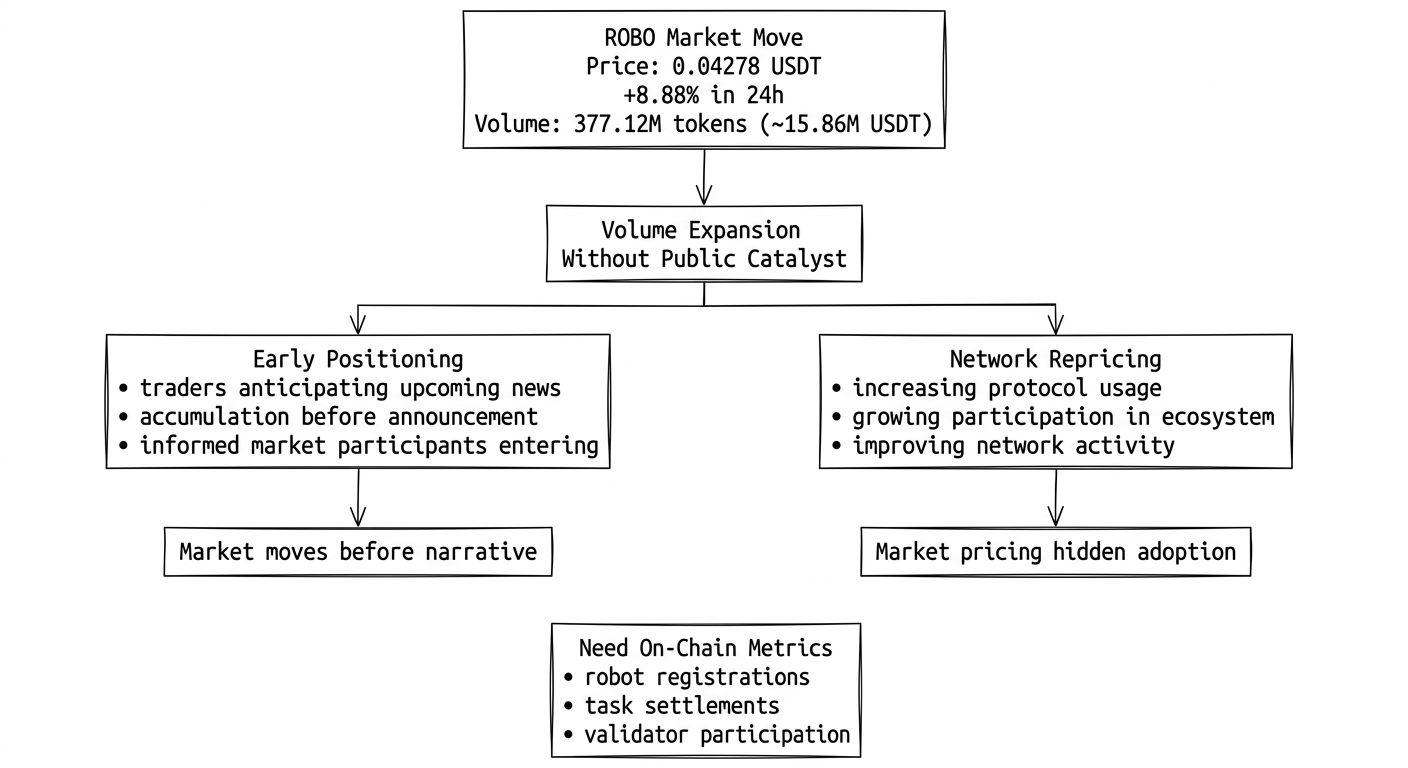
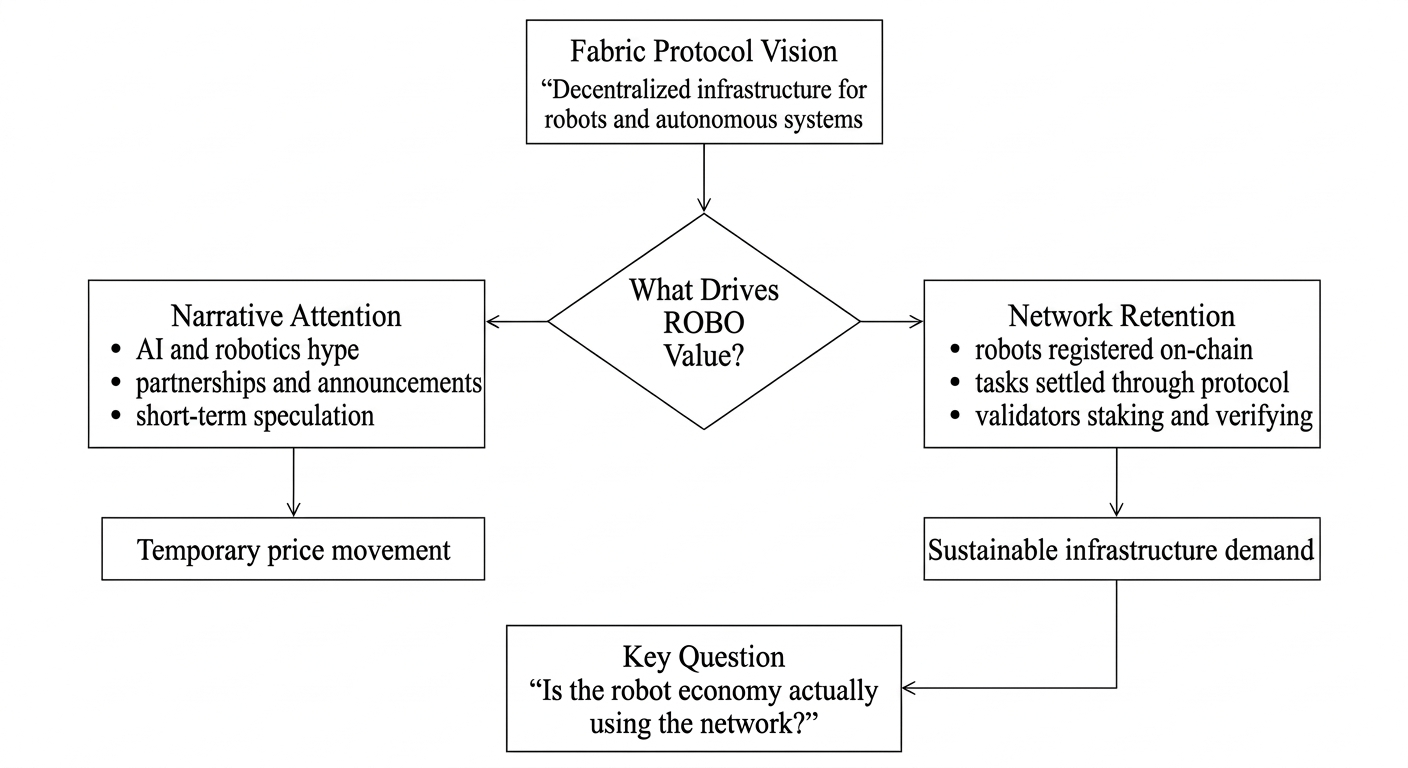
That distinction matters because Fabric Protocol is not a meme coin, and it is not a Layer 1 competing on transaction speed or gas fees. Fabric Foundation describes the network as infrastructure designed to help humans and intelligent machines work together safely and productively, with ROBO functioning as the token used for network fees, identity verification, staking, and governance. The whitepaper frames Fabric as a decentralized system to build, govern, own, and evolve general purpose robots, with the mission of creating coordination rails that allow machines, builders, validators, and users to interact through open protocols instead of closed corporate stacks. If that vision holds, then ROBO should not trade like a narrative token. It should trade like infrastructure, and infrastructure tokens derive value from usage, not from hype cycles. The problem is that right now I cannot verify whether usage is actually increasing, because Fabric Foundation has not published the onchain metrics that would let me track robot registrations, task settlements, validator participation, or x402 transaction volume. Without those numbers, I am left interpreting volume and price action, which is a weaker signal than I would like for a token positioning itself as critical infrastructure.
The timing of this volume expansion is also worth noting. ROBO launched on February 27, 2026, which means we are now roughly two weeks past launch. That is the period where most tokens see volume decay sharply as the initial listing excitement fades and only the committed participants remain. ROBO did experience that decay, dropping from over 100 million USDT in early March down to the low teens by mid-week. But now volume is expanding again, and it is expanding without the kind of headline that usually drives retail FOMO. That pattern suggests institutional or semi-institutional interest, which is either very bullish if they know something we do not, or very concerning if they are positioning to distribute into strength once retail shows up. I do not have enough information yet to tell which one we are seeing, but I am leaning toward the former because the price action is controlled, the range is tight, and there is no sign of aggressive dumping even as volume picks up.
Here is where I still have friction with the broader Fabric story. The token allocation shows that 29.7 percent of ROBO went to ecosystem and community, 24.3 percent to investors, 20 percent to team and advisors, and 18 percent to foundation reserve, with much of that supply locked under cliff and vesting schedules. The circulating supply is currently around 2.231 billion tokens out of a 10 billion maximum supply, which means roughly 78 percent of total supply is still locked. That is fine for now, but it also means that as vesting unlocks start hitting in late 2026 and into 2027, ROBO will need genuine demand from network usage to absorb that supply without collapsing. Volume expansion today is encouraging, but volume expansion in a bull cycle is easy. The harder test is whether ROBO can sustain liquidity and usage during quieter market conditions, and whether Fabric Foundation can prove that the network is growing organically rather than just riding the broader crypto narrative about AI and robotics.
The governance question is also unresolved, and I think that matters more than most traders are pricing in. Fabric's whitepaper says token holders can signal on network upgrades and protocol parameters, but it also says governance rights do not extend broadly beyond protocol operations, and that early stage decision making may involve a limited set of stakeholders. That language tells me that in practice, governance over Fabric Protocol is likely centralized for now, with the foundation or a small coalition of early participants making the decisions that actually shape the network. I am not saying that is wrong. Early stage protocols often need tighter control to avoid governance gridlock or attack vectors. But if you are buying ROBO thinking you are getting meaningful governance influence, you should read the fine print carefully, because the token may not give you the power you think it does. What ROBO does give you is exposure to network growth if Fabric Foundation executes, and exposure to dilution if they do not. That is the trade.
I also keep thinking about what retention looks like for a system like Fabric Protocol. In most DeFi protocols, retention shows up as TVL growth, active users, or transaction count. For Fabric, retention should show up as robots getting registered with persistent onchain identities, tasks being verified and settled through Proof of Robotic Work, validators staking ROBO and participating in verification, and developers building applications that interact with the network. Those are the metrics that would tell me ROBO is not just a token with a good pitch deck, but a token embedded in a system that people are using repeatedly because it solves a problem they cannot solve another way. Fabric Foundation has announced partnerships with hardware manufacturers like UBTech, AgiBot, Fourier Intelligence, and Unitree, and they launched the x402 protocol with Circle to enable autonomous USDC payments for robot services. Those are real developments, and they matter. But partnerships and protocol launches are inputs, not outcomes. I want to see the outcomes, and the outcomes are onchain activity that proves the system works and that participants are coming back.
So what would change my mind in either direction? If Fabric Foundation publishes transparent onchain metrics in the next two to four weeks showing hundreds of robots registered, thousands of tasks settled, and growing validator participation, then this volume expansion starts looking like early positioning ahead of a retention breakout. If we see sustained daily volume above 15 million USDT without needing constant new catalysts, that tells me there is genuine two-sided interest in ROBO beyond just launch week speculation. If the price can hold above the EMA 20 and build a base in the low 0.04s while volume stays elevated, then technically we are setting up for a move toward the mid 0.04s and potentially a retest of the 0.048 level we touched in early March. On the other hand, if Fabric Foundation stays quiet on metrics, if volume fades back below 10 million USDT, or if governance decisions continue happening behind closed doors without transparency, then I start worrying that ROBO is infrastructure in name only, and that the real control and value capture is happening at the foundation level rather than at the token holder level.
For now, I am watching ROBO with more interest than I was yesterday. The volume expansion is real, the technical setup is improving, and the project is positioned in a sector that could genuinely matter if robotics adoption accelerates over the next few years. But I am not confusing potential with proof. Fabric Protocol is still early, the metrics are still opaque, and the governance structure is still centralized. That does not make ROBO uninvestable. It makes it a bet on whether Fabric Foundation can turn a compelling vision into a network that people actually use, and whether they can do it fast enough to justify the current valuation before vesting unlocks start pressuring price. The token is up today, volume is up today, and the chart looks better than it did. What happens next depends on whether Fabric Foundation can show us the retention data that proves this is not just another well packaged idea waiting for the next narrative cycle. I am watching the numbers, and I am waiting to see if the story catches up.
#ROBO $ROBO @Fabric Foundation
