Artificial intelligence has reached a strange point. Models can write essays, generate code, summarize research papers, and answer complex questions within seconds. The outputs often look convincing, sometimes even brilliant. But anyone who has worked with AI for long enough knows the uncomfortable truth behind that fluency: confidence does not always equal accuracy. Models can hallucinate facts, misinterpret context, or invent details while sounding completely certain. For casual tasks this may be harmless, but when AI starts touching finance, research, healthcare, or autonomous systems, the cost of being wrong becomes much higher.
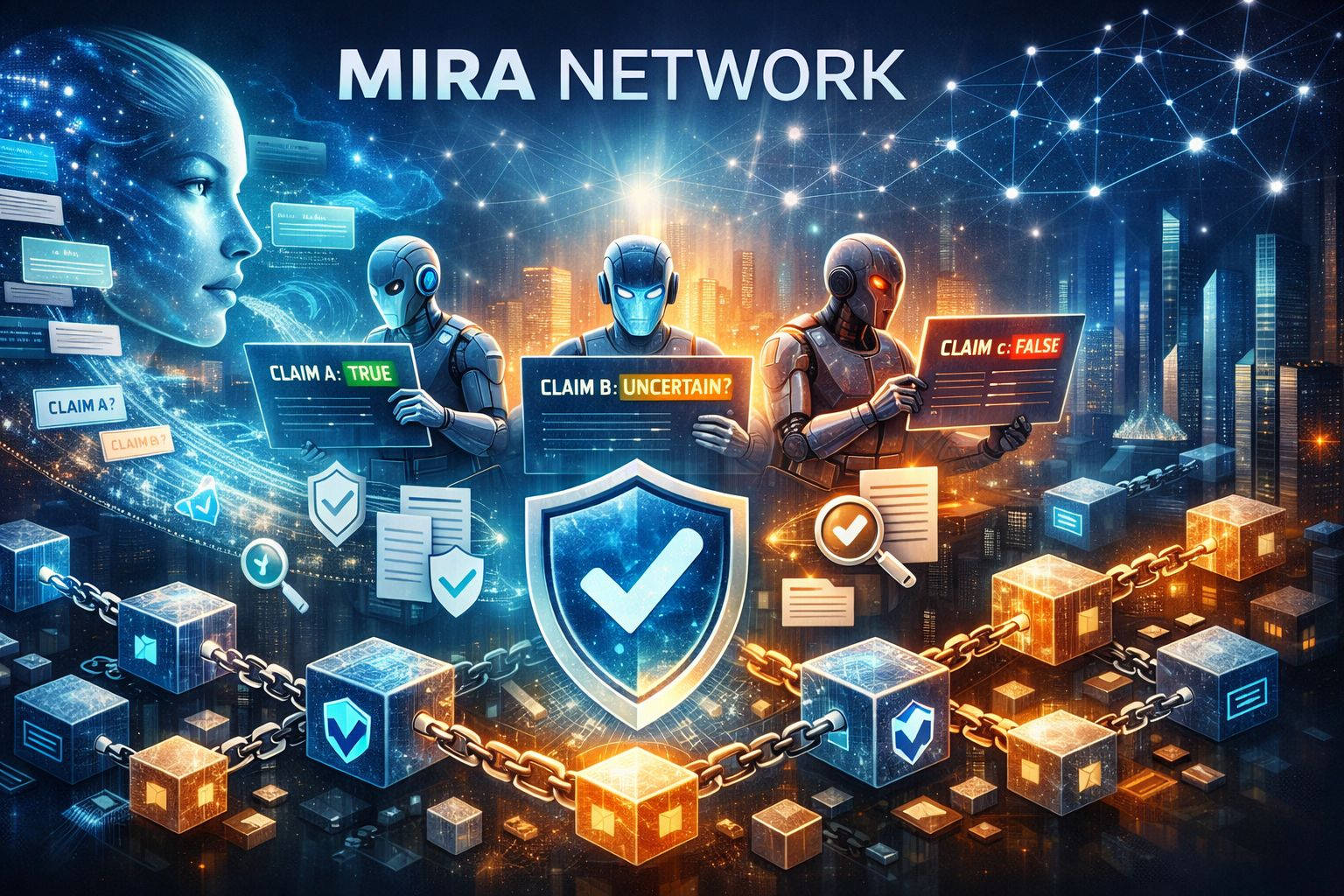
Mira Network is built around that exact problem. Instead of trying to make AI sound smarter, the project focuses on making AI outputs more trustworthy. The idea is straightforward but powerful. Rather than accepting a model’s answer as a final truth, Mira treats that answer as something that needs to be verified. The network breaks complex outputs into smaller claims and then distributes those claims across multiple independent AI models for validation. Instead of relying on one system’s judgment, the network looks for agreement across many. What emerges is a form of decentralized verification where consensus replaces blind trust.
This approach changes how we think about AI reliability. Today most systems operate in a single-model environment: one model produces the answer and another model might check it. But that still leaves a lot of room for error. Mira’s design assumes that reliability improves when multiple perspectives are involved. Different models analyze the same claim, compare results, and reach a collective decision. If several independent systems agree on a claim, confidence increases. If they disagree, the network recognizes uncertainty instead of pretending it knows the answer.
What makes this system work is the economic layer built around it. Participants who run verification models must stake the network’s native token, MIRA. That stake gives them the right to participate in validating claims and earning rewards. But it also introduces accountability. Validators are incentivized to behave honestly because their rewards depend on accuracy and reputation within the network. In simple terms, the protocol tries to align financial incentives with truthful verification. If the system functions as intended, good validators earn more influence while unreliable ones gradually lose credibility.
The MIRA token sits at the center of this process. It is used for staking by validators, governance participation, rewards for verification work, and payment for accessing network services. This gives the token a direct role in the operation of the protocol rather than existing purely as a speculative asset. As the network processes more verification requests from applications, demand for participation and services grows alongside it. That connection between utility and activity is important because it ties the token’s relevance to the actual use of the network.
Beyond the core protocol, Mira is also building an ecosystem designed to test this idea in real environments. The project has attracted venture support from firms like BITKRAFT Ventures and Framework Ventures, which helped fund early development. On the product side, Mira has supported applications and developer initiatives aimed at integrating verification into everyday AI workflows. Grants and ecosystem programs encourage builders to experiment with tools that rely on verifiable outputs rather than simple generation.
This ecosystem approach matters because a verification network only becomes meaningful if it is used. AI models already generate enormous amounts of information every day. The real opportunity lies in creating systems that can confidently say which parts of that information are reliable. If Mira can position itself as the infrastructure that verifies AI outputs before they are acted upon, it becomes more than a technical experiment. It becomes a foundational layer for AI applications that require trust.
Still, the challenge ahead is significant. Decentralized verification must prove that it can operate efficiently, securely, and economically at scale. If the process becomes too slow or expensive, developers may fall back on centralized solutions. Mira’s success depends on demonstrating that distributed consensus can deliver reliability without sacrificing performance. In other words, the network must show that trustless verification is not only possible but practical.
What makes Mira interesting is that it addresses a problem many people in AI quietly acknowledge but few are solving directly. The industry has spent years improving generation quality, yet reliability remains an open question. As AI systems move closer to autonomous decision-making, the ability to verify information becomes just as important as the ability to produce it.
Seen from that perspective, Mira is less about building smarter AI and more about building dependable AI. Its vision suggests a future where machine outputs are not simply accepted but proven through verification networks. If that vision succeeds, the value of the system will come from something far more durable than hype: the ability to turn uncertain intelligence into information that people can actually trust.