
I’ve been watching ROBO Fabric Foundation for a while now, and my view has changed in a quiet way over time.At first, I saw it the way most people see projects like this. You notice the ambition, the structure, the promise of what it could become. But the longer I stayed with it, the less interested I became in the surface and the more interested I became in the problem underneath it. And honestly, the deeper issue in robotics has never felt like intelligence alone. It has felt like trust.
That is the part people rarely sit with for long. A robot can move well, respond well, adapt well, and still leave behind a very human discomfort. Who is really responsible for what it becomes over time? Who decides how it evolves? Who checks whether the system is acting within the boundaries it claims to have? And when something goes wrong, who can actually explain what happened without hiding behind complexity?
That is where ROBO Fabric Foundation started to feel different to me. Not because it sounded louder than other projects, but because it seemed to take that discomfort seriously. General-purpose robotics has been moving forward like a black box for too long. Powerful systems are often built behind closed doors, updated in private, and governed by a small number of people while everyone else is asked to trust the outcome. That may work for a while, but it does not build lasting confidence.
Fabric Protocol seems to begin from the idea that robotics cannot mature that way. If these machines are going to become part of shared human environments, then the system around them has to be more visible, more accountable, and more structured. That is what makes its decentralized foundation important. Instead of treating robots like dependent devices waiting for instructions from a central server, Fabric treats each robot as a participant inside a broader decentralized network. That changes the philosophy of the whole system. Control is not meant to disappear into one hidden center.
The role of verifiable computing matters for the same reason. In most systems, people are still expected to trust that the machine did what it was supposed to do. Fabric tries to replace that uncertainty with proof. A robot’s action is not only executed, but tied back to code and conditions that can be verified. That may sound technical, but emotionally it changes everything. People are far more willing to live beside complex systems when they do not feel forced into blind faith.
The public ledger adds another layer to that trust. Its value is not just transparency as a slogan. Its value is memory. It creates a shared record of changes, decisions, and machine state that does not belong only to insiders. In a field where complexity can quickly become an excuse for opacity, that kind of public trace matters more than most people admit.
What also stands out is the idea of collaborative evolution. Fabric suggests a world where robots do not just execute tasks but evolve through shared information and governance. That is ambitious, but what makes it thoughtful is the restraint around it. Owners can opt out. Changes are not simply forced downward. Evolutionary patches can be tested through digital twins before they ever reach physical machines. That says a lot about the mindset behind the protocol. It shows that change is being treated as something that must earn trust before it earns deployment.
I think that is why the project feels more serious over time. It is not just trying to make robotics more advanced. It is trying to make it more livable. Safety is not framed as an afterthought, but as something built into the system itself. And community trust, if it grows, will not come from hype. It will come from watching how the protocol behaves, how carefully it evolves, and whether it continues choosing accountability over spectacle.
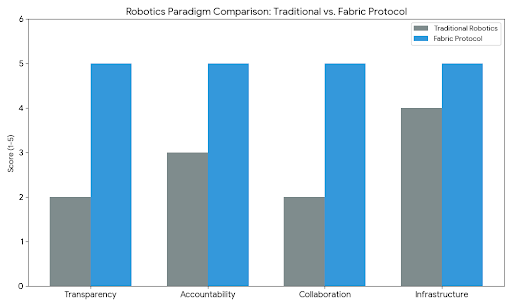
If that discipline holds, ROBO Fabric Foundation could quietly become something important. Not because it promises the loudest future, but because it may help make the future of robotics feel less hidden, less fragile, and more humanly trustworthy.
@Fabric Foundation #ROBO $ROBO
