
I still remember one night sitting down to revisit Fabric Protocol after the market had gone through yet another familiar cycle of heating up and losing steam, and my first reaction was not excitement but a kind of caution that had already become instinct. Anyone who has stayed in crypto long enough understands this: when the whole market starts obsessing over robots, the thing worth examining is not speed, but the rules surrounding that power.
What stands out about Fabric Protocol is not how many things its on chain robots can do, but how the project designs governance so those robots do not become machines set loose simply because they can move faster than humans. The more authority a robot has to read data, allocate capital, or react to market signals, the more governance has to function as a real layer of behavioral control. In a project like this, the central question is not how smart the robot is, but what it is allowed to do, within what limits, and who can stop it when reality drifts away from the original assumptions.
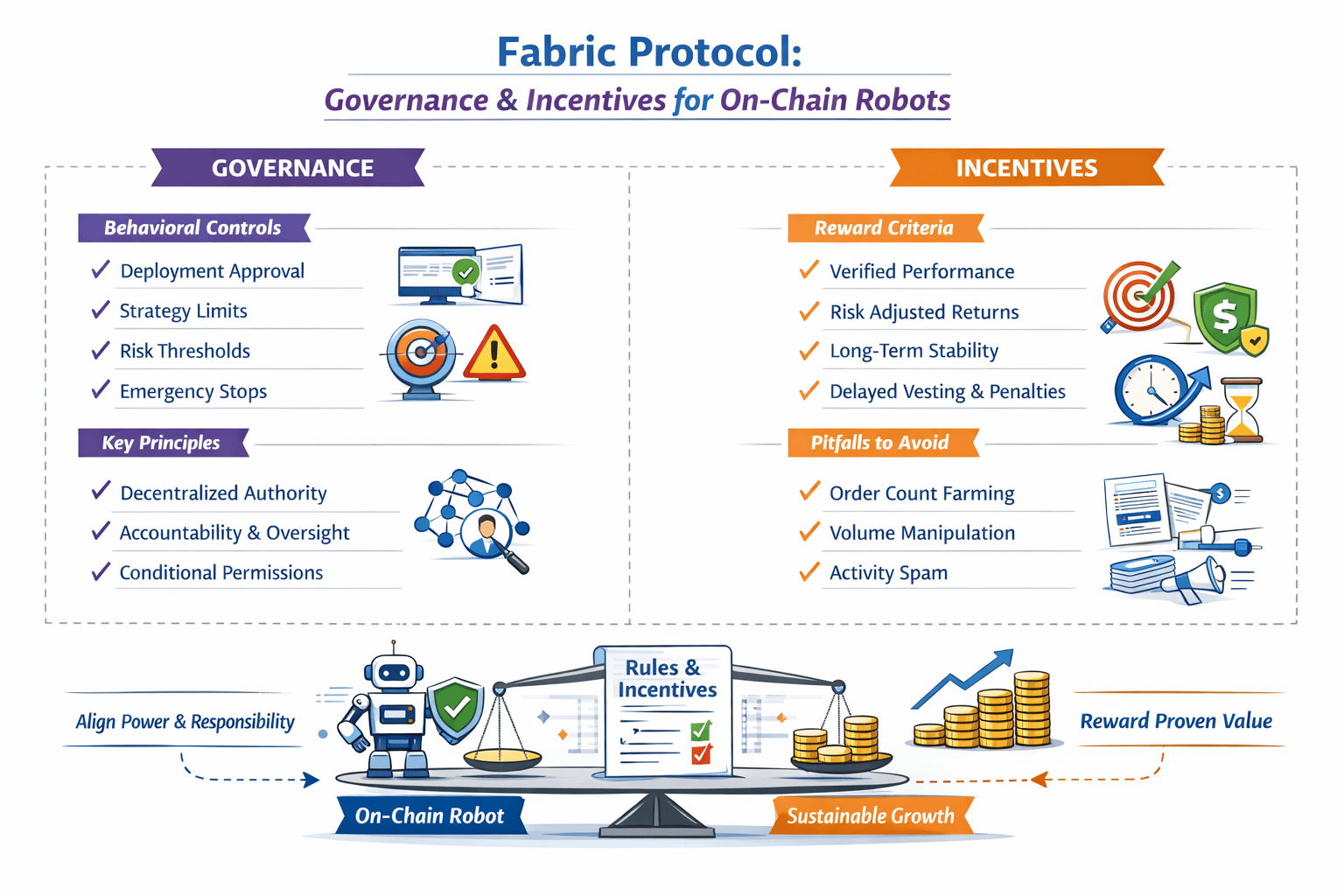
To me, this is the most mature part of the design if you look at it from a builder’s perspective. Governance for on chain robots has to answer a few basic questions. Who has the right to deploy a robot. Who has the authority to expand its strategy. Where the risk limits are set. And at what level the emergency stop mechanism sits. Maybe the most important point is that power has to be broken into smaller pieces. A serious system does not give the same actor full authority to observe, decide, and execute, then hope to clean things up afterward.
This is exactly where Fabric Protocol touches an old lesson the market keeps relearning. Governance has no real value if it does not force the actor to align incentives with responsibility. It sounds simple, but, ironically, the more we talk about machines, the more we return to that deeply human principle. An on chain robot cannot be judged only by its performance or its reaction speed. It has to operate inside a framework where every permission comes with conditions, every condition is observable, and every deviation can lead to consequences.
But governance is only one half of the picture. The other half is incentive design. With Fabric Protocol, the real question is not how to make robots more active, but how to reward the exact kind of behavior the protocol actually needs. This is the part where I paused the longest, because most incentive systems in crypto die from the same old mistake. A system measures what is easy to measure, and the actors optimize exactly that. If rewards are tied to order count, the robot creates more orders. If rewards are tied to volume, the robot spins volume. If rewards are tied to activity, the robot produces noise.
I think Fabric Protocol can only go the distance if incentives are tied to the quality of outcomes after accounting for risk, stability, and the ability to sustain performance over time. A robot showing attractive returns over a few days is not necessarily good. It may simply be borrowing risk from the future while the dashboard still looks clean in the present. That is why rewards cannot arrive too early. They need some delay, some kind of vesting over time, and penalties when results later reverse. It is striking how something as dry sounding as an unlock schedule can decide whether Fabric Protocol nurtures real value or just trains extractive behavior. Put simply, governance defines the behavioral boundaries, and incentives have to make staying within those boundaries worthwhile.

After years of watching the market change narratives over and over without really changing its nature, the lesson I take from Fabric Protocol is fairly clear. Designing on chain robots is not as hard as designing the rules that prevent those robots from harming the system once they are given real authority. And designing rewards is not as hard as making sure those rewards reflect value that has actually been verified. If this project can do both at the same time, it has a chance to move beyond the idea stage and become infrastructure that people can trust. If not, then this will still be just another new story retelling an old mistake. In a market that is always fascinated by speed but rarely respects discipline, can Fabric Protocol stay grounded long enough for governance and incentives to mature within the same cycle.