
The robotics industry is standing at a critical crossroads. For decades, the development of autonomous machines has been a "black box" affair—dominated by proprietary hardware and closed-source software. While this worked for isolated factory arms, the stakes change completely when robots enter our hospitals, our streets, and our homes. In these high-stakes environments, transparency isn't just a feature; it’s a safety requirement.
Now through @Fabric Foundation introducing a decentralized framework for "Physical AI," they are tackling the trust deficit head-on. At the center of this movement is the #Robo token, which serves as the economic and coordination engine for an open, verifiable robotics ecosystem.
Decentralizing the Machine: The Fabric Foundation Vision
The fundamental problem with centralized robotics is the lack of accountability. If a proprietary robot makes a critical error in a public space, auditing the "why" behind that action is often impossible for third parties. @Fabric Foundation solves this by building an open foundation where machine actions are recorded on a public ledger.
This isn't just about logging data; it’s about verifiable computing. By distributing the computational tasks across a global network, the protocol ensures that every robotic action is traceable and auditable. This modular approach allows developers to collaborate on general-purpose robots that aren't tied to the whims of a single corporation.
The #robo ecosystem thrives on this transparency. Through community governance, the network decides on regulatory compliance and safety standards, ensuring that the "Physical AI" economy remains open and secure. As global regulations tighten around AI and automation, protocols that offer built-in, verifiable compliance infrastructure will likely become the gold standard for enterprise adoption.
ROBO Market Analysis: Watching the Rebound at $0.03900
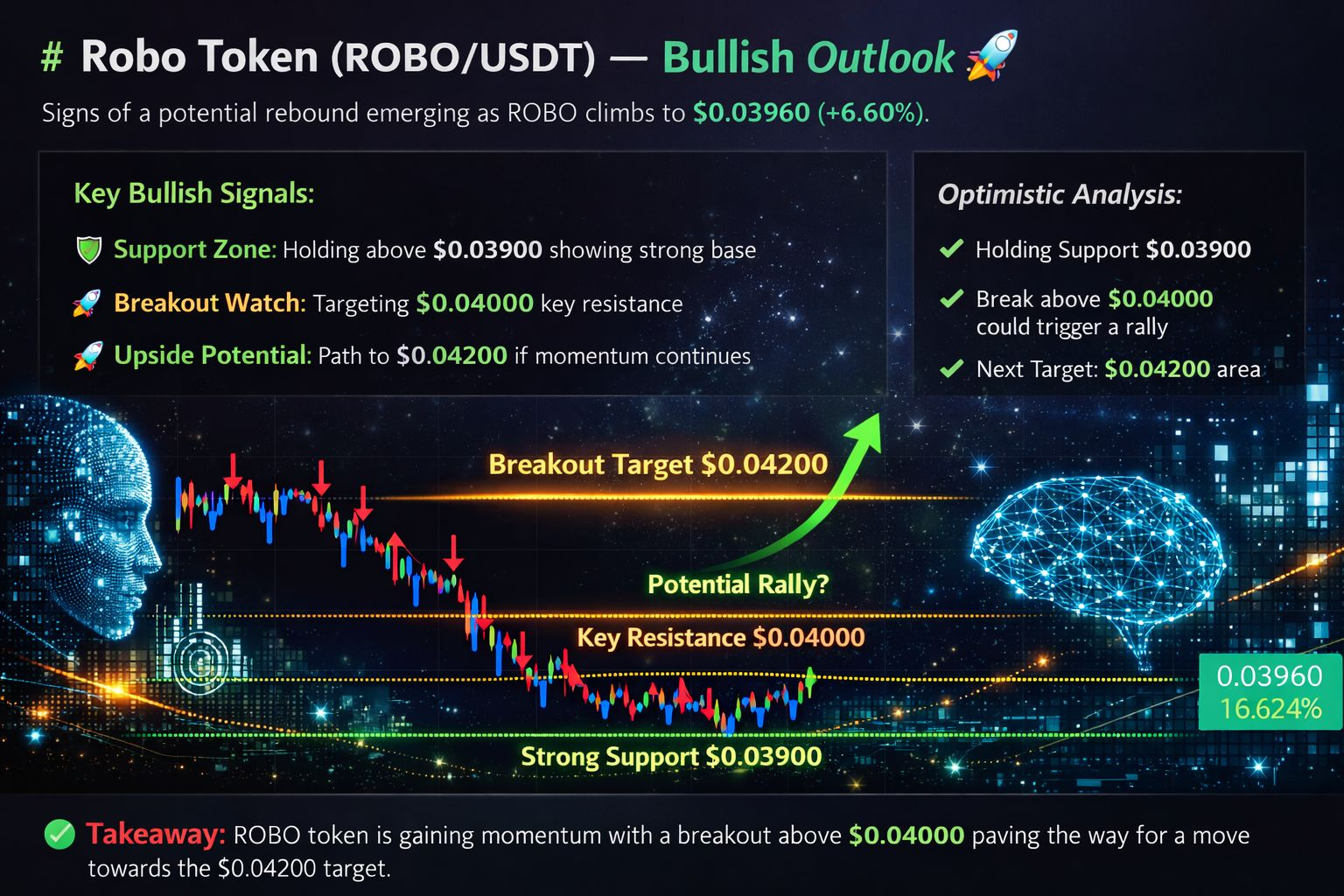
While the long-term vision of fabricfnd is about changing the world, short-term traders are currently focused on a very specific set of technical levels. As of March 11, 2026, the $ROBO token has experienced a volatile session on Binance, currently trading around the $0.03960 mark.
After a sharp 6.60% intraday dip, the price action suggests that the "weak hands" have been shaken out, and a base is forming. The $0.03900 level has emerged as a critical line in the sand. Every time the price has approached this zone, we have seen renewed buying interest, signaled by strong accumulation patterns on the 1-minute and 5-minute charts.
The Path to Recovery:
* The Support Floor: Holding above $0.03900 is the primary objective for bulls. As long as this level remains intact, the "oversold recovery" narrative remains the dominant play.
* The Resistance Hurdle: To confirm a true trend reversal, #robo needs a decisive breakout above $0.04050. A move past this psychological barrier would likely trigger a wave of FOMO from sidelined traders.
* Leading Indicators: Keep an eye on the network's internal metrics. An increase in active node operators and data providers within the @fabricfnd ecosystem often precedes positive price action for #ROBO , as it reflects actual utility and network growth.
Strategic Indicators for Analysts
If you are tracking the strength of the protocol, these are the "under-the-hood" metrics to monitor:
1. Bond Utilization Rate: How much of the circulating $ROBO is currently locked in operational or delegation bonds? A rising rate suggests supply-side pressure.
2. Slashing Events: Frequent slashes indicate either a network in flux or a robust security layer weeding out bad actors.
3. veROBO Lock Average: A high average lock time (e.g., >2 years) signals that the community is betting on the long-term "Physical AI" narrative rather than short-term price action.
Currently, $ROBO is consolidating around the $0.039 – $0.040 zone. With the token having recently hit major exchanges, the next few weeks of validator onboarding will likely define the new price floor
Final Thoughts: A Foundation for the Future
The transition from "closed robotics" to "verifiable robotics" is perhaps the most significant shift in the history of automation. It moves us away from a future of corporate silos and toward a future of collaborative, community-governed machines.
Whether you are looking at @fabricfnd for its groundbreaking technology or trading $ROBO for its technical setups, one thing is clear: the physical AI economy is being built right now, and it’s being built on a foundation of trust.