
okay so theres a section in the Fabric whitepaper that most people skip completely because it sounds philosophical and honestly i almost skipped it too 😂
but the architectural inspiration section contains the clearest explanation of why $ROBO robot identity works the way it does — and the logic comes directly from biology.
what caught my attention:
humans store their blueprint in long chains of nucleic acids. DNA. every person on earth has a unique genome. small random changes to that genome are the basis of evolution and give each individual a unique identity. the genome encodes capabilities, composition, inherited history — everything that makes one human different from another.
the Fabric whitepaper uses this exact structure as the architectural inspiration for robot identity. except instead of physical chains of nucleic acids — robots get digital identity chains built from cryptographic primitives.
every robot on the Fabric network gets a unique identity based on those cryptographic primitives. that identity references metadata — capabilities the robot has, interests it serves, composition of its software stack, and the rule-sets that govern its actions. just like a human genome is readable by biologists — robot identity on Fabric is readable on-chain by anyone with the right tools.
the angle that interests me:
why does robot identity matter for $ROBO specifically?
think about what happens without it. a robot completes a task. how does the network know which robot completed it? how does the protocol verify that the robot claiming reward is the same robot that did the work? how does a user know the robot serving them has the capabilities it claims?
without persistent cryptographic identity — none of these questions have verifiable answers. fraud becomes trivially easy. a bad actor creates fake robot identities, claims completed tasks, collects rewards, disappears. the entire $ROBO reward mechanism depends on tracing verified work back to a specific persistent identity.
with cryptographic identity — every task completion gets signed using the robot’s identity key. the signature is verifiable on-chain. the identity is persistent across sessions. capabilities are declared and referenceable. rule-sets are transparent.
identity is not just a technical layer — it is the trust anchor that lets the $ROBO economy price robot work, reputation, and accountability.
the ERC standards angle:
the whitepaper references ERC-7777 and ERC-8004 as proposed identity and governance standards for robots on Fabric. ERC-7777 handles robot identity and trust. ERC-8004 handles governance participation. together they give each robot a verifiable on-chain presence that persists across tasks, sessions, and time — robot equivalent of a passport combined with a professional license.
this matters for $ROBO token economics directly. work bonds — the $ROBO staked by operators — are tied to specific robot identities. slashing events follow specific identities. seniority for task selection builds on specific identities. reputation accumulates on top of identity. the entire economic incentive structure of $ROBO depends on identity being persistent, verifiable, and unfakeable.
what they get right:
the biological analogy is more than poetic. DNA works because it is persistent, unique, publicly decodable by the right tools, and carries complete information about the organism. cryptographic robot identity on Fabric follows the same logic digitally. persistent across time. unique per robot. referenceable on-chain. carries capability and rule-set information.
the speed of robot skill sharing — one robot learns, all robots can install — only works safely if you can verify which robots have which skills and trust their declared capabilities. identity is the prerequisite for the entire skill economy.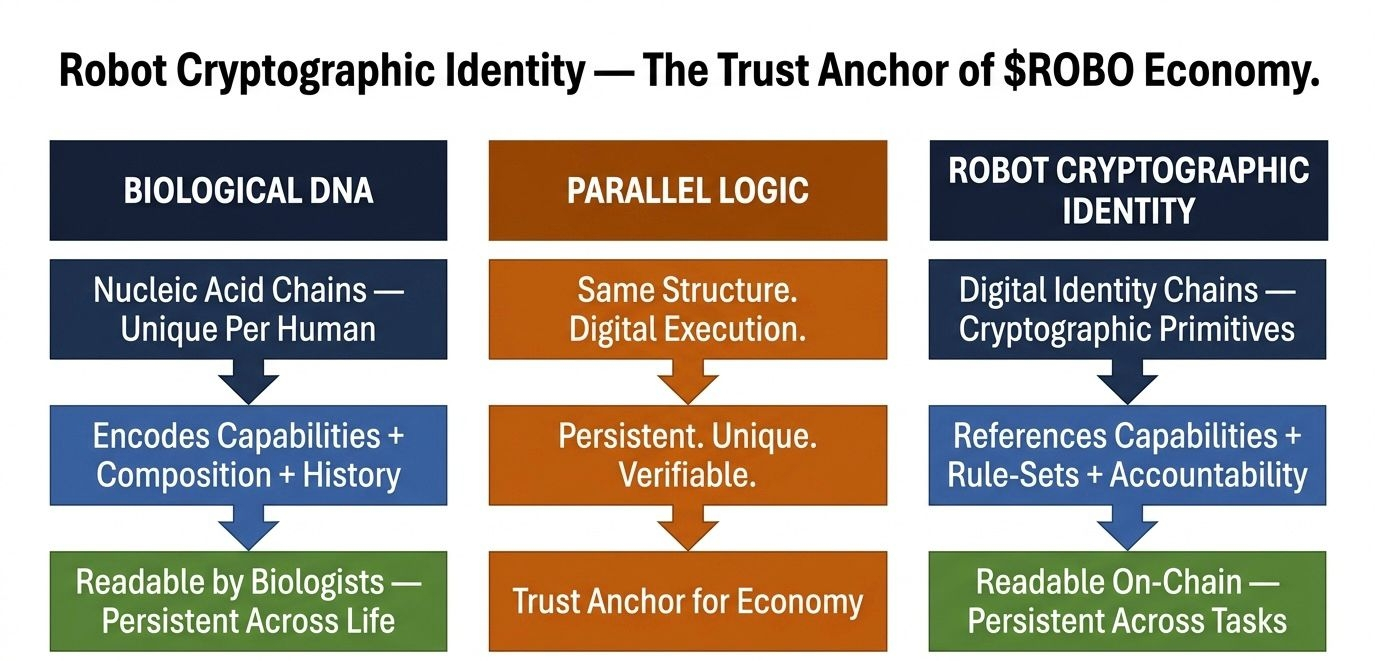
what worries me:
ERC-7777 and ERC-8004 are proposed standards. adoption across different robot hardware platforms — different manufacturers, different operating systems, different architectures — requires industry-wide coordination that goes beyond $ROBO token economics into standards politics. getting UBTech, Fourier, Unitree all implementing the same proposed identity standard is a coordination challenge nobody has publicly confirmed solved.
honestly don’t know if cryptographic robot identity becomes the universal trust layer that makes the entire $ROBO economy function — the digital DNA that lets humans verify robot capabilities, history, and rule-sets — or if hardware fragmentation across manufacturers slows universal identity adoption before the network reaches meaningful scale 🤔
watching: ERC-7777 adoption across robot platforms beyond OM1, whether proposed standards get formally endorsed by major hardware partners, first on-chain robot identity registrations post Q2.
what’s your take — cryptographic robot identity modeled on biological DNA is the foundational trust layer that makes $ROBO economy possible or proposed standards and hardware fragmentation make universal adoption unrealistic before market consolidates?? 🤔