
The first time I watched the order book of a newly listed token, it felt oddly quiet. Prices moving, trades printing, but underneath there was a kind of structure holding things together. When I first looked closely at tokens like ROBO, what struck me wasn’t just the price or the market cap. It was the invisible presence of market makers quietly shaping the early life of the market.
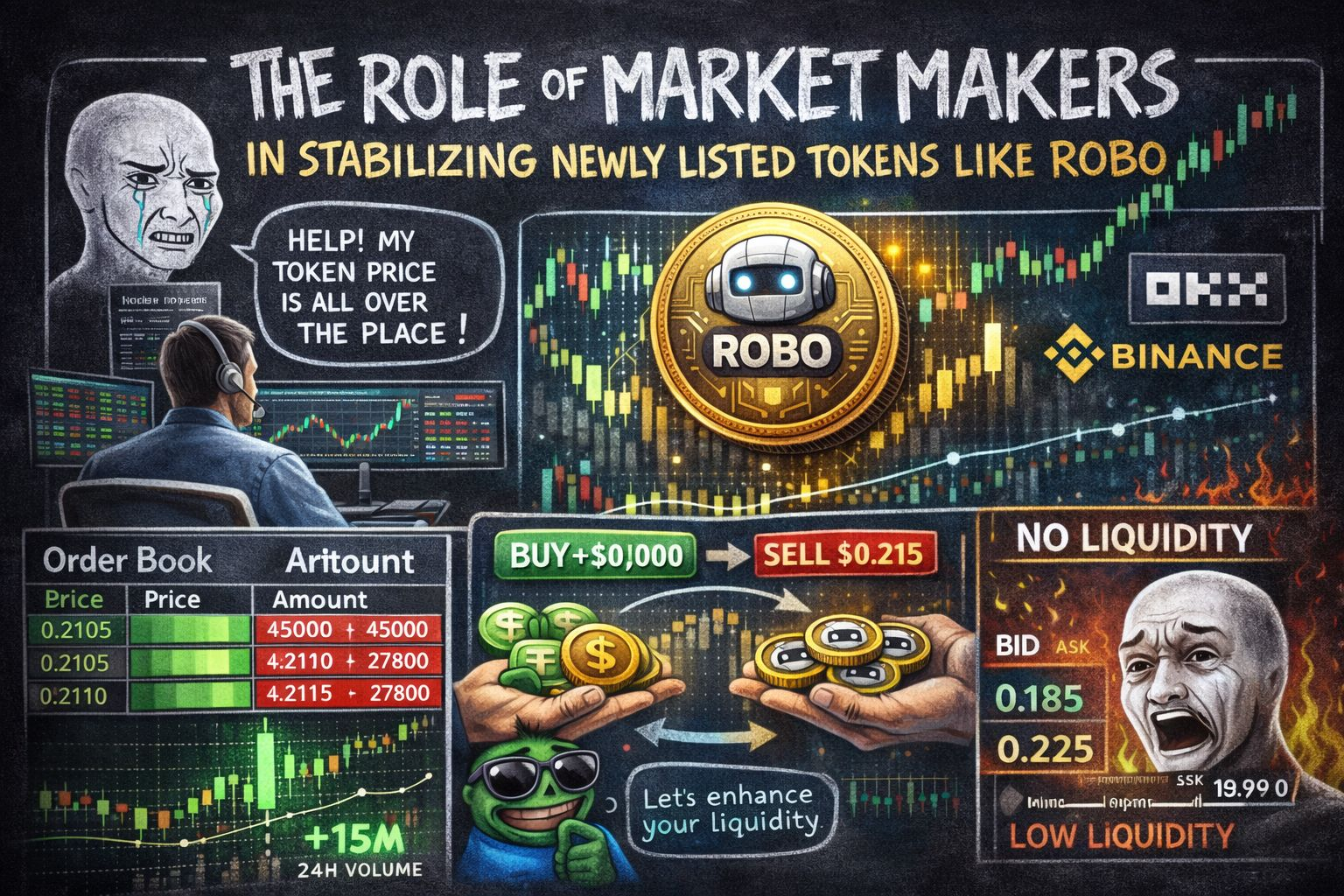
New tokens rarely enter trading environments that are naturally stable. Liquidity is thin. Participants are uncertain. And the price people see on the screen is often being discovered in real time. For something like ROBO, currently trading on exchanges such as Binance and OKX, the early phase of price formation is not just about buyers and sellers meeting. It is also about professionals stepping in to keep that meeting orderly.
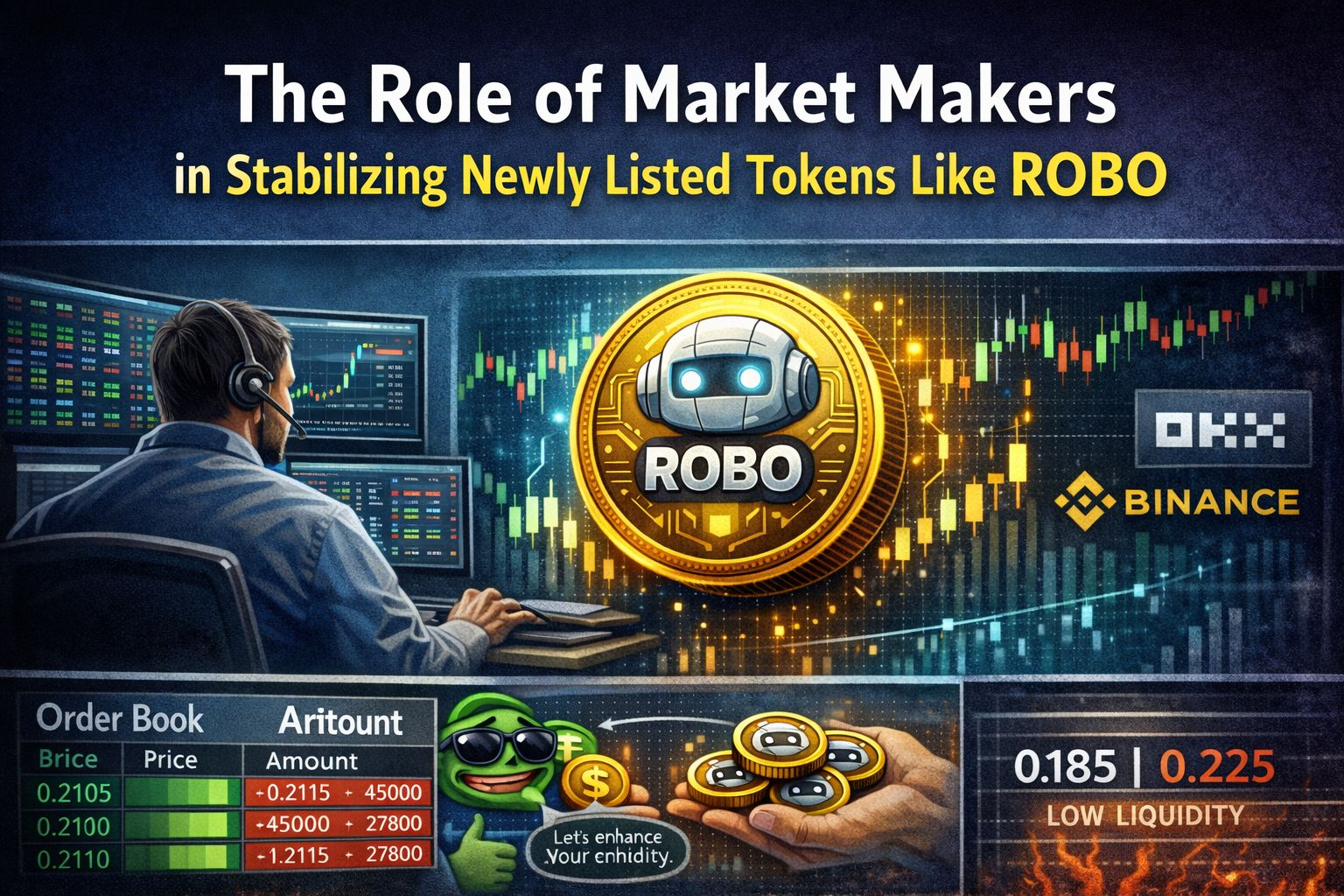
On the surface, market makers simply place buy and sell orders. They sit on both sides of the order book, offering liquidity so traders can execute instantly instead of waiting for a counterparty. That part is easy to see. If you open a ROBO trading pair, you will notice bids and asks stacked closely together. The spread might sit around 0.2 to 0.6 percent depending on market activity. That tight spread does not happen naturally when a token first lists. Someone is maintaining it.
Underneath that visible layer is where the real work happens.
Market makers manage inventory risk constantly. When they sell tokens into the market, they accumulate stablecoins or fiat. When they buy, they accumulate the token itself. Their systems rebalance these positions automatically, sometimes across multiple exchanges. If ROBO suddenly spikes in demand on Binance while liquidity on OKX lags behind, market makers can arbitrage the difference. They buy where it is cheaper and sell where it is higher. That action compresses price gaps quickly.
Understanding that helps explain why newly listed tokens often stabilize faster than people expect.
Without market makers, small trades could move the price dramatically. Imagine a token with only $200,000 sitting in visible order book depth. A single $30,000 market buy could push the price up several percent instantly. When professional liquidity providers are involved, that depth might quietly expand to $1 million or more across several price levels. The same $30,000 trade suddenly becomes a small ripple instead of a shockwave.
Meanwhile the numbers around ROBO reveal how important that support can be.
Data tracked on platforms like CoinGecko and CoinMarketCap often shows newly listed tokens with daily volumes between $10 million and $40 million during their early discovery phase. If the token’s market capitalization sits somewhere near $80 million to $100 million, that means a significant portion of the circulating supply changes hands frequently. That level of activity creates volatility unless someone is smoothing the process.
Market makers are the ones absorbing that volatility.
They buy when sellers overwhelm the book. They sell when buyers rush in. Not because they believe in the project necessarily, but because their job is to keep spreads tight and markets functional. The result is a trading environment that feels steadier than the underlying supply and demand would normally allow.
That stability creates another effect that many people overlook.
Price discovery becomes more credible.
When traders see consistent liquidity and narrow spreads, they are more willing to participate. A token that might have struggled to attract $2 million in daily trading volume can suddenly sustain $15 million once liquidity conditions improve. The market begins to trust that they can enter and exit positions without severe slippage. Liquidity itself becomes a signal.
But this system also carries risks, and ignoring them would be naive.
Market makers are not charities. Their activity is usually tied to formal agreements with the token project. These agreements might involve token allocations, incentives, or performance targets related to spread width and trading volume. If those incentives disappear or the relationship ends abruptly, liquidity can evaporate surprisingly fast.
We have seen this happen before across the broader crypto market.
Tokens that once showed deep order books suddenly experience wide spreads and thin liquidity once market maker support fades. A spread that used to sit at 0.3 percent might widen to 2 percent or more overnight. For traders, that change feels like the market suddenly became fragile.
Early signs suggest ROBO has avoided some of those issues so far. Its trading pairs maintain relatively consistent order book depth, and arbitrage between exchanges tends to close quickly. That suggests professional liquidity management is in place.
Still, the real question is whether this support evolves as the project grows.
Market making works best when it transitions from artificial structure to organic participation. In the early phase, professionals provide the foundation. Over time, real users, investors, and institutions need to replace that scaffolding with genuine demand and supply.
If that shift happens, the market becomes self sustaining. If it does not, liquidity can remain dependent on incentives that are expensive to maintain.
Meanwhile the broader crypto market is quietly moving toward a more structured liquidity environment. Exchanges are tightening listing requirements. Professional trading firms are expanding their role. And token projects are increasingly aware that liquidity management is not optional. It is infrastructure.
For smaller projects, this changes the economics of launching a token.
A few years ago, listing on a major exchange was often enough to attract attention. Today, projects need coordinated liquidity strategies across platforms, automated arbitrage systems, and consistent order book depth from day one. The early trading phase has become a technical operation rather than a simple listing event.
Watching ROBO’s trading activity through that lens reveals something interesting.
The stability people see on the screen is not accidental. It is the result of systems, incentives, and professional trading strategies operating quietly in the background. Most traders never notice this layer because when it works well, the market simply feels normal.
And that might be the most important point.
In crypto, stability is rarely natural at the beginning. It is usually built. The tokens that survive their early months are often the ones where that invisible foundation was carefully put in place.#robo $ROBO @Fabric Foundation $DODO $ACX