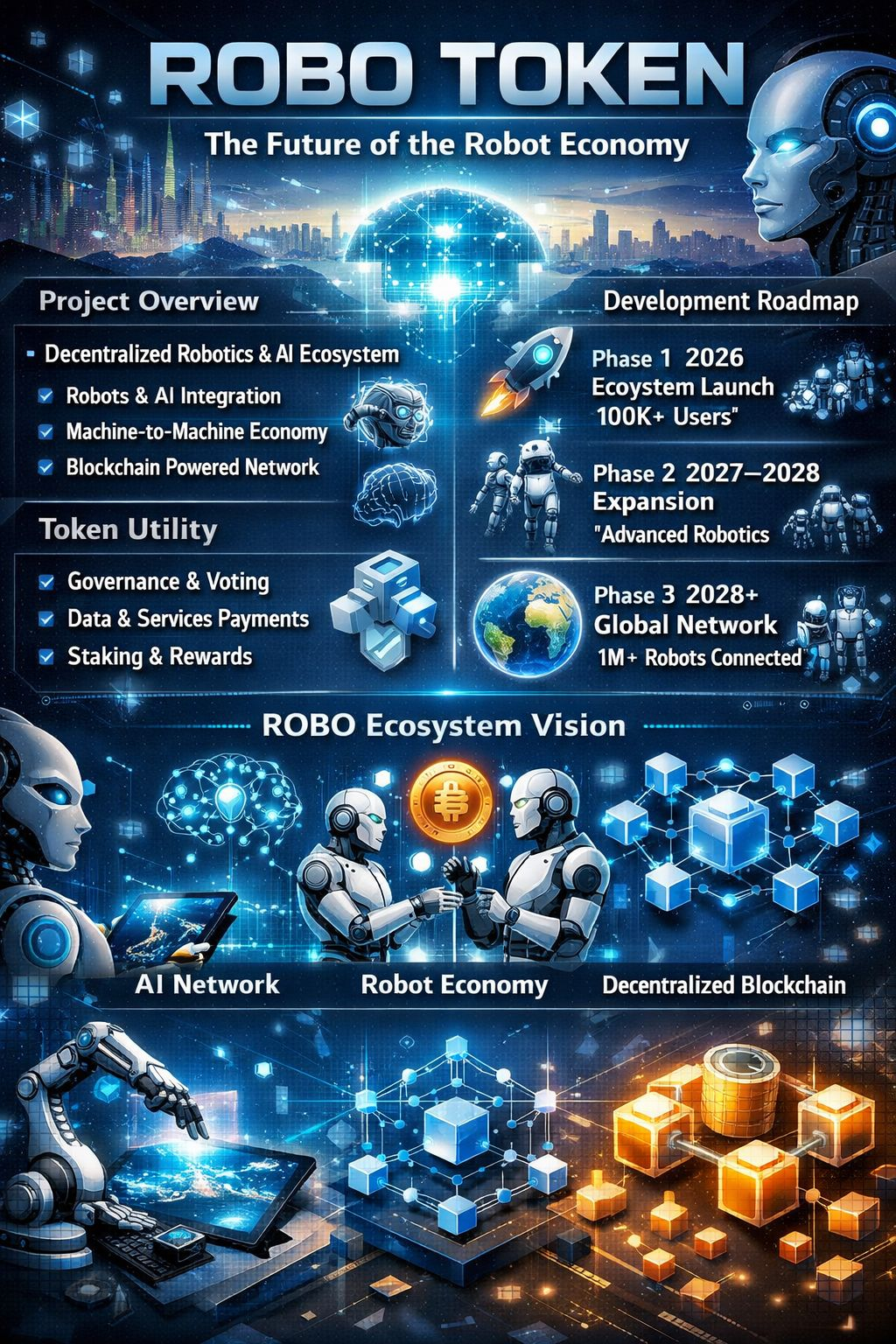
Fundamental Analysis of ROBO Token
1. Project Overview
$USDC ROBO Token is a cryptocurrency designed to power a decentralized robotics and AI ecosystem. The token is associated with projects such as Fabric Protocol and robotics-focused blockchain initiatives that aim to connect robots, artificial intelligence systems, and humans in a shared economic network. (AInvest)
The core idea behind ROBO is to create what developers call a “Robot Economy.” In this model, robots and AI agents can perform tasks, generate data, and receive incentives through blockchain-based coordination. The ROBO token acts as the governance, payment, and incentive layer of this ecosystem. (AInvest)
Unlike traditional cryptocurrencies focused only on finance or DeFi, $ROBO aims to combine:
Blockchain infrastructure
Artificial Intelligence
Robotics industry data and computing power
Decentralized governance
This approach attempts to build a machine-to-machine economic network where robots can participate in economic activities such as data sharing, computing tasks, and automated services.
Core Fundamentals
1. Utility of the Token
The ROBO token has several functional roles in the ecosystem:
1. Governance
Token holders can vote on protocol upgrades, economic model adjustments, and ecosystem expansion. (@robochain.top)
2. Incentives
Developers, robotics companies, and computing power providers earn ROBO tokens for contributing to the network. (@robochain.top)
3. Transaction Medium
Used for robot data trading, computing power leasing, and service settlement in the ecosystem. (robochain.top)
4. Staking and Security
Users can stake ROBO to secure the network and receive rewards.
Tokenomics Overview
Key highlights:
Total supply: ~10 billion tokens
Ecosystem allocation: ~40%
Team and advisors: ~25% with vesting
Public sale: ~20%
Foundation reserves: ~15% (MEXC)
The large ecosystem allocation suggests the project prioritizes long-term development and adoption incentives.
Development Roadmap
Phase 1 – Ecosystem Launch (2026)
Main goals:
Launch ROBO token and blockchain infrastructure
Establish main chain with multiple sidechains
Implement robot data storage and computing power leasing
Form partnerships with robotics companies and equipment operators
Build an early user base targeting 100,000+ users (robochain.top)
This stage focuses on building the basic technological foundation and early adoption.
Phase 2 – Expansion (2027–2028)
Key developments:
Advanced autonomous robot operations
Multi-robot workflows and task coordination
Developer ecosystem and Robot Skill App Store
More tools for human-AI collaboration
The goal is to transform the network from experimental infrastructure to a developer platform.
Phase 3 – Global Ecosystem (2028+)
Long-term vision:
Connect 1 million+ robots globally
Integrate robotics with AI, IoT, and metaverse environments
Fully decentralized governance through DAO
Large-scale commercialization of robotic services (robochain.top)
The final vision is a self-governed robot economy where machines can autonomously perform economic activities.
Market Potential
Strengths
Combines three fast-growing industries
Robotics
Artificial intelligence
Blockchain
Unique concept: machine-to-machine economy
Potential adoption in manufacturing, logistics, and autonomous services
Growing interest from crypto exchanges (e.g., roadmap mentions of listing reviews). (AInvest)
Risks
Highly complex technology stack
Regulatory uncertainty around AI and blockchain
Adoption challenge — robotics integration is still early stage. (AInvest)
Long-Term Outlook
If successfully implemented, ROBO could become part of the next generation of infrastructure where robots and AI interact economically with humans. However, the project is still early-stage, meaning its success depends heavily on developer adoption, real-world partnerships, and technological execution.
In summary:
Bullish thesis
Robotics + AI + blockchain narrative
Expanding ecosystem
Real-world use cases
Bearish thesis
Early development phase
High technical complexity
Dependence on robotics industries