
remember the other afternoon, pausing mid-conversation with a friend who had just received yet another data-breach alert from his bank. He shrugged it off with the usual line: “Everything’s public now anyway—what’s one more leak?” It wasn’t dramatic, just that quiet resignation we all carry when personal details feel permanently exposed. Nothing to do with crypto, just the ordinary friction of living in a world that demands visibility to function.
That same unease lingered later when I opened Binance Square and settled into the CreatorPad campaign task. The brief was direct: lay out the full ecosystem for “What Is Midnight Network Full Ecosystem Explained.” As I navigated the submission screen and paused on the overview of the partner-chain architecture anchored to Cardano, the pieces clicked in a way that felt off-balance. It was right there—watching how the system splits public proofs from shielded states—that the thought refused to settle.
We’ve convinced ourselves in crypto that total transparency is the only honest path to trust and decentralization. But what if that conviction is the constraint we’ve been dragging around?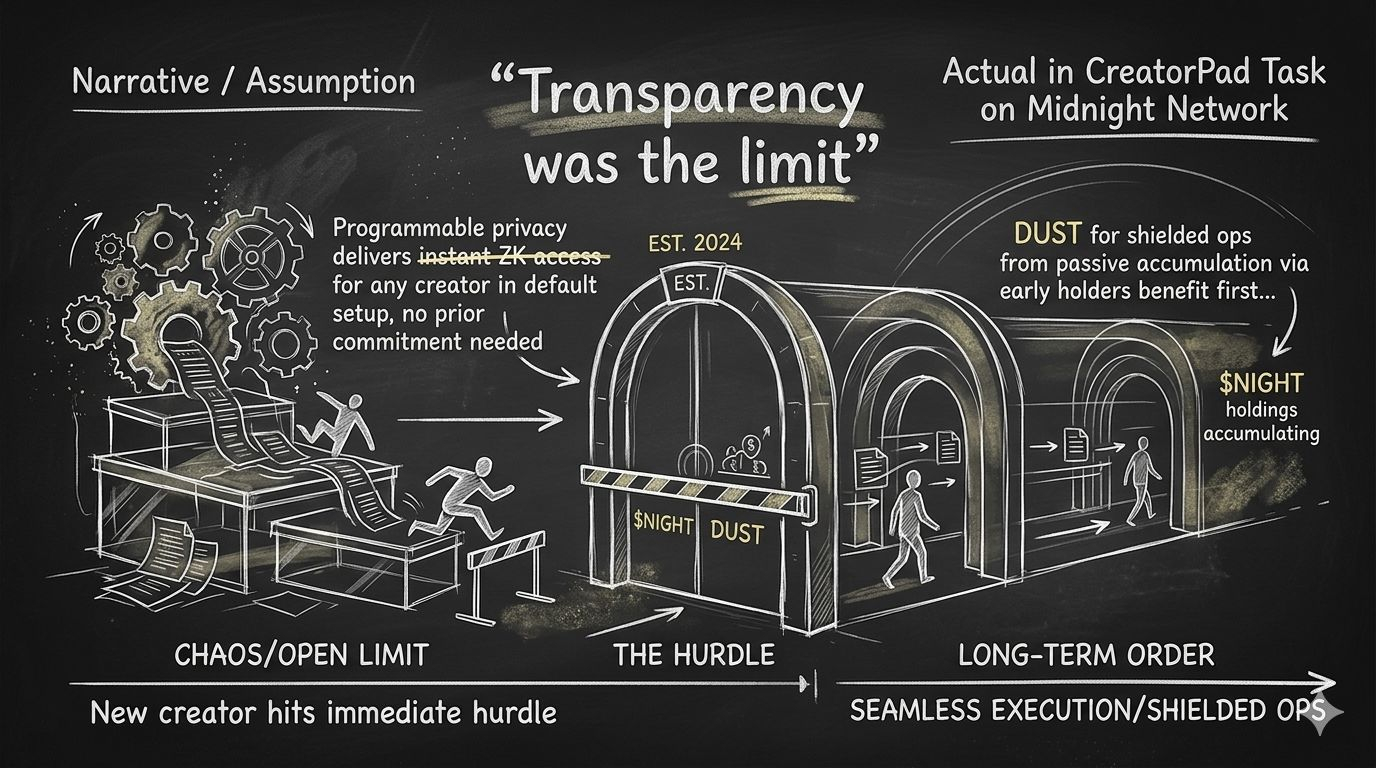
The longer I sat with it, the more the idea expanded past any single project. Most chains treat every ledger entry like an open book: balances, transfers, logic—all visible to anyone with an explorer. The promise is noble: no one can hide, so no one can cheat. Yet that same openness quietly excludes the very uses that could move crypto beyond speculation. Banks, insurers, hospitals—entities that handle sensitive data under strict rules—can’t operate where every detail is broadcast. They need to prove something happened without broadcasting the something itself. The result is a technology praised for purity but sidelined in practice, left to enthusiasts while the larger economy keeps its distance.
Midnight Network appears in this story not as a fix but as a quiet contradiction. Its ecosystem threads zero-knowledge tools through smart contracts so that verification can happen without exposure. One layer stays visible for consensus and auditability; another stays local and private, revealed only when the owner chooses. The dual-token arrangement—where holdings quietly generate the resource needed for activity—keeps fees predictable without turning every payment into a public confession. None of it screams revolution. It simply refuses the forced choice between “show everything” and “hide everything.”
Stepping back from the task itself, the discomfort sharpens. The founding story of blockchain was distrust of gatekeepers who decide what we see. Somewhere along the way we swapped one gatekeeper for another: the ledger itself, now demanding universal sight as the price of entry. Midnight doesn’t tear that ledger down; it layers options on top, letting participants decide the aperture. That feels risky to admit because it nudges against the purist script that any shade of privacy equals weakness or compromise. Yet watching real-world constraints through the ecosystem map, the script starts to read like idealism that forgot how humans actually work—messy, regulated, protective of what matters.
The thought doesn’t arrive with answers, only a persistent tug. If controlled visibility is what finally lets decentralized systems serve the uses we keep saying we want, then the old insistence on full exposure begins to look less like principle and more like habit.
So where does that leave the chains that still treat every byte as sacred and public—do they remain the pure heart of the space, or have they quietly become its ceiling? #night $NIGHT @MidnightNetwork