I’ve been around crypto long enough to know that every few years a new architectural idea arrives promising to fix everything that came before it. So when I first started hearing people talk about the future of modular blockchain architecture, especially in the context of systems like the Midnight Network, my reaction wasn’t excitement. It was hesitation.Crypto has a habit of declaring every new structure a revolution before the previous one has even finished proving itself.
We’ve seen similar moments before. NFTs were supposed to redefine ownership.Social tokens were expected to reshape creator economies. DAOs promised open, community-driven governance models that could coordinate people without traditional institutions. Some of these experiments produced interesting ideas, but many struggled once the systems had to operate beyond early enthusiasm. Participation slowed, governance became complicated, and fragmented platforms made coordination harder than the original pitch suggested.
The bottleneck has rarely been the concept itself. More often, the friction appears in coordination. Different platforms store data in different ways. Communities organize around different tools. Governance structures grow complex as more participants enter the system. Instead of a single coherent environment, what emerges is a patchwork of disconnected networks, each operating with its own rules and data silos.
That fragmentation matters when blockchain systems start interacting with real economic activity. Platforms, developers, users, and institutions rarely operate within the same infrastructure. Data about transactions, contributions, or governance decisions can become scattered across tools that do not easily communicate with one another. In practice, this makes verification and coordination more difficult than the original decentralized vision suggested.
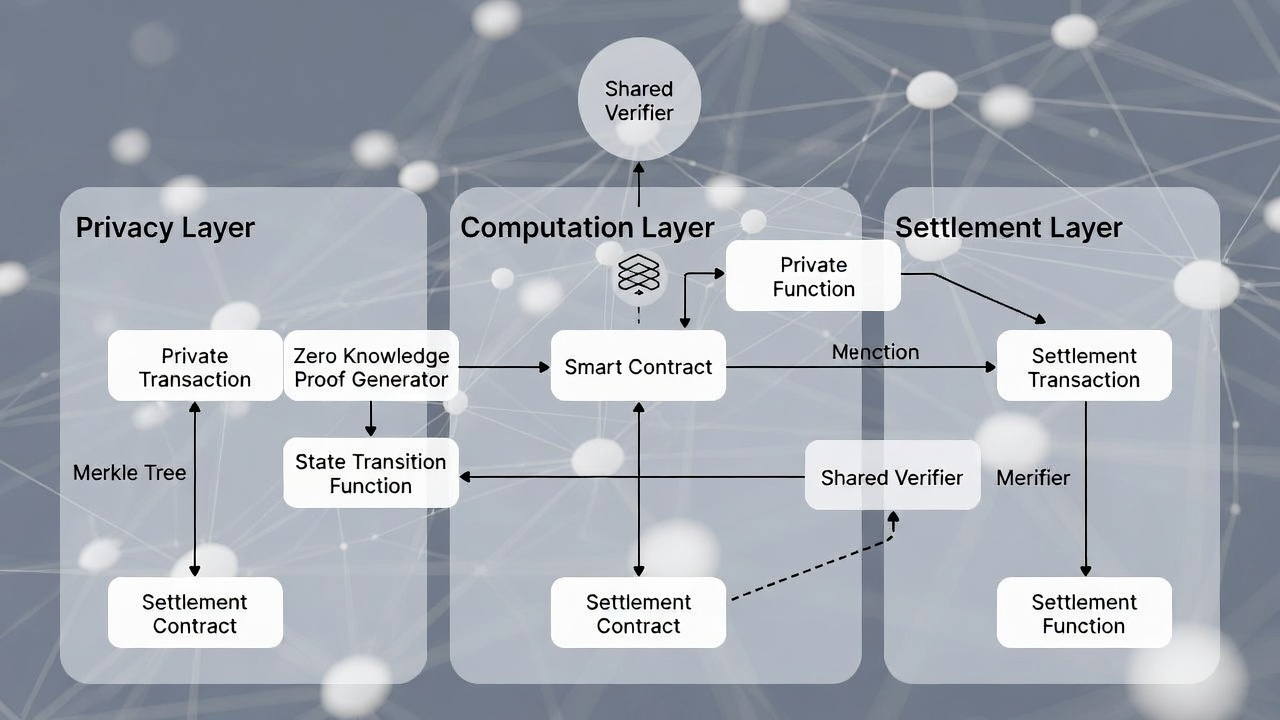
This is where the idea of modular blockchain architecture becomes interesting. Rather than forcing every function into a single chain, the modular approach separates responsibilities into different layers. In the case of the Midnight Network and the broader NIGHT ecosystem, the model suggests a system where privacy, computation, and settlement can operate as coordinated components rather than one monolithic structure.
In simple terms, modular architecture treats blockchain more like shared infrastructure. Different parts of the system handle different tasks, but they remain connected through a neutral ledger and shared verification mechanisms. The goal is not to replace existing platforms, but to create a coordination layer where multiple participants can rely on the same record of activity.
Blockchain makes the most sense here when it provides something other systems struggle to maintain: shared truth. A neutral record that different parties can verify without relying on a single authority. If the architecture works as intended, it could improve traceability, transparency, and accountability between systems that otherwise operate independently.
Still, the challenges are significant. Adoption requires developers and platforms to integrate with unfamiliar infrastructure. Modular systems introduce their own complexity. Questions around scalability, latency, and regulation remain unresolved. And large platforms rarely move quickly when new architectures threaten their control over data.
So the future of modular blockchain architecture, including projects like Midnight, remains uncertain. But the idea itself raises an important question: if decentralized systems are going to coordinate real economic activity, what kind of infrastructure will actually support that coordination?
For now, modular architecture looks less like a guaranteed breakthrough and more like an experiment in how blockchain systems might evolve. Whether it succeeds or not, it’s a direction that’s at least worth watching carefully.