
I remember the first time I read carefully about Midnight. It was late at night, right after I had closed a token watchlist that I knew, with near certainty, most of those names would not survive a bad liquidity season. What I felt then was not excitement, but the caution of someone who has been around long enough to understand that any project talking about privacy will eventually have to answer a harder question: how do you verify, and how do you live with regulation.
What made me stop at Midnight was not the promise of privacy, but the way it frames the core contradiction of blockchain. Public chains give us strong verifiability, but the price is exposing almost every trace of activity on the ledger. Chains that are too opaque may preserve secrecy, but they struggle to enter domains that require audits or legal accountability. This project is trying to stand in the middle, where users do not have to surrender all their data just to participate, while the system still preserves the ability to prove what is true.
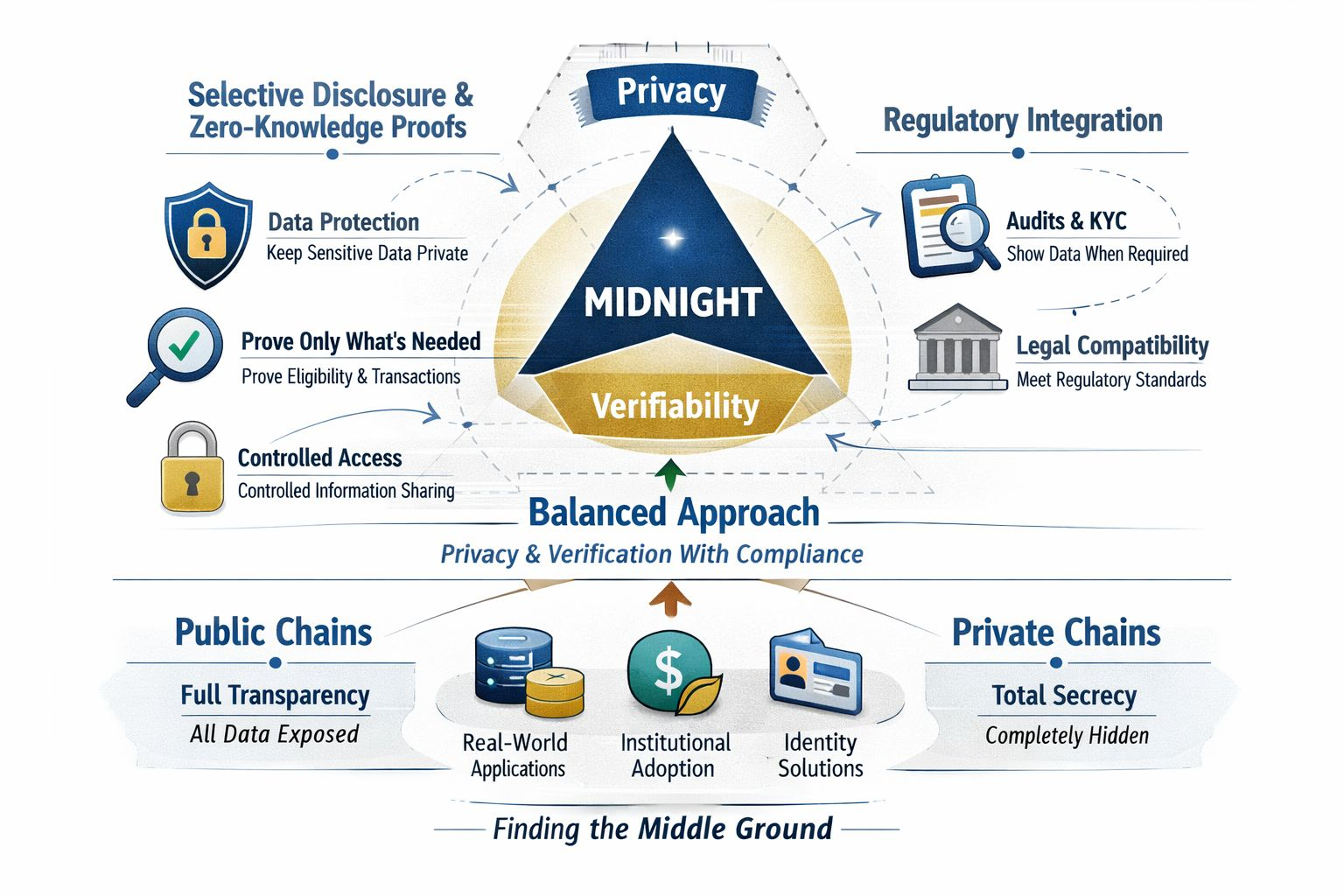
I think this is the most valuable part of Midnight. It does not tell a privacy story by shutting every door. Instead, it moves toward selective disclosure. Put simply, you only prove the part that needs to be proven, rather than handing over your entire life file on chain. A person can prove eligibility, a business can prove a transaction is valid, an application can prove compliance while still keeping the original data private. This approach rests on zero knowledge proofs and selective disclosure, meaning the proof is separated from the underlying data. To be honest, this is one of the few arguments that makes blockchain feel closer to real life.
The second thing that caught my attention is that Midnight does not avoid the word compliance. In crypto, the moment you mention audits, AML, or KYC, many people become uncomfortable, as if speaking about rules is already a betrayal of the original spirit. But, rather ironically, if you cannot resolve the relationship between private data and legal requirements, most applications remain no more than elegant experiments. This project accepts the reality that, at times, information has to be proven or revealed to the right party and within the right scope. Not open to everyone. Not sealed off from everyone. But turning disclosure into an intentional act.
Maybe to an outsider that sounds like a small difference in language, but for a long time builder, it is not. If everything is fully public, transaction data and user behavior become free raw material for surveillance tools and competitors. If everything is fully private, the system becomes very hard to connect with finance, identity, or enterprise processes. Midnight interests me because it does not pick one extreme just to win applause. It tries to turn privacy into a programmable technical resource. Each application reveals only what it needs to reveal. That is the kind of flexibility that actually matters in the long run.
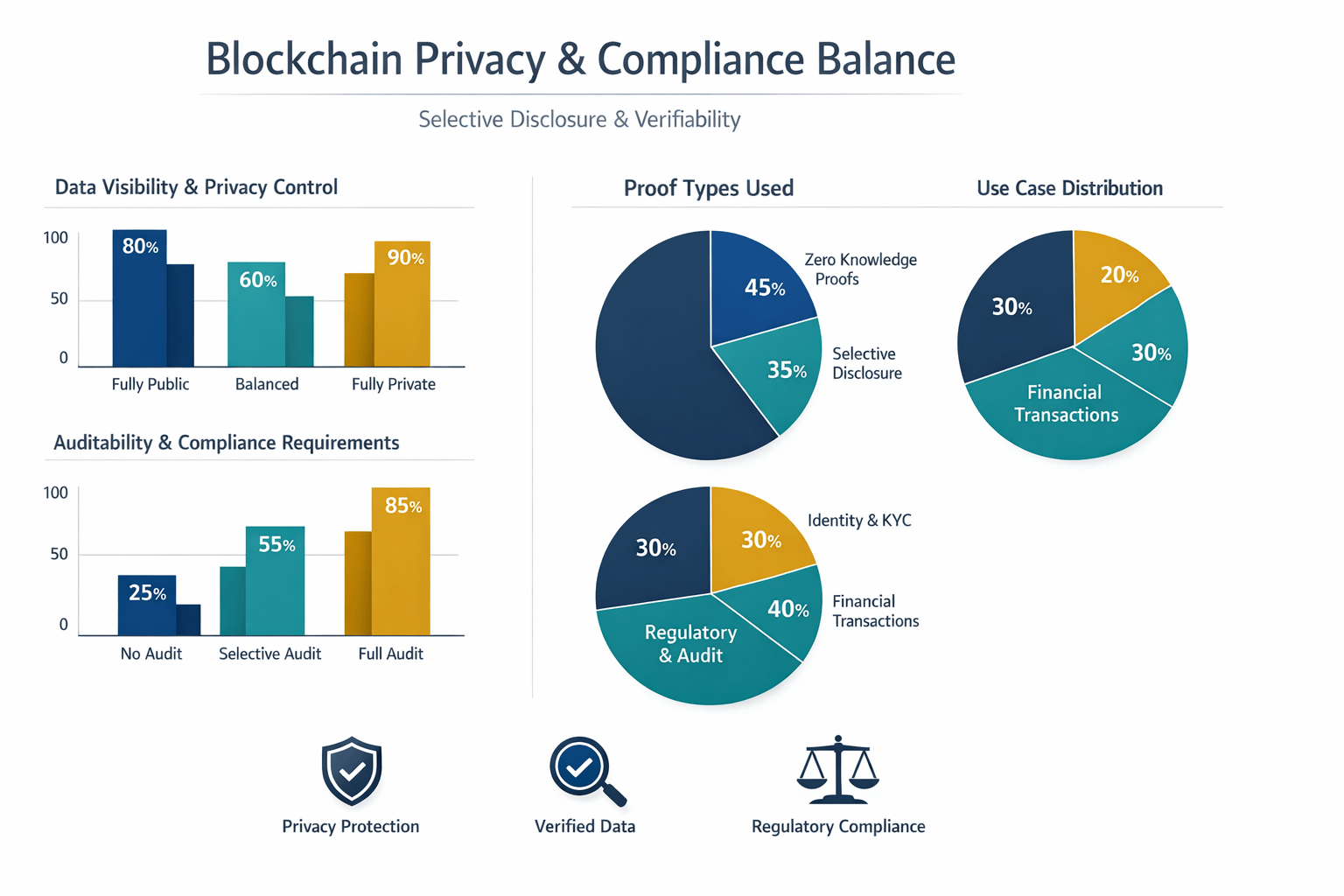
Of course, I am not romanticizing this path. Models like Midnight often move more slowly because they force the market to accept an uncomfortable truth, namely that the world does not operate on a binary choice between absolute freedom and absolute control. A story that says everything will become private, or everything must become transparent, is always easier to tell than an architecture built around balance. No one would have guessed that, after all these years, the hardest thing would not be building new technology, but convincing people that maturity usually looks far less romantic than they expected.
In the end, the lesson I take from Midnight is not only about technology, but about design philosophy. If blockchain wants to grow up, it has to learn how to protect people without blinding the system, and let the system see enough truth without forcing people to surrender everything. Privacy without verifiability will sooner or later be pushed to the margins. Verifiability without preserving the dignity of data is just a shinier version of old surveillance. And if this project is really trying to solve that exact problem, then what remains is whether the market is mature enough to accept this kind of uncomfortable but necessary balance.