
The more I think about digital ownership, the more it feels like access was never really the main issue.
It’s control.
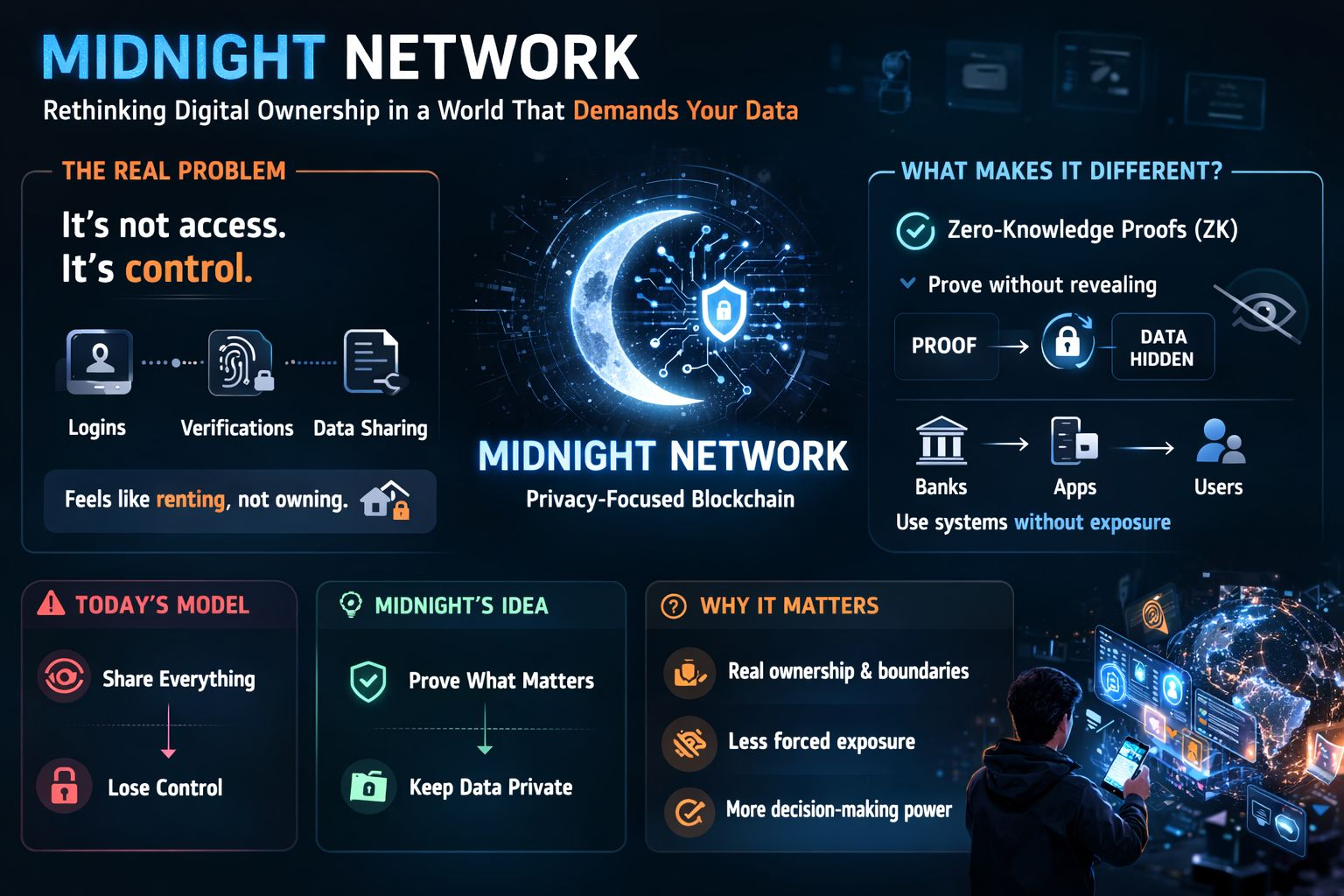
We already “use” plenty of digital systems. We sign in, link wallets, verify identities, move information around, accept terms nobody actually reads, and move on. On the surface that looks like participation. But most of the time it doesn’t really feel like ownership. It feels more like you’re renting your place inside a system that keeps asking for more than it should.
That’s the thought I keep circling back to.
Somewhere along the way, constant exposure started being treated like a normal cost of entry. Want to prove something? Reveal more. Want to use a platform? Share more. Need access? Hand over the data first and maybe ask questions later. It’s become such a routine pattern that most people barely even pause to think about it anymore.
That’s part of why Midnight Network catches my attention.
Not because “data ownership” is some new slogan. Crypto repeats that line every few minutes. But because Midnight seems to take a more uncomfortable question seriously: do people truly own their data if every system that’s actually useful still pushes them to expose it?
I’m honestly not convinced they do.
If ownership is supposed to mean anything, it should include the ability to choose what remains private, what gets shared, and when it happens. Otherwise it’s just access dressed up with better marketing. Sure, you might hold the asset. You might control the account. But if the system keeps pushing you to reveal information every time you try to do something meaningful, then your control was already limited from the start.
That’s where Midnight’s perspective feels stronger than the typical blockchain pitch.
It’s not just saying people should own things on-chain. It’s leaning toward something more difficult. Users should be able to interact, prove things, and participate without constantly exposing the underlying data. That shifts the idea of ownership from simple possession to actual decision-making.
And honestly, that feels more genuine.
Most people aren’t thinking about ownership in some big philosophical sense anyway. What they really care about is what gets exposed, who can see it, how long that information sticks around, and whether they’ll ever get control of it back. In that context, losing data control doesn’t always look dramatic. Sometimes it just looks normal. A login here. A verification there. A platform asking for your entire story when it really only needs a single detail.
That’s more of a design issue than a user issue.
Midnight’s use of zero-knowledge proofs stands out because it pushes back against that pattern. At least in theory, it allows someone to prove what needs to be proven without handing over all the data behind it. That doesn’t suddenly fix the entire internet. But it does challenge a bad assumption that’s been hanging around for years — the idea that trust only works when users reveal everything first.
I don’t think that assumption has aged very well.
The way digital systems work today rewards convenience, but at the same time it quietly teaches people to give up control bit by bit. Once that pattern becomes normal, the idea of ownership slowly starts to shrink. Not all at once—just little by little. Quietly enough that people start mistaking participation for real power.
So when I look at Midnight, I don’t just see another privacy-focused chain.
I see a project experimenting with whether digital ownership can mean something stronger than simply having your name attached to something. Whether ownership can actually include boundaries. Whether it can mean proving something without revealing the entire record behind it. Whether a system can still be useful without making user exposure its default rule.
Maybe it turns into a real shift. Or maybe it remains more of an idea than something people actually practice.
But the question behind it still feels like the right one.
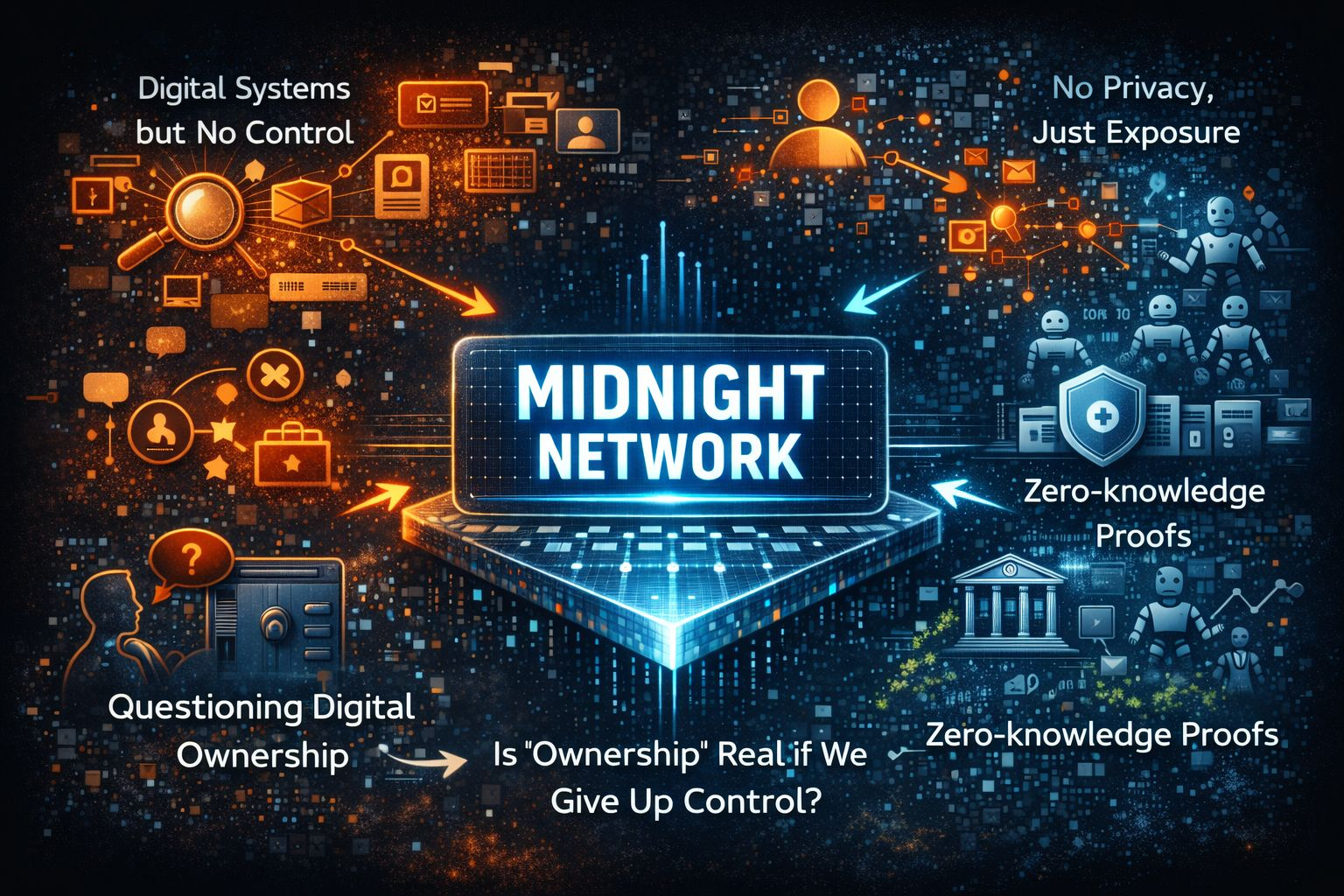
If the digital world keeps asking users for complete visibility just to participate, then what are they really supposed to believe they own?
@MidnightNetwork #night $NIGHT
