
I'm constantly watching the evolution of blockchain, trying to separate temporary noise from the technologies that quietly reshape the foundation of the entire industry. Midnight Network is one of those projects that made me pause. Not because it promises louder marketing or bigger headlines, but because it addresses a contradiction I’ve noticed for years in crypto: the systems built to empower users often expose them more than they should.
Public blockchains created something revolutionary. Trust without intermediaries. Transactions verified by code instead of institutions. But that same transparency introduced a problem that becomes more obvious as the ecosystem grows. Every wallet movement can be tracked. Every transaction is permanently visible. For early crypto enthusiasts this openness felt liberating, yet for businesses, developers, and institutions it creates a barrier that’s difficult to ignore.
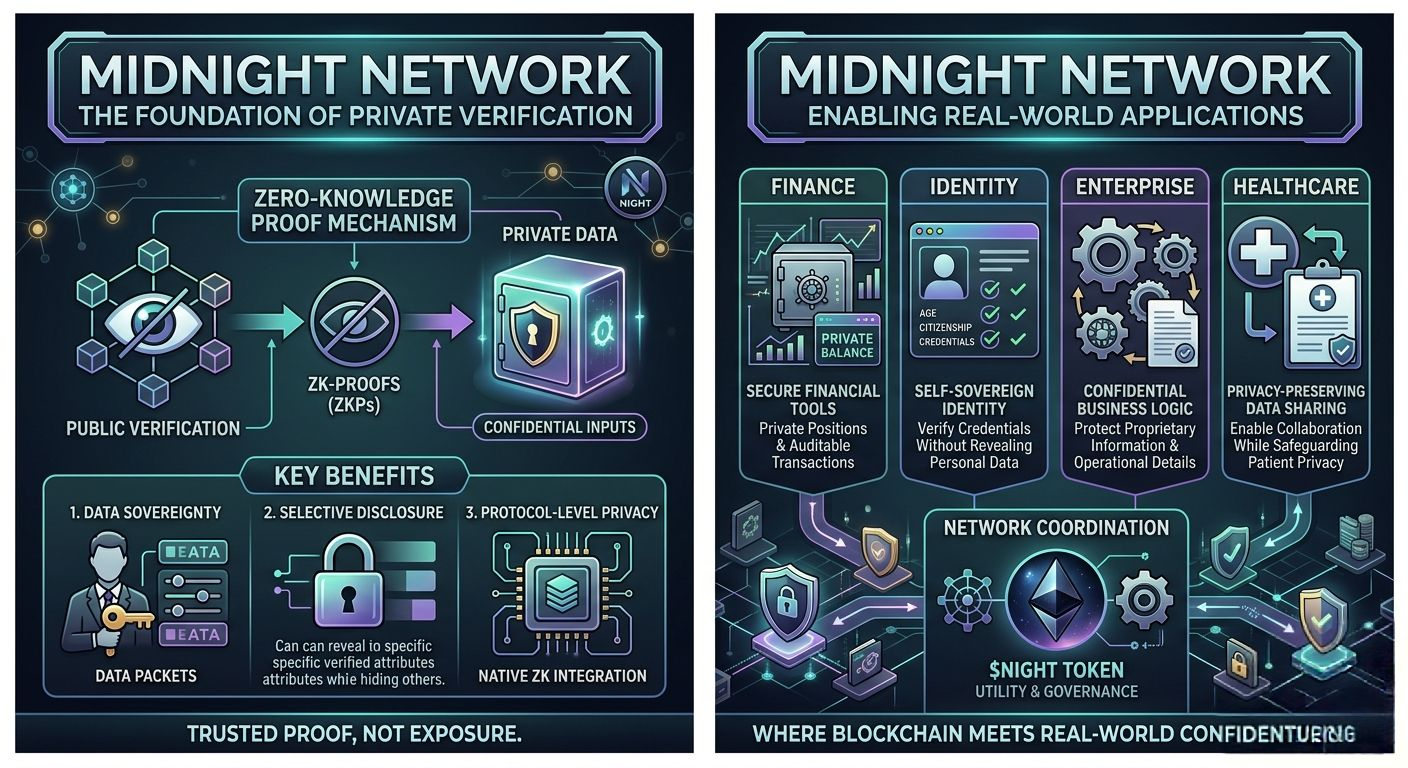
Midnight Network approaches that tension with a different mindset. Instead of choosing between transparency and privacy, it attempts to balance both through zero-knowledge proof technology. The idea behind this cryptographic system is powerful. Information can be verified as true without exposing the underlying details. A transaction can be confirmed without revealing the full data behind it. A contract can execute while sensitive inputs remain hidden.
This is where the network begins to feel less like another blockchain and more like a structural evolution in how decentralized systems operate.
Most chains today operate on the philosophy that everything must be visible in order to maintain trust. Midnight suggests that trust can exist in a different form. Proof becomes more important than exposure. Verification replaces surveillance. Users still interact with a secure and auditable network, but they retain control over the information that defines their digital activity.
From a developer’s perspective, that opens entirely new territory.
Applications that require confidentiality suddenly become realistic. Financial tools where positions are not publicly exposed. Identity systems where credentials can be confirmed without revealing personal data. Enterprise solutions where companies can use blockchain infrastructure without broadcasting sensitive operational details to the world. These are areas that transparent blockchains have struggled to support, not because the technology lacked power, but because privacy remained unresolved.
Midnight attempts to solve that problem at the protocol layer rather than treating privacy as an add-on. Zero-knowledge mechanisms are integrated into the design itself. Developers building on the network inherit the ability to work with protected data from the beginning, rather than attempting complicated workarounds later.
That design philosophy matters more than many people realize. Infrastructure decisions made at the protocol level shape what entire ecosystems are capable of becoming.
The broader market is slowly recognizing this shift. After years of cycles driven by speculation and trend narratives, attention is gradually returning to foundational technology. Investors and builders are asking a more serious question now: which networks actually expand the capabilities of decentralized systems?
Midnight appears to be answering that question by focusing on data sovereignty. Participation in blockchain shouldn’t require surrendering control over personal or organizational information. Ownership should extend beyond digital assets and include the data created by interacting with the network.
The $NIGHT token operates within that framework as part of the network’s economic coordination. Yet the deeper story sits underneath the token itself. Midnight is exploring how blockchain can evolve into infrastructure that supports real-world systems where confidentiality is not optional but essential.
Healthcare platforms, regulated financial products, enterprise collaboration networks, and secure identity layers all require verification without exposure. Zero-knowledge technology makes that balance possible, and Midnight positions itself directly within that emerging design space.
What fascinates me most about projects like this is that they rarely arrive with dramatic spectacle. The most important changes in technology often happen quietly, buried inside cryptographic systems and protocol architecture. Their real significance only becomes visible years later when developers begin building entire industries on top of them.
Midnight Network carries that same quiet potential. It doesn’t attempt to replace the entire blockchain ecosystem or compete purely through speed and scale. Instead, it expands what decentralized networks can safely handle.
And if this model proves successful, the next era of blockchain might not be defined by how much information is visible on-chain, but by how intelligently networks protect what should remain private.
@MidnightNetwork #night $NIGHT
