
I’m noticing a pattern in crypto markets that rarely gets discussed openly. I sometimes call it coordination drag a hidden structural cost that appears when a system claims decentralization but still concentrates control over the data that defines reality inside the network. On paper everything looks distributed, validators are global, ledgers are public, governance appears open. Yet the critical information flows remain centralized somewhere in the background. The market rarely recognizes this immediately, but over time it quietly shapes trust, liquidity, and participation.
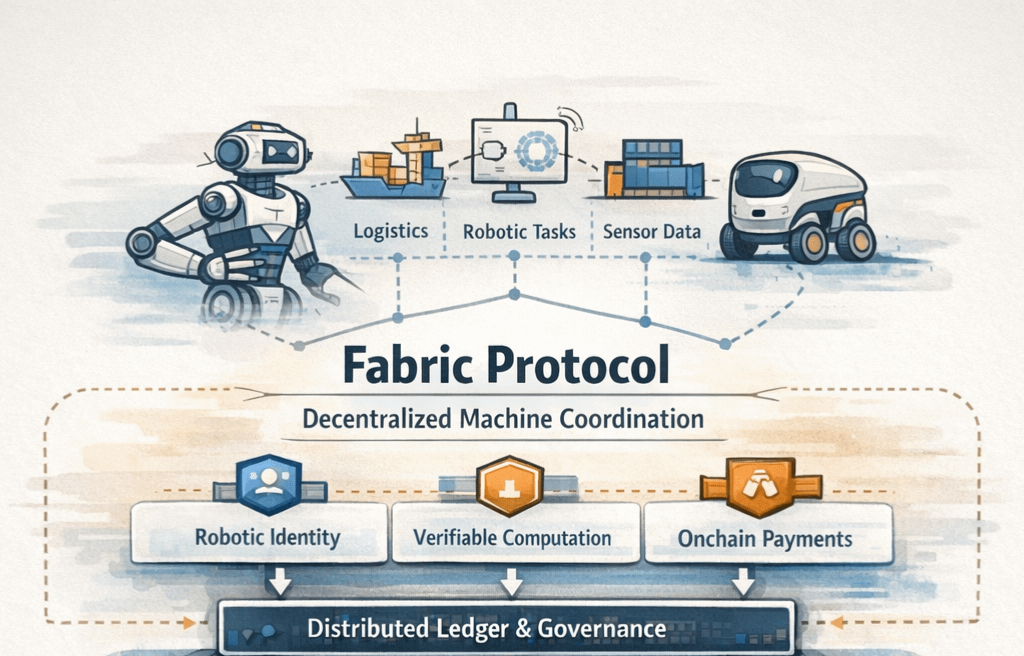
When I look at Fabric Protocol, what stands out to me is that the conversation is not really about robots. At least not in the way most people initially interpret it. The deeper idea is coordination infrastructure for a world where machines increasingly operate inside economic systems. Robots move goods, inspect infrastructure, manage logistics, and interact with digital networks. But those machines cannot currently participate as independent economic actors. They cannot verify identity, settle value autonomously, or coordinate actions through a shared system of trust.
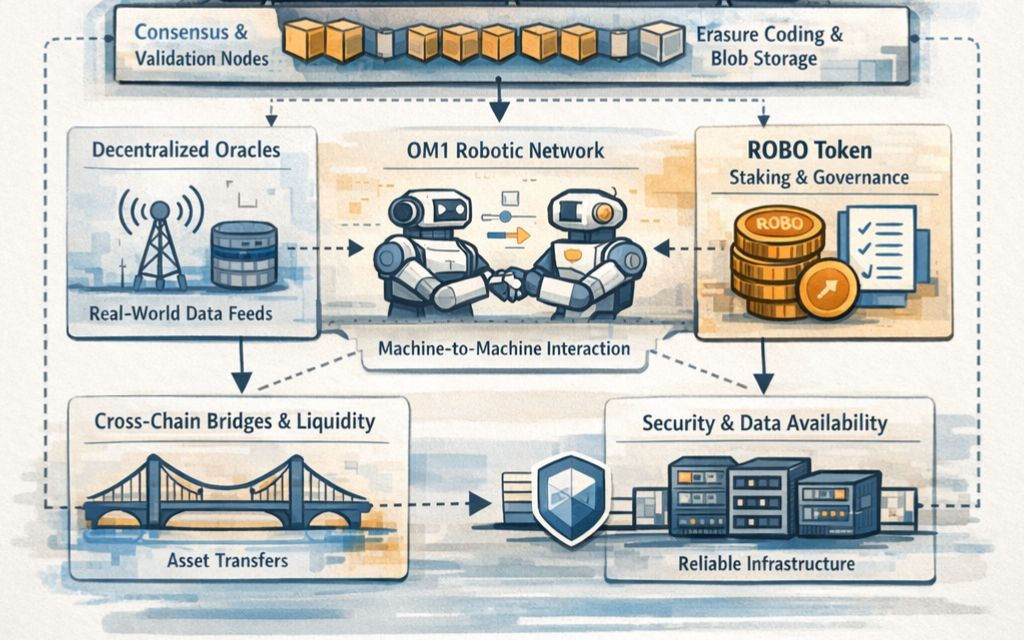
Fabric attempts to address that gap by building a public coordination layer where machines can hold cryptographic identities, record their actions, and participate in decentralized governance. In simple terms, robots become verifiable participants within a shared digital environment rather than isolated machines operating under proprietary control.
The concept sounds futuristic at first. But when I step back and think about it through the lens of crypto infrastructure, it actually fits a familiar pattern. Every major network eventually becomes a coordination engine. Bitcoin coordinates monetary trust. Ethereum coordinates programmable financial agreements. Fabric is attempting to coordinate machine behavior.
And coordination, in practice, is where systems either mature or collapse.
One thing trading has taught me over the years is that decentralization loses meaning very quickly when the underlying data layer is centralized. I’ve seen this dynamic play out repeatedly in DeFi. A protocol may have a distributed validator set and open smart contracts, but if the oracle network feeding prices is controlled by a handful of providers, then the entire system ultimately depends on those feeds. When markets become volatile, those dependencies reveal themselves.
Execution friction becomes visible in those moments. Oracle updates lag behind real market prices. Liquidation engines trigger incorrectly. Traders try to exit positions but confirmations arrive too late. I remember watching one cascade unfold during a volatile market cycle where the oracle delay was only a few seconds, yet that gap was enough to trigger liquidations across multiple platforms.
Those few seconds changed everything.
Machines operating in the physical world face an even stricter version of that reality. A robot coordinating logistics tasks cannot rely on unpredictable settlement delays or inconsistent verification layers. If the network cannot confirm actions reliably, the machine cannot act with confidence. In that environment, infrastructure becomes less about ideology and more about reliability.
Fabric’s architecture reflects this tension. The protocol introduces a system where robots can register identities, interact through verifiable computing environments, and record their actions on a public ledger. These identities allow machines to authenticate themselves, perform tasks, and settle value autonomously without relying entirely on centralized control layers.
But identity alone does not solve the deeper issue.
What matters is who owns the operational data produced by those machines.
If telemetry streams, sensor outputs, and operational logs ultimately pass through centralized servers before reaching the blockchain, decentralization becomes superficial. The network may record the results, but it does not truly govern the process. Fabric’s approach attempts to distribute these interactions through modular infrastructure where machine data can be verified and recorded transparently.
This is where infrastructure design quietly becomes complex.
Robotic systems generate enormous amounts of operational information. Task completion logs, environmental data, movement tracking, and verification signals all produce continuous streams of information. Storing and verifying that information inside a blockchain environment requires careful separation between what must be recorded onchain and what can remain offchain while still being provably accessible.
Techniques like distributed data availability layers, erasure coding, and modular storage architectures begin to matter here. Not because they sound technically impressive, but because they determine whether the network can remain decentralized while still handling real-world workloads.
Another interesting design choice is Fabric’s decision to initially deploy on Base, an Ethereum Layer 2 environment. From a strategic perspective, this reduces early infrastructure risk. Security, liquidity access, and developer tooling already exist within the Ethereum ecosystem, allowing the protocol to focus on machine coordination rather than building an entire network stack immediately.
At the same time, the long-term vision includes migrating toward a dedicated Layer 1 infrastructure optimized specifically for machine interactions. That shift suggests that the protocol anticipates a future where robotic coordination requires more predictable execution conditions than general-purpose chains typically provide.
Block time consistency, validator reliability, and confirmation guarantees become essential when machines depend on the network to make operational decisions.
Human traders already struggle with these dynamics. Machines would experience them even more directly.
Participation psychology also plays an underrated role in how networks evolve. In crypto systems, small interface decisions shape behavior more than many people expect. Signing transactions, paying gas fees, waiting for confirmations—these experiences influence how participants perceive reliability.
If interacting with a network feels uncertain or fragile, participants instinctively reduce exposure. Liquidity becomes cautious. Builders hesitate to integrate deeply.
Fabric introduces its native token as the coordination mechanism for the network, handling transaction settlement, staking, and governance participation. But the interesting element is how token incentives connect to real robotic activity. Instead of rewarding passive capital alone, the system attempts to link economic rewards to verifiable machine work.
That design moves the token away from pure speculation and toward operational signaling within the network. Whether markets treat it that way remains uncertain, but structurally it reflects an attempt to align incentives with real activity rather than abstract financial flows.
Every infrastructure system eventually encounters stress scenarios, and imagining those situations often reveals more about a design than reading its documentation.
Picture a future logistics environment where thousands of autonomous machines coordinate deliveries through a shared blockchain network. A congestion event slows confirmation times. Some machines wait for verification before executing tasks. Others attempt to continue operating with delayed data.
Suddenly coordination begins to fragment.
Two machines may attempt the same task simultaneously. Payment confirmations arrive out of sequence. Resource conflicts appear. Small delays compound into larger operational disruptions.
Designing systems that survive these situations requires anticipating failure long before it occurs. In my experience, the most mature infrastructure projects are the ones that quietly assume things will break and prepare for that moment.
Fabric will eventually face those tests.
Another reality that cannot be ignored is the structural trade-off between decentralization and operational practicality. Robotic networks inevitably depend on hardware manufacturers, sensor providers, and data infrastructure. These elements introduce unavoidable points of centralization.
The real challenge is not eliminating those dependencies entirely but making them transparent and limiting their influence over the network’s governance and data verification.
Compared with high-performance chains designed primarily for financial throughput, Fabric’s problem space is more complex. Financial transactions are digital abstractions. Machine coordination involves physical actions in unpredictable environments.
Governance therefore becomes less about ideological decentralization and more about adaptive resilience. Protocol rules must evolve as new hardware, operational risks, and coordination models emerge.
Liquidity, oracles, and external market forces will eventually intersect with this ecosystem as well. Machines performing tasks will require stable payment settlement layers. Oracle systems will verify real-world outcomes. Bridges will connect value flows across networks.
And traders, inevitably, will speculate on the infrastructure supporting it all.
But markets tend to reward systems that prove reliable over time rather than those that generate the most attention early on.
Fabric Protocol sits quietly at the intersection of robotics and decentralized infrastructure. Its ambition is not merely to tokenize machines but to create a coordination framework where robots can act as independent participants within economic networks.
That ambition will not be tested by marketing narratives or early adoption metrics.
The real structural test will be simpler and far more demanding.
As the network grows, the question will become whether the data that defines machine behavior remains decentralized, verifiable, and resilient under pressure. If the system preserves those properties while scaling, Fabric may become a foundational layer for machine coordination in the same way earlier networks became foundational for digital finance.
If it cannot, coordination drag will eventually reappear.Quietly at first.Then everywhere.
@Fabric Foundation #ROBO $ROBO
