
Look… I was reading about this Fabric Protocol thing earlier and honestly my first reaction was pretty much the same reaction I have with like 90% of crypto projects in 2026. An eye roll. Seriously. Because every week there’s some new “network for AI,” “robot economy,” or “machine coordination layer,” and half of them fade away before anyone even builds something real.
So yeah… I went into it expecting the usual hype.
But the idea itself? Kind of interesting. Not flawless. Not revolutionary. Just… interesting.
The underlying problem actually becomes pretty clear if you think about it for a minute or two. Robots are starting to appear everywhere now. Warehouses, factories, hospitals, delivery sidewalks… those little rolling box robots that always look slightly lost. And all of them operate inside these closed ecosystems controlled by companies.
A complete black box.
You don’t really know what data trained them. You don’t know what updates they receive. You don’t know how they make decisions when something unusual happens. And companies definitely aren’t eager to reveal any of that because it’s considered their “secret sauce.”
Which is fine… up to a point.
But once robots start operating around everyday people, things can get complicated.
Imagine a robot driving through your city delivering packages. Overnight it receives an update to its navigation model. Who reviewed that update? Who checked whether the training data behind it was reliable or not? No one outside the company even knows the update took place.
And companies saying “trust us” doesn’t really convince people anymore.
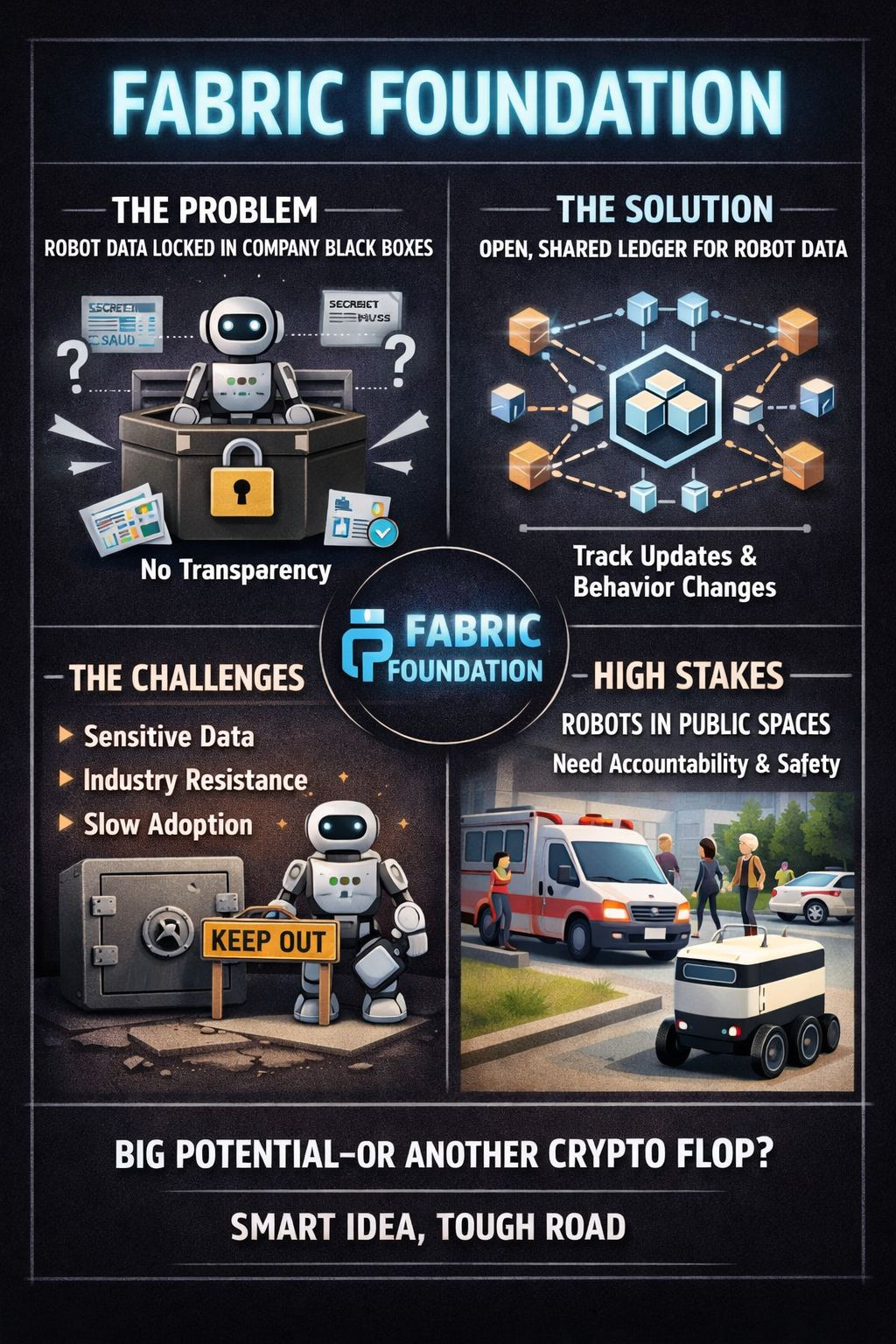
So what Fabric Protocol seems to be trying to do is build a shared system where robot updates, data, and behavior changes can be recorded openly instead of being hidden away on company servers.
Sounds straightforward.
It really isn’t.
Robotics is chaotic by nature. Hardware fails. Sensors misinterpret things. AI models behave strangely in edge cases. Even a tiny adjustment can trigger behavior nobody expected.
And still… someone somewhere looked at all that chaos and thought, “yeah, let’s hook this up to a public protocol.”
Bold decision.
Or maybe a bit crazy. Hard to say.
Anyway, the core concept is basically to use a shared ledger where robot data, updates, and contributions from developers are recorded so people can actually see how machines evolve over time. Not just assume it. Actually verify it.
Simple idea. Enormous challenge.
And look… I’ve been around crypto long enough to know how this usually goes. A lot of infrastructure projects end up building something technically impressive and then almost nobody uses it. It happens constantly. Great technology. No real adoption.
Robotics companies usually focus on hardware costs, battery performance, sensor accuracy, manufacturing pipelines… not on connecting everything to some global protocol just yet.
So adoption could take a long time.
Two years. Five years. Hard to say.
But here’s the part that actually made me stop and think for a moment.
Robotics is gradually turning into public infrastructure. Not just factory machines hidden inside warehouses anymore. These systems are moving into streets, hospitals, airports, shopping centers… basically places where people are present every day.
And when machines start operating in spaces shared with humans, people naturally expect transparency.
A lot of it.
You can’t just say “our algorithm works, trust us.” People want records. Logs. Accountability. Something that shows the system isn’t behaving in random or unpredictable ways.
That’s where Fabric actually begins to make sense.
Instead of every robotics company running inside its own isolated bubble, the protocol is trying to build shared infrastructure where updates, training inputs, and system behavior changes can be tracked.
Out in the open, not hidden.
Which is honestly a nice change compared to the usual wall of corporate secrecy.
But let’s not act like the idea is flawless.
The moment you start talking about shared data and open collaboration, companies start getting nervous. Really nervous. Data is power, and robotics data is incredibly valuable.
Nobody is eager to hand that over.
So the biggest obstacle here probably isn’t the technology.
It’s incentives.
If enough developers, researchers, and robotics teams actually contribute to the network, it could slowly turn into useful infrastructure. But if nobody participates… it just ends up as another half-finished protocol sitting on GitHub.
I’ve seen that story before.
Plenty of times.
Wait, I almost forgot to mention something that bothered me though…
The marketing language around projects like this can get pretty ridiculous sometimes. Suddenly you’re hearing phrases like “machine economies” and “autonomous agent coordination layers,” and the whole thing starts sounding like someone let an AI generate an entire whitepaper.
Relax. We’re talking about robots and data systems.
Not the Matrix.
Still… the whole agent infrastructure concept they mention actually makes some sense once you strip away the buzzwords. The internet was originally built for humans using browsers and apps. Autonomous machines interact in a completely different way. They constantly exchange sensor data, request computing power, verify models, and coordinate with other systems. So yeah… building infrastructure designed for machines instead of humans isn’t that crazy.
Honestly, it’s kind of logical.
Let me put that another way…
It only really makes sense if robots actually become as widespread as people keep predicting.
Because if the robotics boom slows down or adoption stalls, a lot of the infrastructure projects built around it will just end up sitting there unused.
And that’s the gamble.
Right now the tech world in 2026 is packed with hype cycles again. AI agents doing everything. Autonomous systems everywhere. “Machine networks.” All that kind of talk.
Some of it is genuinely interesting.
And some of it is complete nonsense.
Fabric feels like it sits somewhere in the middle. Not nonsense, but definitely not a guaranteed success either.
Just a project attempting to tackle a real problem before that problem becomes impossible to ignore.
And honestly? That’s pretty rare in crypto these days. Most projects just follow whatever hype is trending.
This one seems more focused on dealing with infrastructure issues people would rather not think about yet.
Which is either very smart…
or just very early.
We’ll find out.
@Fabric Foundation #ROBO $ROBO
