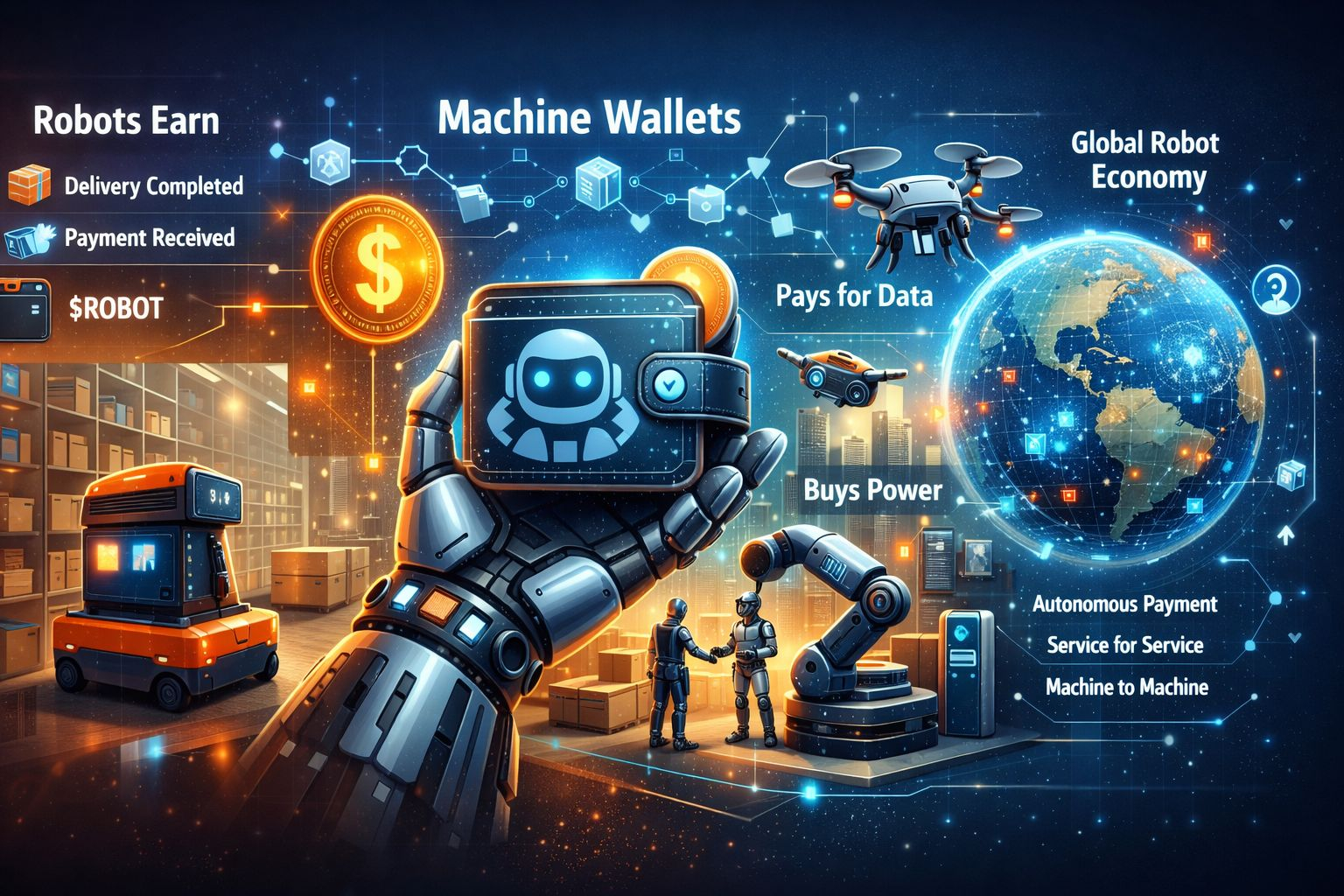
A few nights ago I found myself watching a short clip of a warehouse robot online. It was one of those smooth, almost hypnotic scenes — a small machine gliding between tall shelves, lifting a box, turning precisely, then disappearing down another aisle. No noise, no hesitation, just quiet efficiency.
People watch videos like that and usually think about automation or jobs or how advanced robotics has become. But the thought that crossed my mind was different.
What if that robot could get paid for the work it just did?
Not the company that owns the warehouse. Not the engineers who built the machine. The robot itself.
At first the idea sounds a little absurd. Robots don’t have bills to pay or families to support. They don’t care about salaries or promotions. They’re tools. And tools don’t need wallets.
But the longer you sit with the idea, the more interesting it becomes.
Machines today already perform real economic work. They assemble cars in factories, move products through logistics centers, inspect bridges and pipelines, and assist in hospitals. Entire industries rely on them. Yet the economic layer around that work — identity, coordination, payments — is still designed entirely for humans and organizations.
The machine does the task, but everything else happens somewhere outside of it.
That arrangement works, but it also creates friction that most people never notice. As robots become more autonomous and more widespread, they interact with many different systems at once: software services, infrastructure networks, data providers, and logistics platforms. Coordinating all of that through human-controlled systems becomes complicated very quickly.
This is where ideas like Fabric Protocol begin to enter the conversation.
The concept is surprisingly simple, even if it sounds strange at first. What if robots and AI agents could have their own verifiable digital identities on a shared network? And with that identity, what if they could also have wallets — a way to send and receive value automatically as they perform tasks?
The point isn’t to make robots “rich.” It’s to allow autonomous machines to participate directly in the economic systems around them.
Imagine a delivery robot moving through a city. It already makes decisions constantly — choosing routes, avoiding obstacles, adjusting to traffic conditions. Now imagine that the robot operates within a network where completing a delivery automatically triggers a payment to its wallet. If it needs updated navigation data, it can purchase that information instantly. When it docks at a charging station, it pays for electricity automatically.
No one needs to manually approve each step.
The system simply coordinates itself.
This idea becomes even more interesting when you zoom out and look at how complex robotics ecosystems already are. A single autonomous machine often depends on many different contributors. One company builds the hardware. Another develops the AI models. A third provides mapping data. Others operate the infrastructure where the robots work.
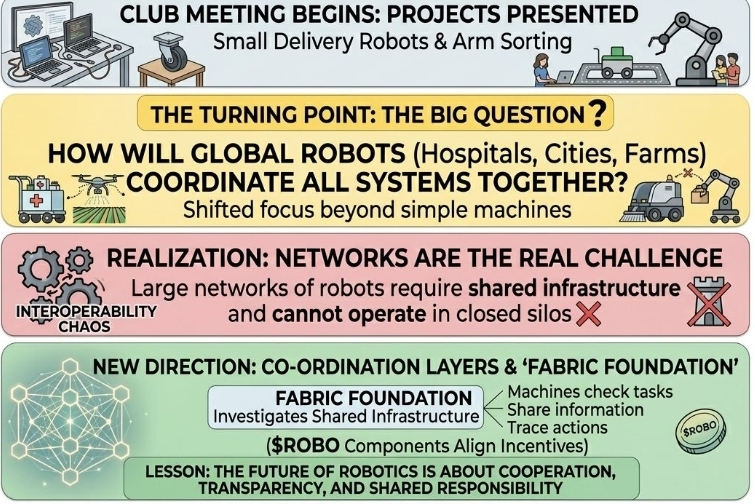
Today those relationships are held together through contracts, centralized platforms, and internal systems. It works, but it doesn’t scale easily when hundreds or thousands of autonomous machines begin interacting across different companies and environments.
Fabric Protocol tries to solve this coordination problem by creating a shared infrastructure where robots can operate with verifiable identities, perform tasks, and exchange value in a transparent way. Instead of every organization building isolated systems, machines could interact through a common network that tracks tasks, computation, and payments.
Whether that vision actually works in the real world is still an open question.
But it becomes easier to imagine when you picture a future warehouse.
Walk into a large logistics center ten years from now. Hundreds of robots move constantly across the floor. Some belong to the warehouse operator. Others might be provided by robotics companies that deploy fleets as a service. A few specialized machines might belong to maintenance providers or inspection teams.
Instead of one centralized system assigning every task, imagine a shared network where jobs appear continuously. Moving a pallet across the warehouse. Scanning inventory in a certain aisle. Delivering packages to packing stations.
Robots capable of completing those tasks can pick them up, perform the work, and receive small payments automatically once the job is verified. Charging stations collect micro-payments for energy. Data services sell updated maps of the facility. Maintenance robots earn compensation for diagnostics.
From the outside it might just look like a busy warehouse. But underneath, it behaves more like a marketplace — one where machines continuously exchange services with each other.
This is where tokens like $ROBOT sometimes enter the picture. In networks where machines exchange thousands of tiny payments — for data, services, or tasks — having a digital asset native to the system can simplify the process. Instead of connecting multiple payment systems, the network uses a shared medium of exchange.
Of course, tokens also bring skepticism. The crypto world has a long history of attaching tokens to ideas that never needed them in the first place. The real test isn’t whether a token exists, but whether the infrastructure actually makes life easier for people building and deploying robots.
If it doesn’t, the idea won’t last very long.
Another subtle shift in this model is that machines start to look a little like customers. Most economic systems assume that humans initiate transactions. People buy products, companies purchase services, and managers approve spending decisions.
Autonomous machines complicate that assumption.
A delivery drone might purchase weather data to improve its route. A hospital robot might request updated diagnostic models for analyzing medical scans. A warehouse robot might pay for mapping updates that help it navigate more efficiently.
Instead of routing every tiny decision through a human operator, the machine handles the transaction itself.
The economy becomes slightly less human-centered.
That idea understandably makes people uneasy. For most of history, tools have been passive. A hammer doesn’t negotiate a contract. A conveyor belt doesn’t decide which task it wants to perform.
Autonomous machines change that mental model. They still don’t have desires or intentions, but they can evaluate tasks, choose actions, and interact with systems in ways that resemble economic behavior.
The line between tool and participant starts to blur.
None of this means a machine-driven economy will appear overnight. Robotics is still expensive. Regulations are strict. Most companies prefer controlled environments over open networks. Many of the ideas being explored today will fail quietly before anything meaningful emerges.
But the direction of travel is hard to ignore.
 Robots are becoming more capable. AI agents are becoming more autonomous. Digital infrastructure is making it easier for distributed systems to coordinate with each other.
Individually, these trends seem manageable. Together, they hint at something new — a world where machines don’t just perform work, but can also verify that work and receive compensation for it.
Whether Fabric Protocol becomes the system that enables that future is impossible to know today. Many projects will experiment with similar ideas.
But the question it raises is fascinating to sit with.
When machines can act, decide, and transact on their own, the global economy may slowly gain a new kind of participant — one that never sleeps, never asks for a raise, and quietly keeps its own wallet somewhere on the network.
#ROBO @Fabric Foundation $ROBO