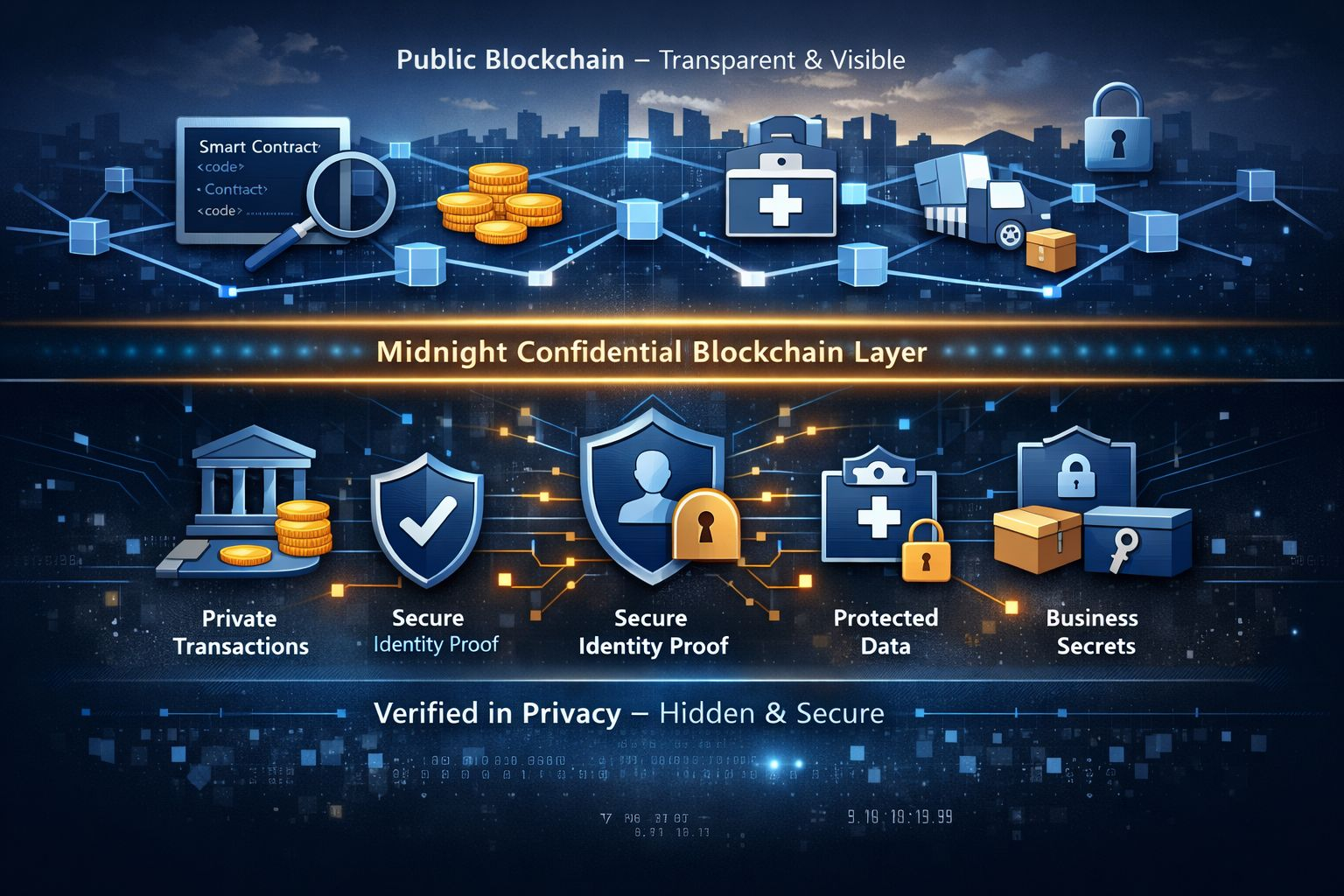
A few days ago I caught myself thinking about something strange in the world of blockchain. We often celebrate transparency as one of its greatest strengths. Every transaction visible. Every contract open. Every movement traceable. In theory, that sounds like the perfect system for trust.
But then another thought followed.
What if transparency is sometimes too much?
Imagine a company trying to build an application on a public blockchain. Their internal logic, financial operations, or sensitive data could suddenly become visible to anyone in the world. That level of openness might work for certain decentralized protocols, but for many real businesses it creates hesitation.
This quiet tension between transparency and privacy has been sitting inside Web3 for years. And while researching different projects recently, I came across one that seems to be approaching this problem from a very interesting angle: Midnight Network.
Midnight is built around a simple but powerful idea. Blockchains should not force developers to choose between decentralization and confidentiality. Instead, it might be possible to design systems where information can remain private while the network still verifies that everything is correct.
To understand why this matters, it helps to look at the core challenge most public blockchains face today. Transparency is fundamental to how they work. Transactions are recorded openly, and smart contracts usually run in an environment where anyone can inspect the logic and data involved. That design creates trust, because everyone can verify what is happening on the network.
However, the same transparency also limits what can realistically be built on top of it.
Businesses deal with sensitive information constantly. Hospitals manage private medical records. Financial companies process confidential transactions. Supply chain platforms track relationships and pricing structures that companies prefer to keep hidden. If these organizations were to move everything onto a traditional public blockchain, they would be exposing information that simply cannot be public.
Because of this, many institutions have stayed away from decentralized networks or built isolated systems that sacrifice openness for privacy.
Midnight Network tries to approach this problem by introducing confidential computation powered by zero-knowledge technology. At first, the phrase “zero-knowledge proof” can sound intimidating, but the concept behind it is actually quite elegant.
Imagine proving that you solved a puzzle correctly without showing how you solved it.
That is essentially what zero-knowledge systems allow. A blockchain can verify that a statement or computation is valid without seeing the underlying data itself. Instead of revealing everything, the system generates a cryptographic proof that confirms the result.
Midnight applies this concept to smart contracts. Rather than exposing every piece of business logic on-chain, developers could build applications where sensitive data remains private while the network still verifies the outcome. The blockchain only sees the proof that the rules were followed correctly.
It is a subtle but important shift in how decentralized applications could work.
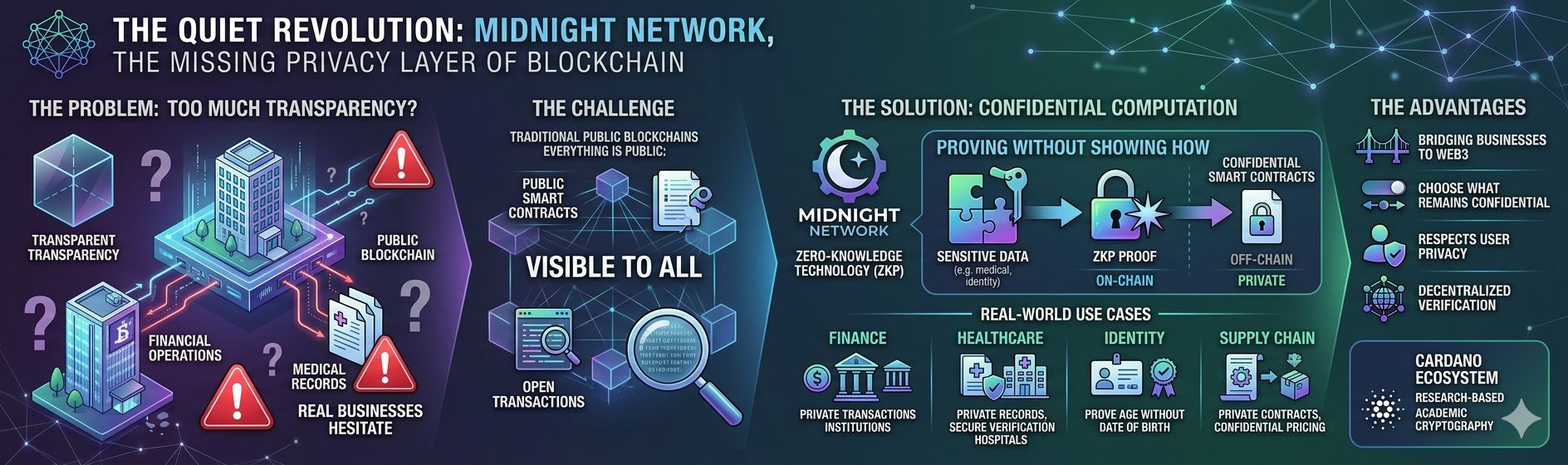 Once you start thinking about real-world scenarios, the potential becomes clearer. In finance, institutions could process transactions or agreements on a decentralized network without exposing internal operational details. Identity systems could allow people to prove specific facts about themselves without revealing their full identity records. For example, someone could prove they meet a legal age requirement without sharing their birthdate.
Healthcare might benefit even more. Patient information is among the most sensitive data in existence. A privacy-focused blockchain layer could allow hospitals, insurers, or researchers to verify information without exposing personal medical records.
Supply chains could also take advantage of confidential contracts. Companies might verify product authenticity, compliance, or shipment data without revealing supplier relationships or pricing structures to competitors.
While looking deeper into Midnight, it also became clear that the project sits within the broader ecosystem connected to Cardano, a community known for emphasizing research and academic cryptography. That background matters because privacy systems rely heavily on advanced mathematics and careful security design.
The growing interest in zero-knowledge technology across the blockchain space reflects a broader realization. Early conversations about Web3 focused mostly on decentralization and scalability. Now developers are beginning to recognize that privacy is equally important if blockchain is going to move beyond experimentation and into everyday infrastructure.
Midnight seems to position itself as a bridge between these worlds. Instead of replacing transparency, it adds another layer where applications can choose what information becomes public and what remains confidential.
For users, this could make decentralized systems feel more comfortable and practical. People could interact with blockchain applications without worrying that every detail of their activity will live permanently on a public ledger. Developers could design systems that respect user privacy while still benefiting from decentralized verification.
The project’s ecosystem also reflects the collaborative spirit common in many modern blockchain networks. Participation from developers, community members, and contributors often plays a role in how networks grow. Token systems in these environments typically help support governance, incentivize development, and reward those who help strengthen the ecosystem.
While the exact mechanics of token distribution can vary across projects, the general goal is often the same: aligning incentives so that the network evolves through community participation rather than centralized control.
While researching Midnight, I realized something that often gets lost in crypto discussions. Many people enter the space through trading, watching charts and price movements. That excitement is understandable. But sometimes the deeper value comes from simply studying how different teams approach complex problems.
Every blockchain project is essentially an experiment. Some try to scale faster. Others focus on cross-chain communication or decentralized governance. Midnight appears to be tackling the quiet challenge of privacy.
From a market perspective, technologies that introduce new infrastructure layers often attract attention when the industry begins focusing on long-term utility rather than short-term hype. Zero-knowledge cryptography has already become one of the most talked-about innovations in blockchain development.
 Whether a particular project succeeds will depend on adoption, developer activity, and real applications being built over time. But exploring these ideas still offers something valuable. It helps reveal where the industry might be heading.
If Web3 truly wants to support global financial systems, healthcare networks, identity frameworks, and enterprise infrastructure, then privacy cannot remain an afterthought. It has to become part of the architecture.
Midnight Network seems to be exploring that possibility by introducing what might be described as the silent layer of blockchain — a place where verification still happens, trust still exists, but sensitive information does not need to be exposed.
And perhaps that is where the next stage of Web3 will quietly unfold. Not just through louder technologies or bigger headlines, but through thoughtful infrastructure that makes decentralized systems compatible with the complexities of the real world.
@MidnightNetwork #night $NIGHT