
When people talk about the future of robotics, the conversation almost always goes in the same direction. Everyone talks about smarter machines, better AI, faster automation, and more capable robots. But the more I think about the bigger picture, the more I feel the real challenge may not be intelligence alone.
I think the missing layer could be identity.
That might sound less exciting than advanced robotics or AI breakthroughs, but to me it feels far more important. A robot can be useful, productive, and even highly intelligent, but if it cannot be identified, verified, and trusted inside an open system, then its role in the economy is still limited. It may be able to do work, but it still cannot participate the way a real economic actor can.
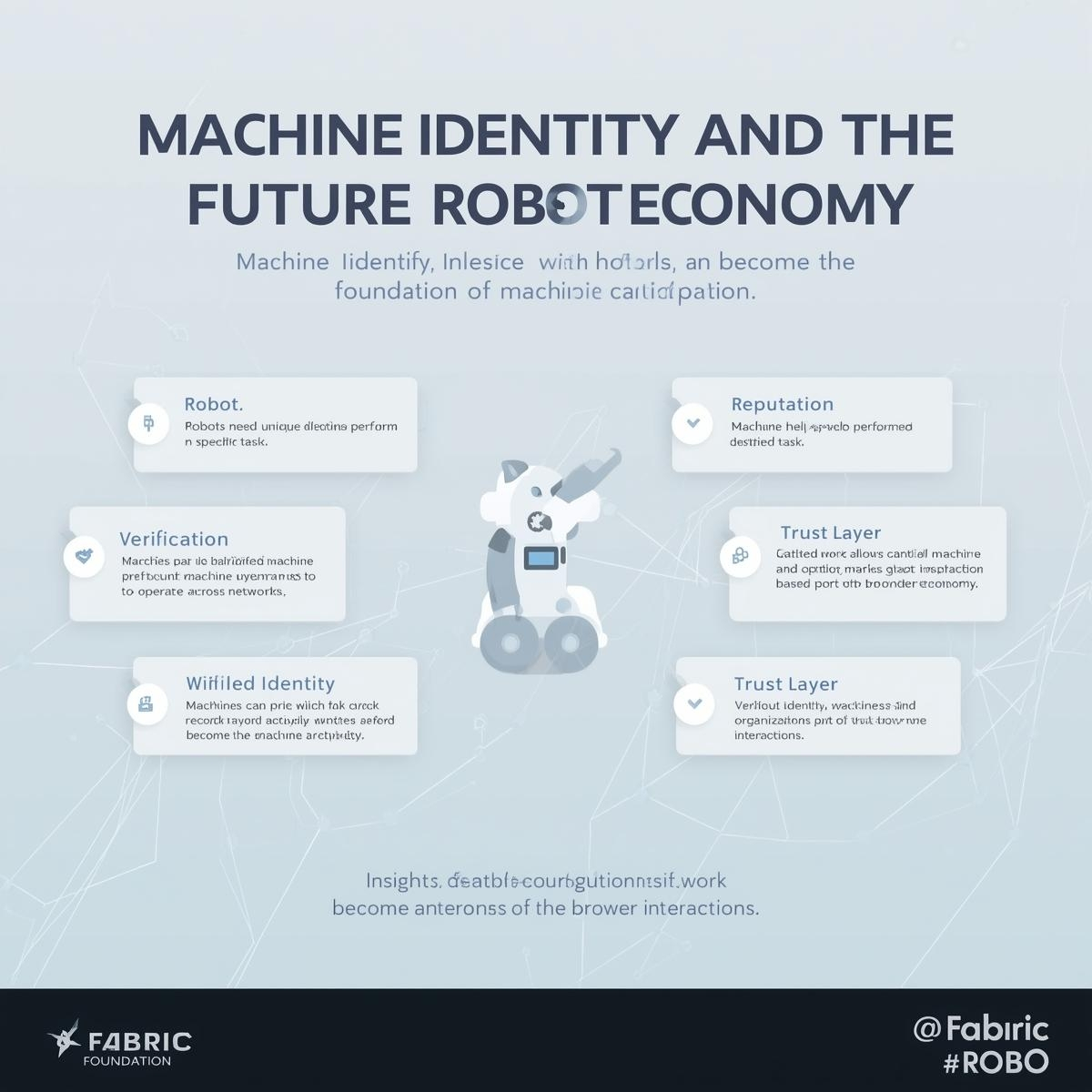
That is why this idea keeps standing out to me when I look at Fabric and the broader robot economy thesis behind $ROBO.
The way I see it, the future robot economy will not be built only on smarter machines. It will be built on the systems that allow those machines to operate in a way that the outside world can recognize. If a robot is going to complete tasks, receive payments, build a track record, or interact with other machines and services, then there has to be some layer that proves what it is, what it has done, and how it should be trusted.
That is where machine identity starts becoming a serious idea instead of just a technical feature.
I think this matters because the world’s existing systems were built around humans. Humans have IDs. Humans open bank accounts. Humans sign documents, build reputations, and interact with institutions through identity frameworks that already exist. Robots do not fit naturally into those same rails. So if autonomous machines are going to become more common in logistics, delivery, industry, or services, then some new infrastructure has to bridge that gap.
From my perspective, that is what makes the Fabric thesis more interesting than a normal token narrative. It is not just asking whether robots will become more useful. It is asking what kind of infrastructure those robots will need if they are going to operate as part of a broader economic network.
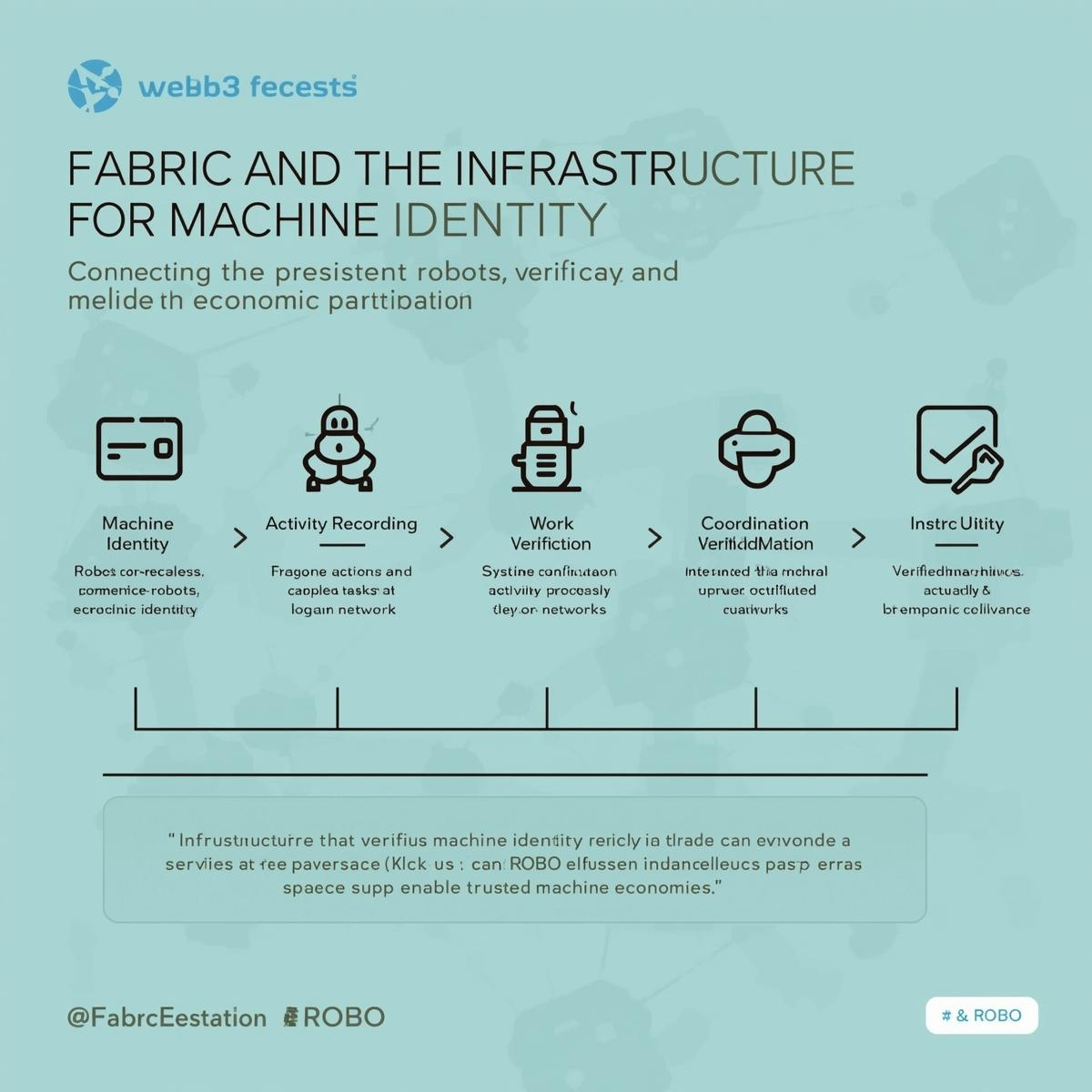
And honestly, I think that is a much better question.
Because once you start from that angle, you stop looking at robotics only through hype. You start looking at the deeper layers underneath it. Identity becomes important because it connects everything else. Without identity, verification becomes weak. Without identity, payment flows become harder to structure. Without identity, coordination across networks becomes messy. And without identity, trust stays fragmented.
That is why I think machine identity could end up being one of the most important parts of robotics infrastructure over time.
It also changes how I look at $ROBO. I do not just see it as another token tied to a narrative. I see it as part of a bigger attempt to build the economic and coordination layer around intelligent machines. If that vision ever starts translating into real usage, then the market may eventually realize that the real story was never only robotics or AI in isolation. It was the infrastructure needed to make machine participation real.
Of course, none of this removes execution risk. That part is obvious. Real adoption, real utility, and real ecosystem growth still have to be proven. But as a thesis, I think this is one of the more interesting directions in the space right now.
Because in the end, smarter robots alone may not be enough.
If the robot economy is going to grow, machines will need identity before they can truly belong to it.