
The block finalized at 00:14:23 but the explorer stayed empty. Not lagging. Empty. I clicked the tx hash at 00:14:24, expecting the usual payload tree, inputs, parameters, the calldata blob. Nothing expanded. Just two proof commitments sitting there, 64 characters each, blinking like they knew something I didn't.
I tried to force it. Hit the debug endpoint at 00:14:30. Sent a raw query for the witness data. Expected bytes. Expected the private inputs that fed the circuit. The Midnight explorer returned: "Null." Not "encrypted." Not "hidden." Null. My wrist cramped from hovering over the refresh key, that specific tendon pull when you're waiting for something that already left.
"Delayed," I typed in my notes. Deleted it. 00:14:35. The block was already six confirmations deep. No delay. The execution had happened elsewhere, in the Midnight's confidential runtime, the user-side witness generation finishing before the network even heard the call. I was looking at the artifact. The cryptographic proof system had already eaten the computation and exhaled only the verification metadata.
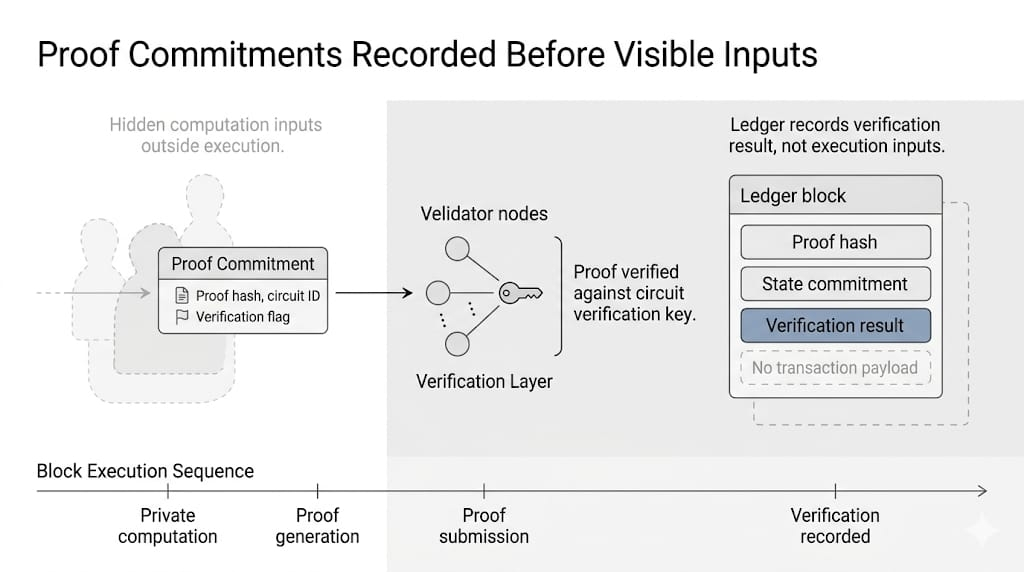
I checked another block. 00:14:40. Same pattern. Midnight's Public verification layer updating—contract commitments, state roots, verification records—but no transaction payload. No inputs. The zero-knowledge proofs were there, matching circuit constraints, validators checking the mathematics against verification keys at wire speed, but the data that created the proof had already evaporated. Ghosted.
My knuckle cracked. Loud. I realized I'd been holding the mouse too tight, finger frozen in a curl. The Midnight proof verification layer doesn't ask for the inputs. Doesn't need them. It checks the proof. The proof checks the circuit. The circuit already ran somewhere I can't access. The blockchain stopped being a database and became... what? A notary? A stamp?
I typed "transparent" at 00:14:52. Backspaced. Wrong. Transparency means you see through it. This is opaque. Solid. The proof sits there, 200 milliseconds of validation, while the execution it represents stays sealed in private state storage. I tried "trustless" instead. Deleted it. Not trustless. Trust shifted. From "do I believe the data" to "do I believe the math that the data existed."
Another block. 00:15:01. Same hash format. Same emptiness. The contract logic had already evaluated locally, the inputs loaded into the circuit, the witness generated, all before the Midnight's public ledger verification caught the first byte. I was watching the verification surface confirm something that had already died in the dark.
I leaned closer. The laptop fan heat hit my cheek. I thought about trying to spoof it. Inject a fake proof. See if the validators would catch it. My finger hovered over the terminal. Then stopped. The circuit would reject it. Or whatever. On Midnight, The proof verification was too fast, too final. The network didn't care about my investigation. It just kept confirming the artifacts, block after block, the ledger filling with proof commitments while I sat there, wrist aching, watching correctness accumulate without ever seeing the wrongness that didn't happen.
The screen flickered. 00:15:17. Another verification record appeared. Validated. Final. The inputs were already gone. My coffee was cold.
I hadn't touched it.