
The more I look at Midnight’s token model, the less I think the interesting part is the user experience.
It’s the power structure sitting underneath it.
On the surface, the $NIGHT and DUST split is clever. Honestly, more thoughtful than most token setups. Users aren’t forced to burn the main asset every time they do something simple. Fees become quieter, more predictable, less irritating. That matters. Good infrastructure should remove friction, not turn every action into another small tax moment.
From a product perspective, the appeal is obvious right away. What I keep thinking about is who ends up carrying the burden that users no longer notice.
Because the cost never truly disappears. It just shifts somewhere else.
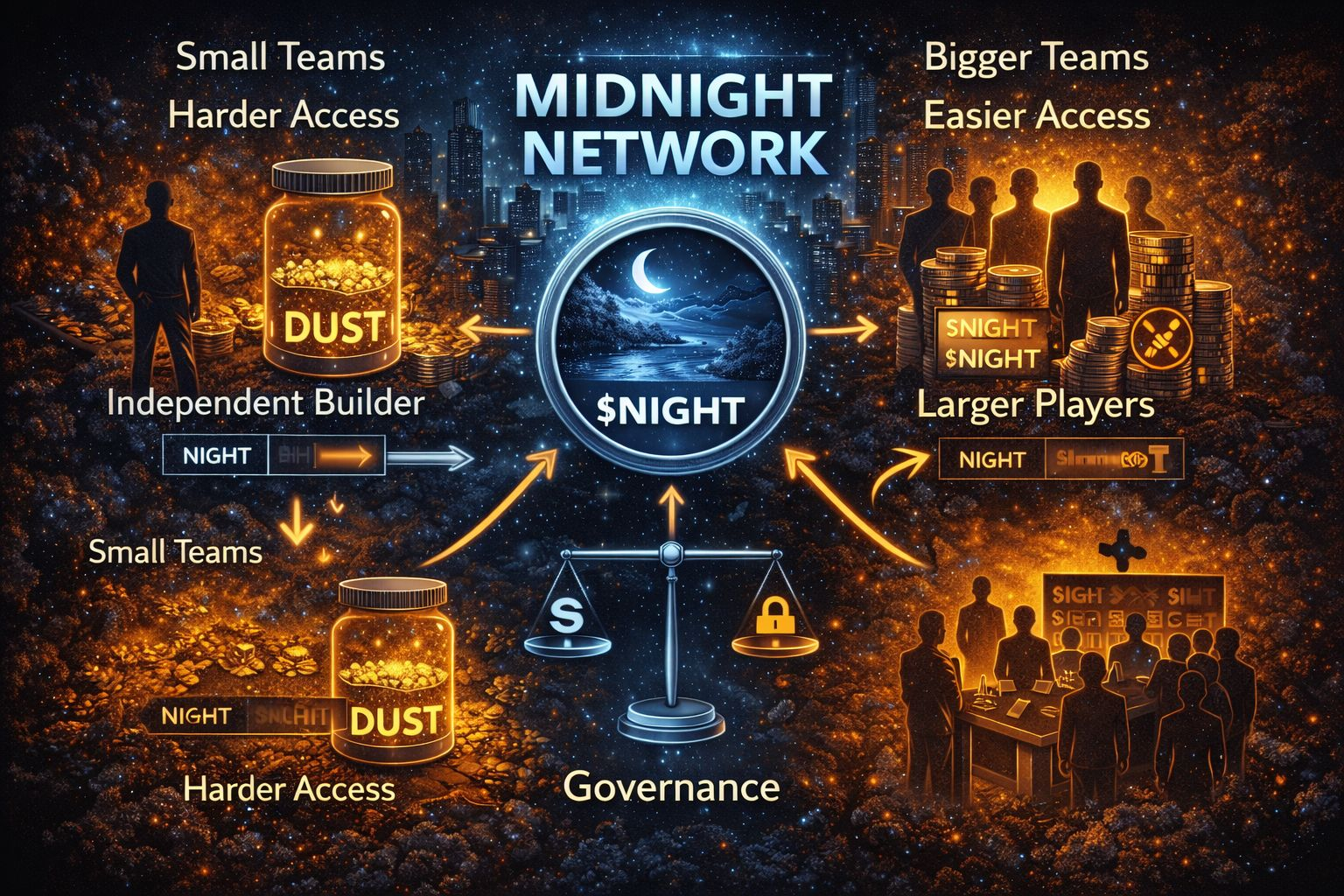
If transactions feel easy or almost free for users, someone still has to hold enough NIGHT to produce the DUST that keeps the application operating. In reality, that “someone” is usually the developer, the operator, or the company running the product. So Midnight’s clean fee structure might not actually remove the burden as much as shift it further upstream.
That’s the friction I keep thinking about.
For a big company, this might work perfectly. Maybe it’s even the best setup. Enterprises can afford to hold capital. They can plan around it, model the costs, absorb them, and treat it as normal infrastructure. Smaller teams don’t see it the same way. An independent builder doesn’t hear “stable fees” the way a well-funded platform does. What they hear is, “how much capital do I have to lock up before this even becomes usable?”
That’s a very different question.
And I think that matters more than token designers sometimes acknowledge. A system can feel open and easy for users while quietly becoming harder for builders to enter. The front end may look smooth, while in the background it slowly decides who can realistically participate.
That isn’t a technical failure. But it could still turn into a decentralization issue.
Midnight’s structure seems built to make the network feel more usable. Less chaotic. Less sensitive to fees. Less like the kind of clunky experience that makes blockchains feel like financial obstacle courses. That part makes sense to me. But if the trade-off is that developers need sizable reserves of NIGHT just to run things properly, then the system may naturally lean toward larger players.
And once that imbalance shows up, it usually builds on itself. Larger players can create stronger applications because they can afford the token base.
Stronger apps bring in more users.
More users reinforce their advantage. Meanwhile smaller builders remain small, not because their product is worse, but because the capital requirements were heavier for them from the start.
At that point it begins to look less like neutral infrastructure and more like access that depends on affordability.
And then there’s the governance side, which is harder for me to overlook.
If the rules that govern how DUST is created, used, or priced can be changed through governance, then the idea of predictable costs only holds as long as that governance remains balanced. And if decision power sits mostly with large NIGHT holders, then the people with the deepest capital pools may also be the ones shaping the rules that define how others participate.
That’s the point where the model starts feeling a little less tidy.
Because now the question isn’t only whether the token structure is elegant. It’s whether it stays fair once influence begins to concentrate. A fee system can look neutral on paper and still turn political in reality if a small circle ends up controlling the switches that decide how expensive the network becomes for everyone else.
I don’t think that means Midnight is broken. Not at all.
I think the hardest part of this design isn’t the battery analogy. It’s the social reality around who can actually afford the battery, who decides the charging rules, and who ends up building on the margins.
That, to me, is the real test.
Not whether the NIGHT and DUST model is clever. Whether it creates a network where smaller developers can truly compete, where governance doesn’t quietly strengthen capital concentration, and where decentralization means more than users just having a smoother fee experience.
Because a system can be beautifully engineered and still end up favoring the same kinds of players it claimed to balance out. And when that happens, the issue isn’t usability.
It’s who actually holds the power.
@MidnightNetwork #night $NIGHT
