
If you spend even a little time in crypto these days, it’s hard to escape the AI narrative. Every timeline, every discussion, every new launch seems to revolve around artificial intelligence. Projects are talking about autonomous agents, predictive trading algorithms, and machine learning models analyzing blockchain data in real time.
At first, I was mostly watching it the same way everyone else was focusing on the AI tools themselves. Trading bots, analytics dashboards, automated strategies all of it looked exciting on the surface. But the more I kept thinking about it, the more one question started bothering me.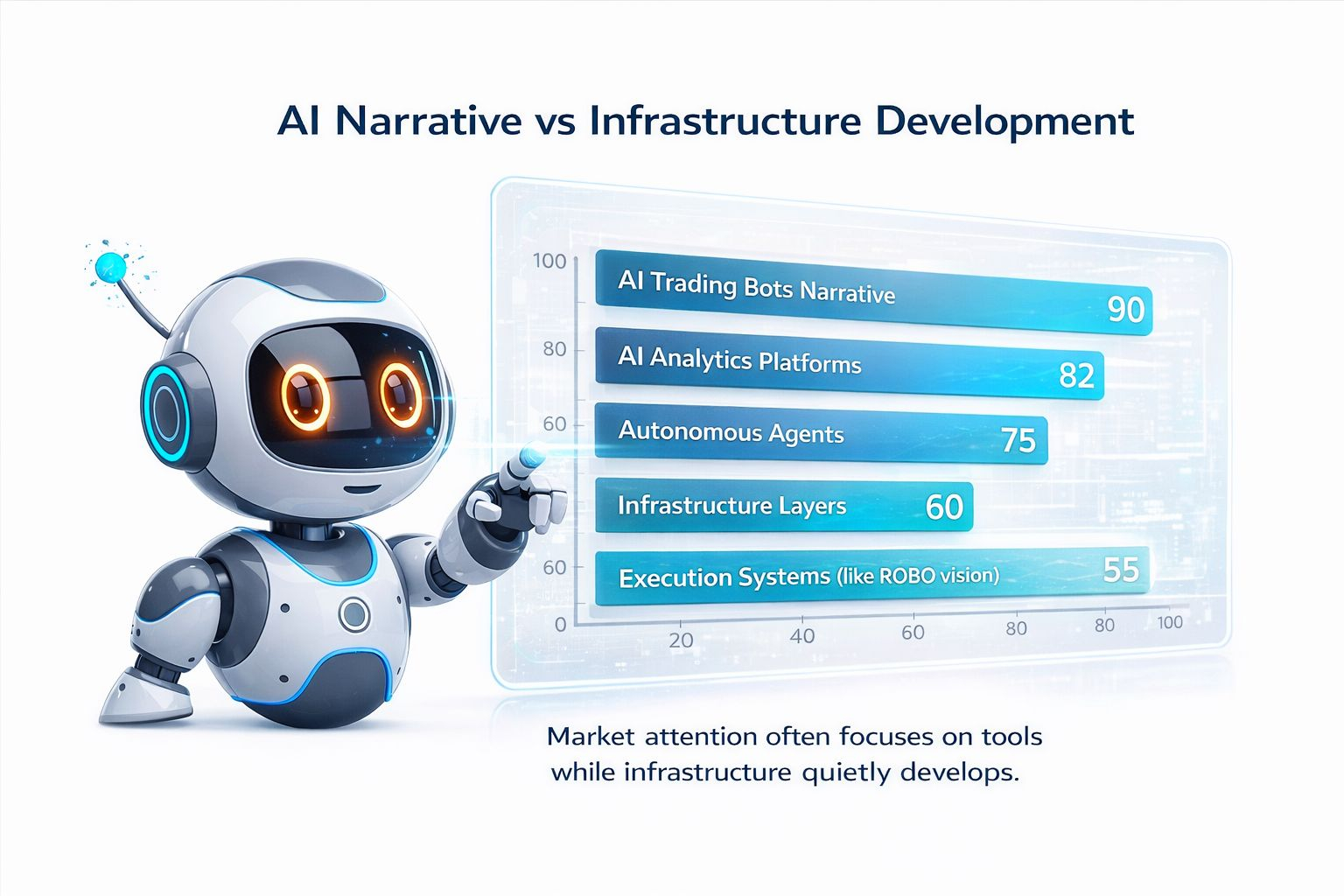
What actually happens after the AI makes a decision?
That question is what eventually pushed me to look deeper into @Fabric Foundation and $ROBO .
A lot of AI projects today focus heavily on analysis. They scan blockchain data, identify patterns, and generate insights that traders or protocols can use. And to be fair, that’s genuinely useful. Crypto produces an insane amount of data, and AI can definitely help make sense of it.
But analysis by itself doesn’t move funds, execute trades, or interact with smart contracts. At some point, an action has to happen on-chain.
And that’s where things start getting interesting.
Imagine an AI system managing part of a DAO treasury. The model might detect that one liquidity pool is becoming inefficient and suggest moving funds somewhere else. That insight could be completely correct. But the real question is how that recommendation safely turns into an actual blockchain transaction.
Without a structured system organizing those choices, things could get messy fast.
Think about plenty or even hundreds of automatic agents interacting with different DeFi protocols at the same time. Some may follow yield opportunities, others may realign portfolios, and others may manage liquidity positions. If those systems aren’t coordinated properly, they could end up conflicting with each other or even increasing market volatility.
In other words, intelligence alone doesn’t automatically create stability.
That’s the part of the talk that made me start paying observation to ROBO.
From what I understand, the idea back Fabric Foundation isn’t just to create another AI-powered application. Instead, the focus seems to be on creating infrastructure that helps automated systems interact with blockchain networks in a more structured way. It’s less about building smarter AI and more about making sure those AI-driven actions operate inside a coordinated framework.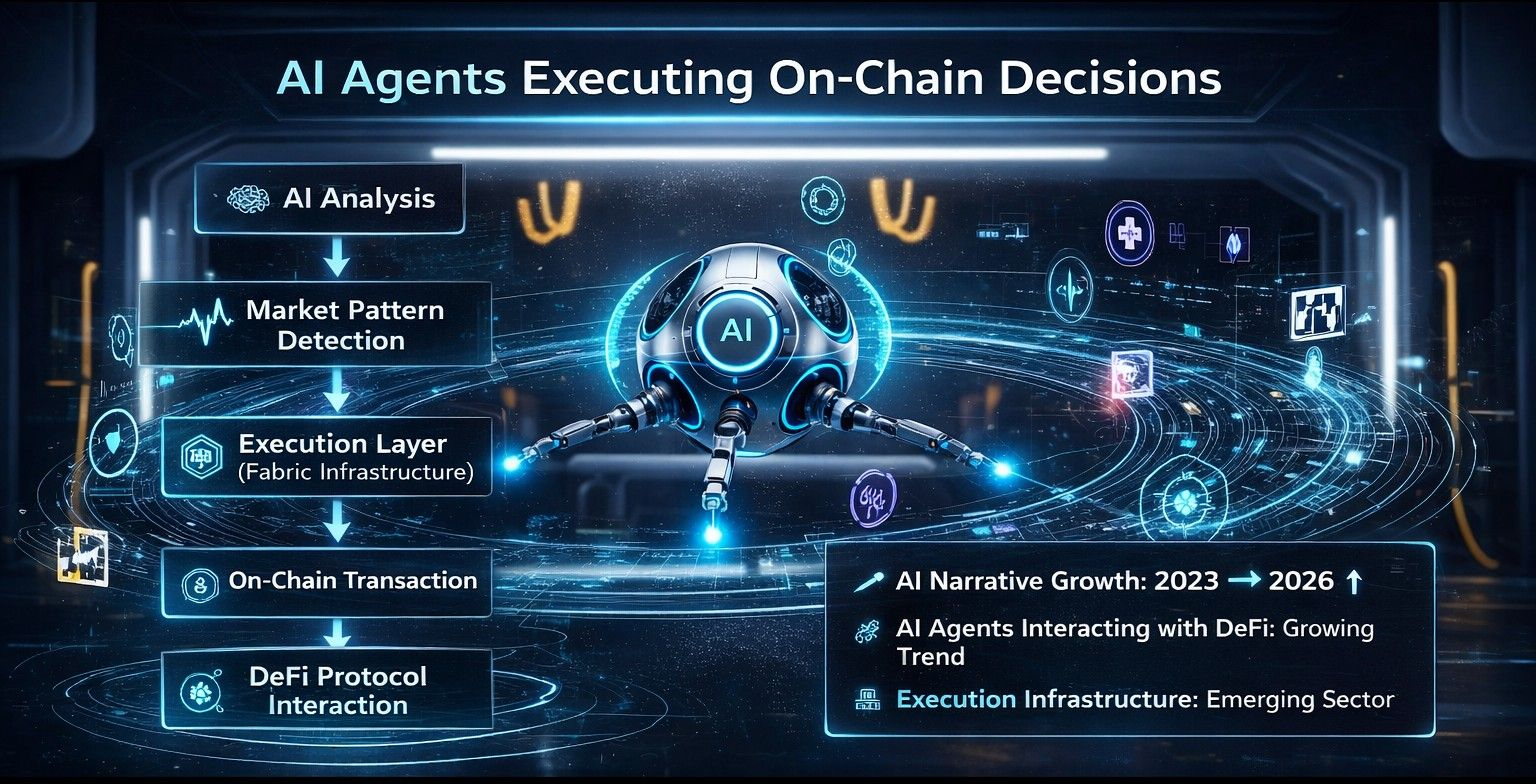
And honestly, that approach reminds me a lot of how earlier crypto cycles played out.
During the early DeFi boom, most people were obsessed with high yields and experimental protocols. Everyone was chasing the next farming opportunity. But over time, the real backbone of the ecosystem turned out to be infrastructure things like liquidity frameworks, scaling solutions, and cross-chain systems.
Those layers weren’t always the flashiest projects, but they ended up being some of the most important.
AI in crypto might follow a similar path.
Right now the space is still experimenting. Some teams are building AI trading tools, others are trying with autonomous agents, and a few are trying to use AI to help with governance decisions. All of that experimentation is part of how innovation happens.
But as these systems become more advanced, coordination is going to matter more and more.
AI interacting with blockchain networks introduces a new level of complexity. Automated decisions, smart contracts, liquidity flows, governance systems all of these moving pieces can interact in unpredictable ways. And when complexity increases, infrastructure usually becomes the thing that keeps everything running smoothly.
That’s why projects focusing on structural layers, like $ROBO, feel interesting to me.
Of course, none of this guarantees success. Infrastructure projects often take longer to gain pull because they depend on developers and protocols actually using the technology. Without real combination, even a good concept can struggle to gain momentum.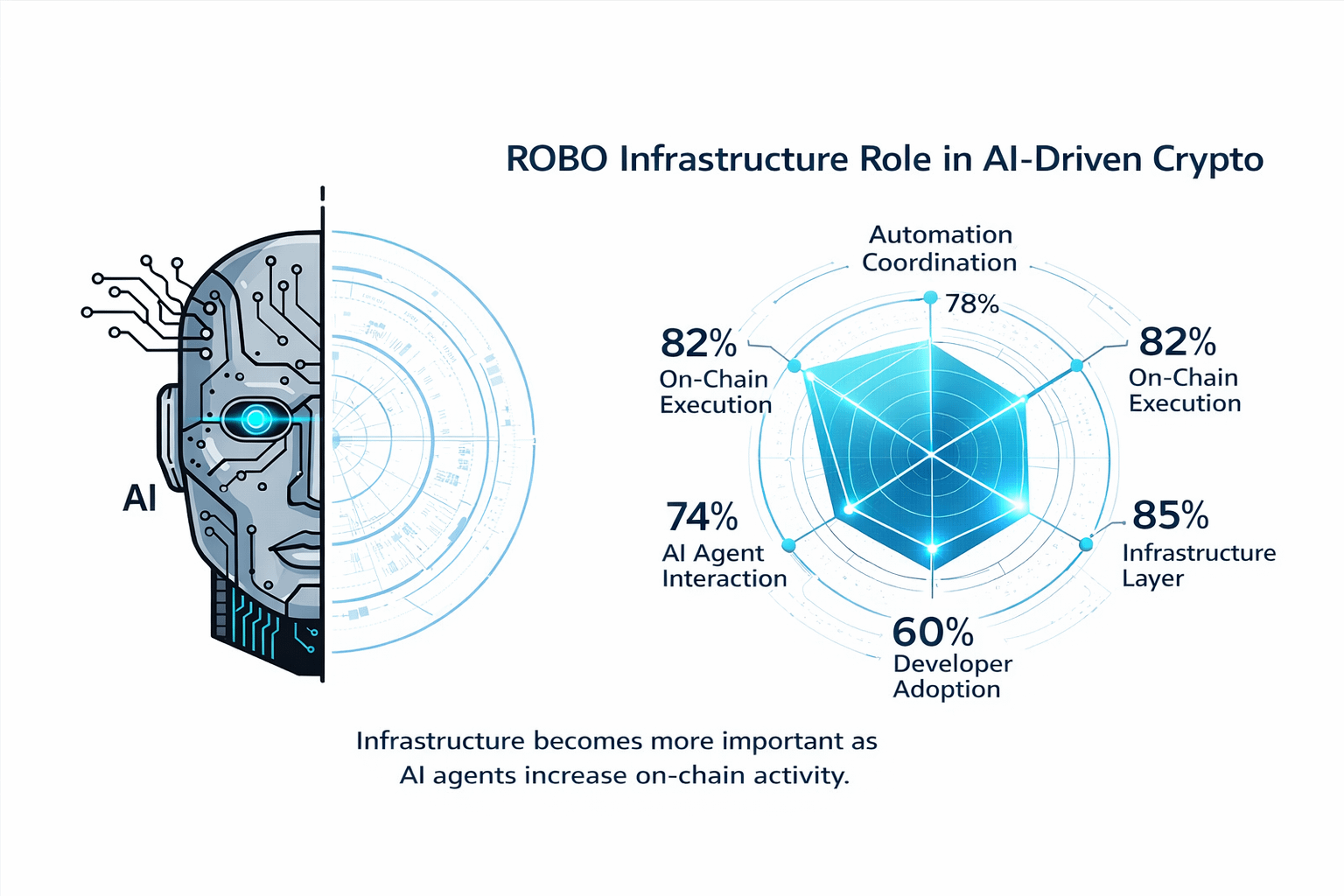
Competition is another big factor. The AI sector in crypto is growing incredibly fast, and it’s very possible that other teams will start building similar frameworks for coordinating automated systems. In the end, the projects that survive will probably be the ones that deliver real utility rather than just strong marketing narratives.
Token economic also play a function. For #ROBO to stay related long term, the token needs to be secyred to actual activity within the ecosystem. If network operations, automation layers, or execution systems depend on it, then demand could naturally grow alongside adoption.
Still, even with those uncertainties, the idea itself feels important.
AI has the potential to make decentralized systems much more efficient. But it also introduces new operational risks. Automated decisions interacting with blockchain infrastructure need reliability, transparency, and coordination. Without those elements, the same systems designed to improve efficiency could end up creating new problems.
Infrastructure is what helps maintain that balance.
That’s why I’ve started looking at Fabric Foundation and ROBO a little differently. Instead of seeing it as just another AI token, I see it more as an attempt to build the connective layer between intelligent systems and decentralized networks.
Whether that vision fully plays out will depend on development progress, partnerships, and real world combination. Crypto moves fast, and narratives can change quickly.
But if AI continues becoming a bigger part of the blockchain ecosystem, the projects quietly building the frameworks that manage those interactions might end up being some of the most important pieces of the entire system.
Right now the AI story in crypto is still unfolding.
And while most people are focused on the loudest innovations, I find myself watching the quieter infrastructure projects like Fabric Foundation and ROBO because sometimes the most important technology isn’t the one making the most noise.