The block looked finished before the computation ever showed up.
That was the strange part.
I was watching the explorer out of habit, refresh, scan the entries, move on. A new block finalized and the verification record appeared almost instantly. Clean. Compact. Just a pair of Midnight proof commitments anchored into the state.
No inputs.
No execution trace.
No contract call tree expanding underneath.
For a moment I assumed the explorer was lagging.
Refresh.
Still nothing.
That’s when the mechanism starts pressing on your intuition a little. Most blockchains show their work. A transaction enters the network, validators replay the execution, state updates ripple through the system, and anyone can follow the entire process step by step.
Midnight doesn’t let you watch the work happen.
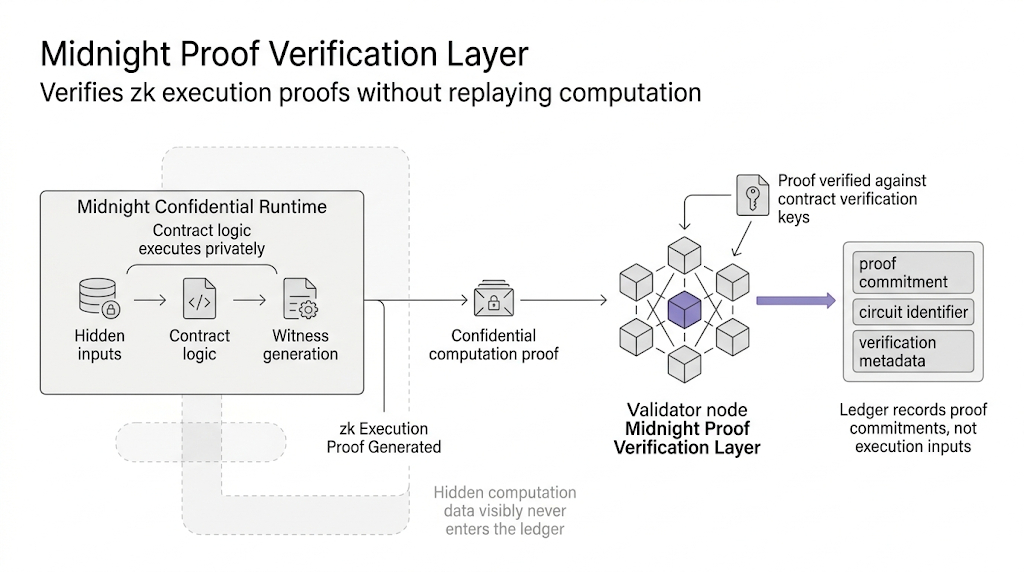
The computation itself runs somewhere else, inside a confidential runtime where contract logic executes privately. Inputs remain hidden. Intermediate steps never leave the environment. What eventually reaches the chain isn’t the execution.
It’s the evidence.
Validators never replay the program.
They verify the proof.
That shift sounds small until you notice where the pressure moves. Traditional smart contracts rely on observable computation: every node repeats the execution so the result becomes undeniable. Midnight pushes that responsibility onto a different surface, the Midnight proof verification layer. Instead of rerunning the contract logic, validators perform on-chain proof verification, checking zk execution proofs against the contract’s verification keys.
If the mathematics holds, the result stands.
The chain never sees the computation itself.
What the ledger records instead are Midnight proof commitments and fragments of Midnight verification metadata, compact pieces of cryptographic evidence confirming that the contract proof circuits were satisfied. The actual inputs never appear. The execution path stays hidden. Only the Midnight confidential computation proofs reach the network.
You can feel the architecture tightening around that idea.
Computation disappears.
Verification remains.
And suddenly the blockchain isn’t replaying programs anymore. It’s validating evidence. The ledger fills with Midnight ledger proof records, each one confirming that some contract logic executed somewhere, under specific rules, producing a result that satisfied the circuit.
You don’t see the work.
You see the proof that the work obeyed the rules.
Which is exactly the point. Sensitive inputs never spread across the network. Private data stays private. Applications can process confidential information without turning the blockchain into a public archive of transaction details.
The mechanism holds under pressure because the verification stays public even while the computation stays hidden.
Still… something about it shifts the mental model.
When execution vanishes from the chain, transparency changes shape. It stops being about watching the process unfold. Instead observers rely on the Midnight proof verification layer to confirm that the computation followed the contract circuits correctly.
The system replaces observable computation with Midnight verifiable private computation.
Elegant.
But also a little disorienting.
Because the explorer now shows you a different kind of truth. Instead of a visible program trace, you see the aftermath, a handful of proof commitments quietly confirming that the circuit rules were satisfied.
The proof carries the light.
The computation stays in the dark.
And after staring at that verification record for longer than I meant to, a question keeps pushing back.
If the blockchain never watches the computation happen, only verifies that it happened correctly, then the network isn’t really an execution engine anymore.
It’s a verification machine.
Which makes you wonder where the center of the system moved.
Did the computation leave the blockchain…
or did Midnight simply make it unnecessary for the blockchain to ever see it?
#Night $NIGHT @MidnightNetwork #night