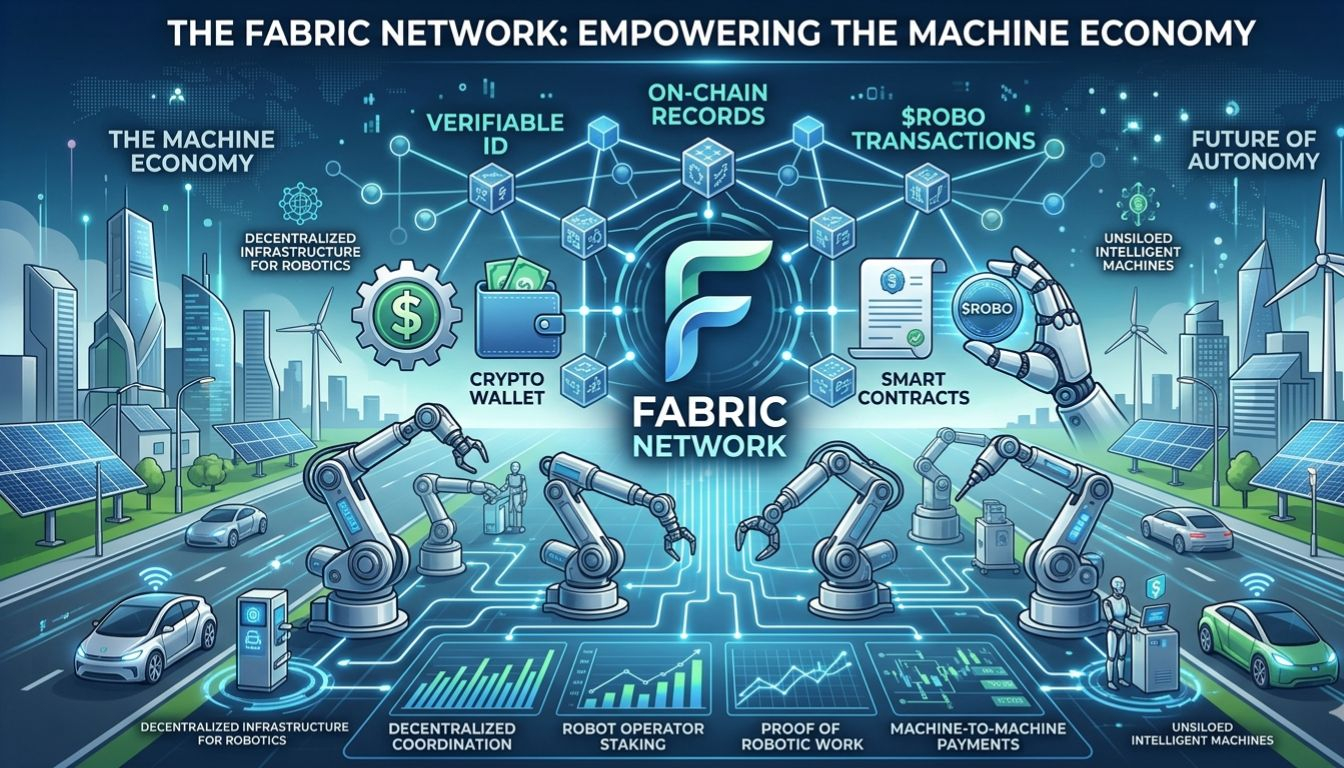
For decades, robots have existed as tools controlled by centralized systems. They can assemble cars, deliver packages, and assist in manufacturing but economically, they remain invisible. Robots cannot hold bank accounts, sign contracts, or participate in financial systems.
That limitation may soon change.
The vision behind @Fabric Foundation is to build the infrastructure that allows intelligent machines and robots to participate in the global economy through blockchain technology. Instead of operating inside isolated corporate networks, Fabric aims to create a decentralized system where robots can register identities, coordinate tasks, and exchange value autonomously.
This concept is often called the Machine Economy.
The Problem Fabric Is Solving
Today, robotic systems are mostly siloed. Each company runs its own fleet of machines, with limited interoperability and centralized control. This creates major barriers to collaboration, transparency, and global deployment.
Fabric proposes a new model a decentralized network where robots can interact through blockchain infrastructure.
Through this system, machines can obtain verifiable digital identities, maintain on-chain records of their activities, and securely participate in decentralized task markets. Blockchain technology provides the transparency and trust layer needed to coordinate machines operating across different organizations and locations.
Instead of being passive tools, robots could become active participants in economic systems.
How the Fabric Network Works
Fabric acts as a coordination layer connecting robotics, AI systems, and decentralized finance infrastructure. The network initially operates on Base (Ethereum Layer-2), benefiting from fast and low-cost transactions while maintaining Ethereum-level security.
Within this environment, robots can:
• Register verifiable on-chain identities
• Store and transfer value using crypto wallets
• Receive payments for completed tasks
• Share data and computational resources
• Coordinate work across decentralized marketplaces
Over time, the Fabric ecosystem plans to evolve toward its own dedicated Layer-1 blockchain optimized for machine-to-machine transactions.
This architecture could enable a future where thousands or even millions of autonomous machines operate across an open economic network.
The Role of $ROBO
At the center of the Fabric ecosystem is $ROBO, the native utility token powering the network.
$ROBO is used for multiple essential functions across the platform:
• Paying network fees for identity verification and transactions
• Staking by robot operators to ensure service reliability
• Governance participation for protocol decisions
• Facilitating machine-to-machine payments
The token also supports a unique incentive mechanism known as Proof of Robotic Work, where rewards are tied to verified robotic activity and contributions within the network.
This design attempts to connect token value with real-world robotic operations rather than purely speculative activity.
Why the Narrative Matters
The convergence of AI, robotics, and blockchain is rapidly becoming one of the most important technological trends of the decade.
As autonomous machines become more capable, new economic systems will be required to manage identity, trust, payments, and coordination between humans and machines.
Fabric is attempting to build that foundational infrastructure.
If successful, networks like Fabric could enable a future where robots do more than perform tasks they could also participate in decentralized markets, generate revenue, and interact economically with humans and other machines.
While the machine economy is still in its early stages, the foundations being built today may define how intelligent machines integrate into society tomorrow.
The future may not just be digital or decentralized.
It may also be autonomous.