Every cycle in crypto has a moment where something new looks too early, too abstract, or too niche to matter. Then a few years later it becomes obvious that the foundations were already being built.
Back in 2019 and early 2020, many people dismissed decentralized finance. Critics argued that nobody would actually use it, that liquidity would stay on centralized exchanges, and that the entire concept was premature. Yet within a few years, DeFi protocols grew into a sector worth hundreds of billions of dollars.
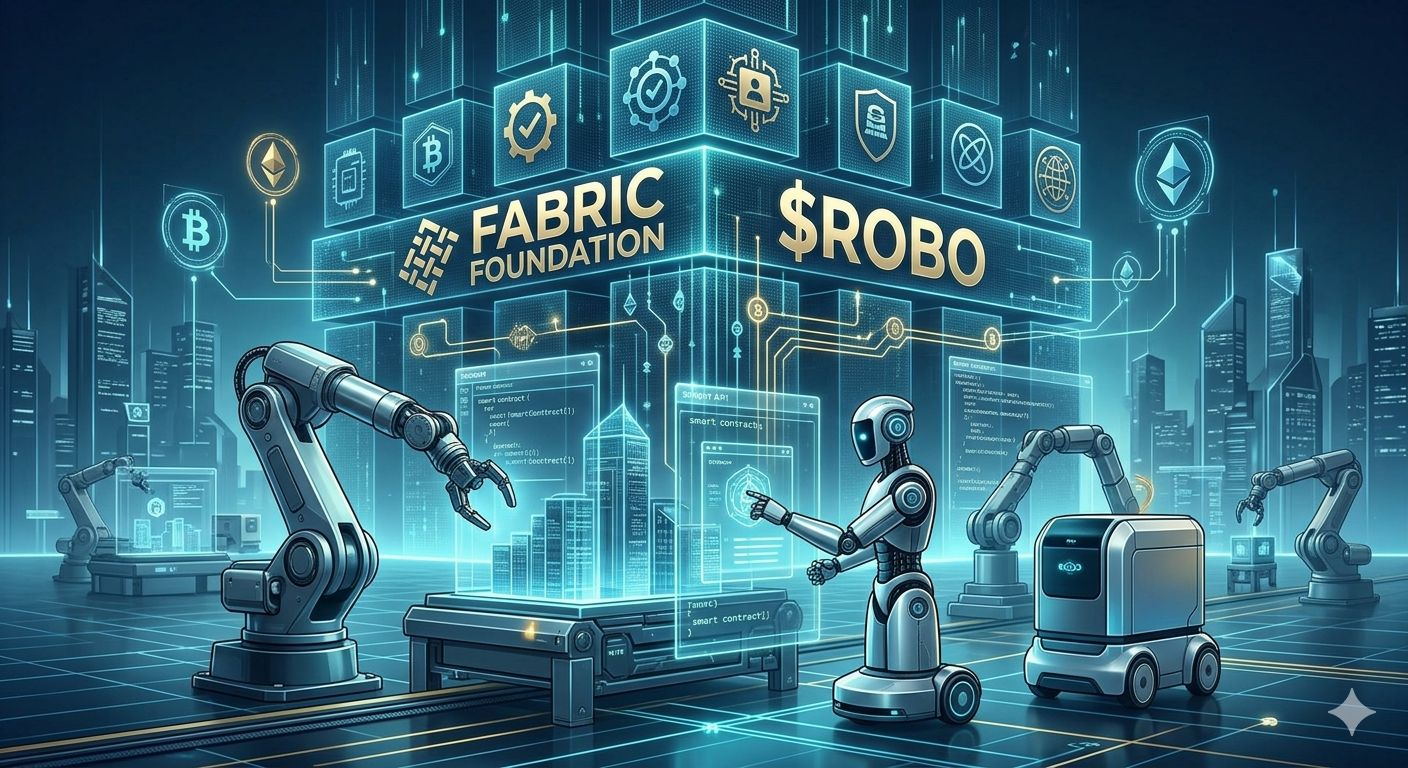
Today, when I look at Fabric Foundation and the ecosystem forming around $ROBO the same pattern recognition appears.
This is not about copying DeFi.
It is about solving a similar structural problem in a completely different industry.
The Coordination Problem
Before automated market makers existed, token trading depended almost entirely on centralized exchanges. If two parties wanted to swap assets, they had to rely on a platform acting as the intermediary, controlling the infrastructure and extracting fees.
Protocols like changed that architecture. Instead of a company coordinating trades, the coordination moved into transparent smart contracts anyone could interact with.
Fabric is approaching a comparable challenge, but in the machine economy.
As robotics and autonomous systems expand, machines increasingly need to interact with other machines, accept tasks, and exchange value. Yet today most of that coordination happens through proprietary systems, closed APIs, or vendor controlled platforms.
There is no neutral infrastructure layer that allows machines to interact economically with each other in a permissionless way.
Fabric’s thesis is simple:
If machines are going to work autonomously, they need an open coordination protocol.
On-Chain Identity for Machines
One of the most important primitives in early DeFi was the ability to trust the protocol itself as the counterparty.
For example, lending platforms like allowed users to supply collateral and borrow assets without relying on a centralized lender. The rules lived entirely in code.
Fabric introduces a parallel concept for machines.
Through an on-chain identity system, robots or autonomous agents can possess verifiable identities with transparent activity histories. Instead of relying on a central authority to verify them, trust comes from cryptographic identity and publicly verifiable records.
This means a machine could theoretically:
- Register its capabilities
- Accept tasks from external participants
- Complete work
- Receive payment automatically
All without a centralized dispatcher or platform sitting in the middle.
Smart Contracts as the Coordination Layer
Another defining innovation of early DeFi was automated coordination.
Protocols such as replaced traditional order books with algorithmic liquidity pools. Anyone could interact with the system because the rules were predetermined in smart contracts.
Fabric applies a similar design philosophy to task coordination.
Instead of a centralized dispatch system assigning work, smart contracts define the rules for how machines:
- Advertise capabilities
- Accept jobs
- Execute tasks
- Settle payments
Machines interact with the protocol directly, removing the need for intermediaries in the coordination layer.
Leveraging Existing Infrastructure
Another reason early DeFi grew so quickly was that it launched on infrastructure developers already understood.
Platforms like and built on the ecosystem, meaning developers could immediately start building with familiar tools.
Fabric appears to be following a similar path.
By maintaining compatibility with the developers who already understand Solidity and existing tooling can build applications without learning an entirely new stack.
Launching within the broader Ethereum ecosystem also means:
- Existing wallets work
- Developer tooling already exists
- Liquidity and users are accessible from day one
It is a practical strategy for bootstrapping adoption.
The Long-Term Architecture
Where things become more interesting is the longer-term roadmap.
Historically, Ethereum itself was never optimized for the massive transaction volumes that DeFi eventually generated. Over time the ecosystem expanded into rollups and application-specific chains to scale.
Fabric hints at a similar trajectory.
Starting on an existing network allows rapid experimentation and developer onboarding. But if the machine economy actually scales, a dedicated infrastructure layer optimized for machine-to-machine transactions may eventually become necessary.
In other words:
Start where the developers already are.
Scale where the machines eventually need to be.
The Biggest Difference From DeFi
There is one major distinction between early DeFi and the machine economy.
When DeFi launched, the users were already on-chain. Crypto participants already had wallets, tokens, and a reason to experiment with new protocols.
Robotics and autonomous systems operate in industries that move far more slowly. Integrating blockchain infrastructure into real-world machines involves hardware systems, enterprise software, and long development cycles.
Adoption will likely take longer.
But the potential market is also far larger.
The Opportunity
The global robotics sector is projected to grow well beyond $200 billion in the coming years, with autonomous systems expanding even faster. Yet despite this growth, there is still no open infrastructure layer designed specifically for machine coordination and machine-to-machine economic activity.
That gap is what Fabric is attempting to address.
Right now the narrative is still forming. Most people can explain what a decentralized exchange does in a single sentence. Far fewer can summarize a machine coordination protocol that easily.
But narratives tend to emerge after the architecture is already in place.
When you look closely at the design on-chain identity, smart-contract coordination, EVM compatibility, decentralized validation, and governance it starts to resemble the structural foundations that early DeFi protocols built years ago.
The difference is that this time the target market is not just finance.
It is the entire emerging machine economy.
And if that economy grows the way many analysts expect, the infrastructure layer enabling machines to coordinate, transact, and collaborate could become one of the most important protocols of the next decade.
For now, it simply looks early.
History has shown that “early” is sometimes exactly where the biggest opportunities begin.
#robo $ROBO @Fabric Foundation