For decades the internet operated under a simple assumption data could move freely across borders. Companies stored information wherever it was cheapest, processed it wherever it was most efficient, and rarely worried about national boundaries. That era is quietly coming to an end.
Governments across the world are now introducing strict data governance laws that require companies to store, process, or verify sensitive information within national borders. Regulations such as Brazil’s and China’s are reshaping how global companies manage data. Similar frameworks are emerging in India, Indonesia, Saudi Arabia, and many other countries.
The result is a new reality often described as digital sovereignty. Nations want greater control over how data generated by their citizens is stored, accessed, and transferred. For global companies, this creates an increasingly complex compliance landscape.
And that is where enters the conversation.
A Different Approach to Data Compliance
Midnight Network is designed as a privacy focused blockchain built within the ecosystem. Its core concept revolves around something known as selective disclosure.
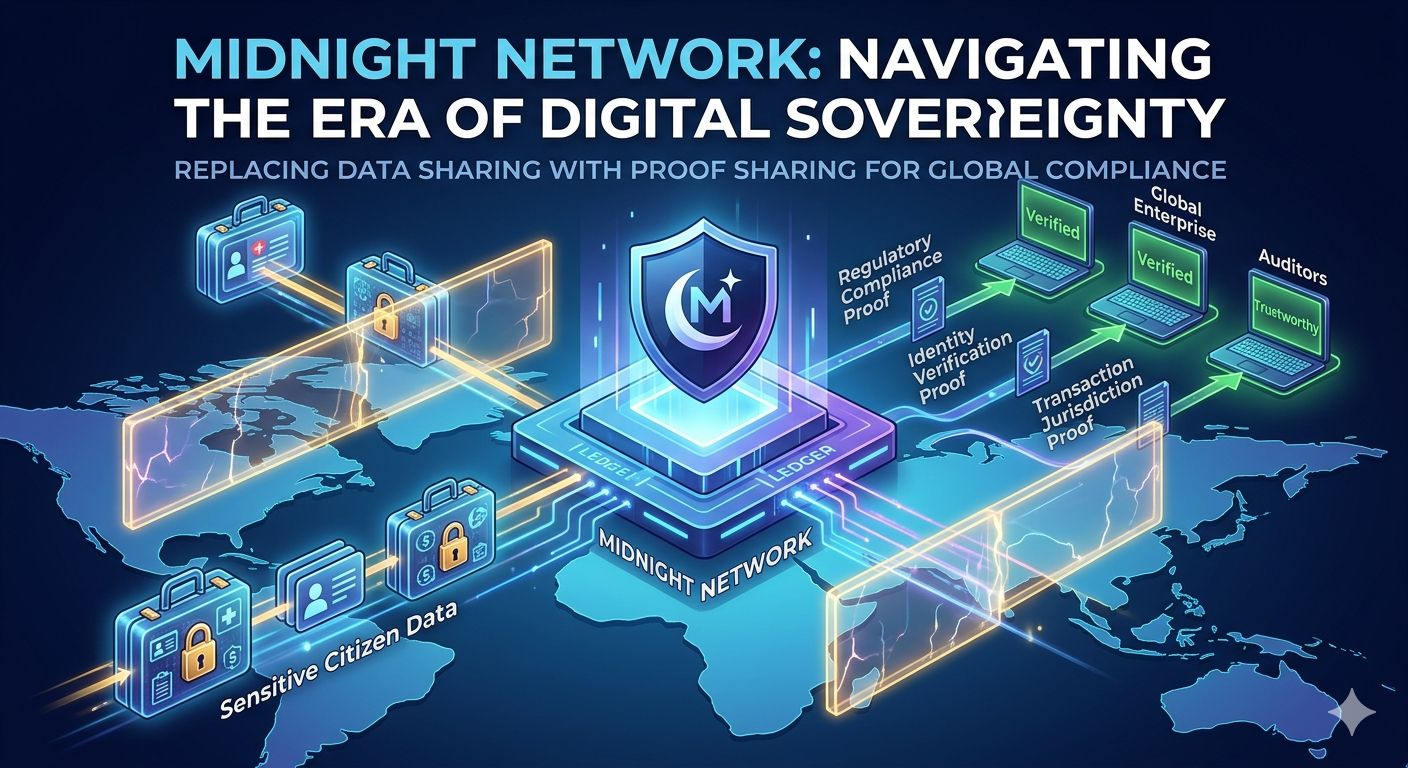
Instead of sharing raw data to prove compliance or identity, selective disclosure allows participants to prove certain facts without exposing the underlying information itself.
For example:
- A company could prove it complies with regulatory requirements without revealing its entire database.
- A user could verify their identity without sharing personal details.
- A transaction could meet jurisdictional rules without transferring sensitive data across borders.
This model relies heavily on technology, which allows one party to prove that a statement is true without revealing the actual data behind it.
In other words, instead of sharing data, systems share proofs about the data.
Why This Matters for Global Businesses
As data localization laws expand, companies face a growing verification problem.
Imagine a European firm trying to demonstrate compliance with Brazilian privacy regulations. Today that process often requires extensive audits, documentation, and sometimes direct access to sensitive datasets. The same challenge appears when financial institutions operate across jurisdictions with different legal frameworks.
This friction creates real costs. International organizations have estimated that cross-border data restrictions already add significant compliance expenses for multinational businesses.
A system that allows regulators, partners, or auditors to verify compliance without exposing the data itself could dramatically reduce that friction.
Potential Use Cases
If the technology works as intended, several industries could benefit:
Financial Services
Banks operating in multiple regions must comply with different regulatory standards. Privacy-preserving verification could simplify cross-border operations.
Healthcare
Medical institutions could share research insights or verify treatment outcomes without exposing personal patient records.
Supply Chains
Companies could prove supplier certifications, origin tracking, or regulatory compliance without revealing proprietary supplier networks.
Digital Identity
Decentralized identity systems are projected to become a massive market over the coming decade, and privacy-preserving verification is a critical component of that future.
Why Timing Matters
The broader geopolitical shift toward regional data control may actually strengthen the relevance of privacy-preserving technologies.
As more countries implement strict data governance laws, organizations will need tools that allow them to demonstrate compliance without constantly transferring sensitive data across jurisdictions.
That structural trend aligns closely with Midnight’s core design philosophy.
The Challenges Ahead
Of course, strong technology alone does not guarantee adoption.
Zero-knowledge systems are still complex to integrate, and developer tooling will play a major role in determining whether enterprises can realistically build on this infrastructure.
There is also the question of regulatory acceptance. While cryptographic proofs can demonstrate compliance technically, regulators in some jurisdictions may still prefer traditional audit trails and documentation.
And like every blockchain project, the $NIGHT ecosystem will remain influenced by broader market conditions.
A Shift From Data Sharing to Proof Sharing
Despite the uncertainties, the idea behind Midnight is compelling.
Instead of moving sensitive data around the world, organizations could simply move verifiable proofs about that data.
If that model gains traction, it could represent a major architectural shift in how global digital systems handle privacy, compliance, and cross-border collaboration.
In a world where governments are increasingly building walls around data, technologies that allow trust without exposure may become one of the most valuable pieces of infrastructure in the next phase of the internet.
The real question now is not whether privacy matters.
It is whether developers and enterprises will adopt tools like Midnight to make that privacy scalable. #night $NIGHT @MidnightNetwork