What pulled me toward wasn’t hype it was resistance.
In a market addicted to polished narratives, most projects feel like they’re optimizing for attention first, substance later. Swap the theme AI, agents, RWA, automation and you’ll often find the same structure underneath: a clean story, a token layered on top, and just enough complexity to look convincing.
Fabric doesn’t feel like that.
It feels like it’s starting from the part everyone avoids.
The Part Nobody Wants to Build
The machine economy is easy to romanticize. Autonomous systems executing tasks, earning value, coordinating at scale it sounds inevitable when you say it fast enough.
But the reality isn’t elegant.
Once machines exist and start acting, everything gets harder:
Who or what is that machine, really?
What is it allowed to do and who decides that?
How do you verify its actions without trusting blindly?
How does value move without breaking accountability?
Where do humans stay involved without slowing everything to a halt?
This is where most narratives go quiet.
Because this is where the work is.
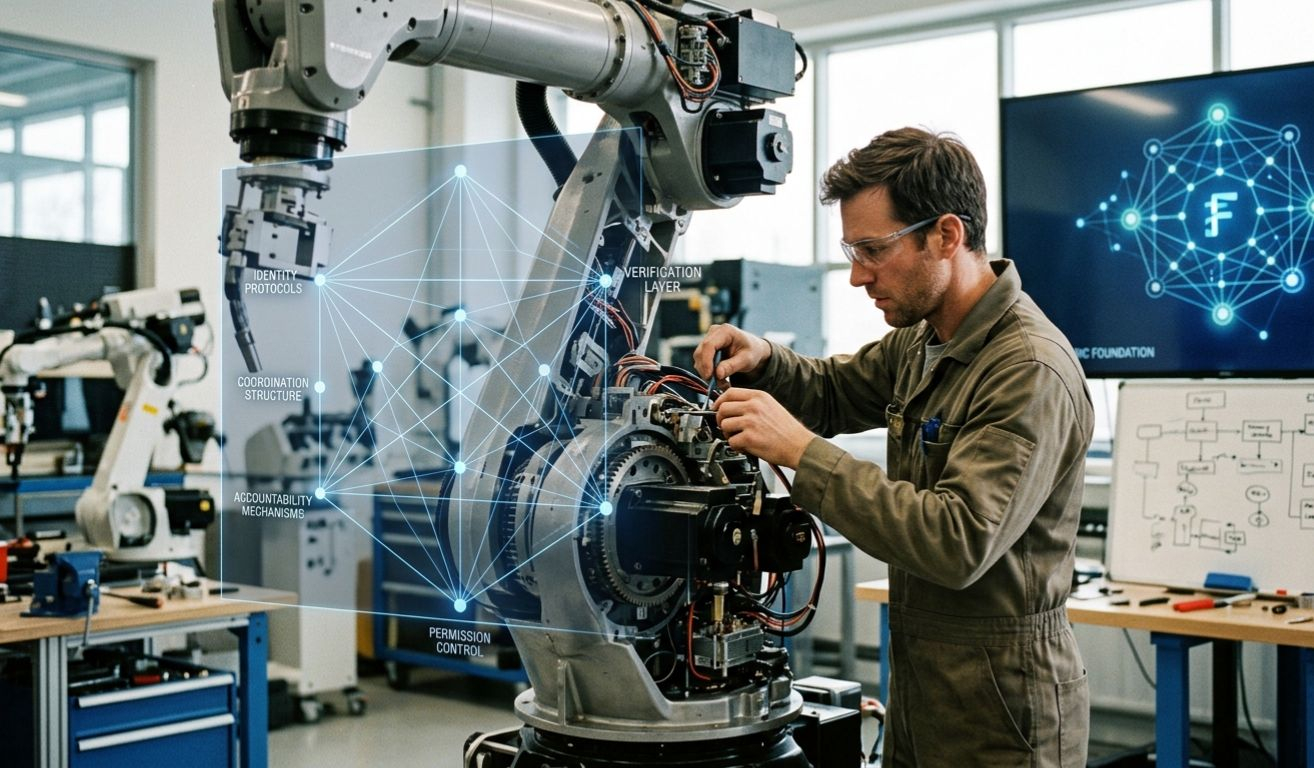
And Fabric seems unusually focused on this layer identity, permissions, verification, coordination. The unglamorous mechanics that actually determine whether any of this can function outside of a demo.
Not a Story Problem A Coordination Problem
A lot of crypto still behaves like storytelling is the hard part.
It isn’t.
We already know how to imagine the future. The real bottleneck is coordination getting independent systems, actors, and incentives to align in a way that doesn’t collapse under its own complexity.
That’s where ideas usually fail.
Not because they weren’t ambitious enough, but because they couldn’t hold structure under pressure.
Fabric reads less like a bet on machines becoming powerful, and more like a bet that without structure, that power goes nowhere.
That’s a very different angle.
Infrastructure Over Illusion
There’s something deliberately unexciting about how this project presents itself.
No exaggerated claims of instant scale. No illusion that everything just “connects.” Instead, it leans into the friction:
Systems don’t naturally trust each other
Actions need proof, not assumption
Access needs to be controlled, not implied
Value transfer needs rules, not vibes
It’s not selling the destination.
It’s trying to build the rails.
And in crypto, that’s usually where patience runs out because rails take time, and time doesn’t always trend.
Respect, With Conditions
None of this means automatic trust.
The space is full of smart ideas that never crossed into real usage. Strong framing doesn’t equal real adoption. Good design doesn’t guarantee demand.
Fabric still has to answer the only question that matters:
Does this become something people actually need?
Not something people talk about. Not something content amplifies. Something that gets used because there’s no better alternative.
That transition from concept to necessity is where most projects quietly fail.
Why It Stays on My Radar
What keeps this project in my head isn’t belief. It’s tension.
It feels like it’s engaging with a real constraint while much of the market is still rewarding surface-level innovation. It’s looking at where systems break instead of assuming they won’t.
That doesn’t make it a winner.
But it makes it worth watching.
Because if machines are ever going to participate meaningfully in open systems, the challenge won’t be imagination. It will be structure identity, coordination, accountability, and trust that doesn’t rely on blind faith.
That’s the layer Fabric is circling.
Interesting > Exciting
I’ve stopped chasing projects that sound exciting.
Excitement is easy to manufacture. It scales fast and disappears just as quickly.
What I pay attention to now is whether something feels grounded in the problem.
Fabric does.
Not perfectly. Not completely proven. But enough to stand apart from the noise.
And in a market full of polished promises, I’ll take something that understands friction over something that pretends it doesn’t exist.
$ROBO #ROBO @Fabric Foundation
Sometimes the projects that matter aren’t the ones shouting about the future.
They’re the ones quietly trying to make it work.