
There's this thing that happens when you watch how robotics projects usually unfold. Someone builds a robot in a lab, it works pretty well in controlled conditions, and then the moment it needs to exist in the real world — with other systems, other people, other rules — everything gets complicated. Not because the robot is bad. Because the infrastructure around it was never designed for that kind of openness.
That's sort of where Fabric Protocol starts making sense.
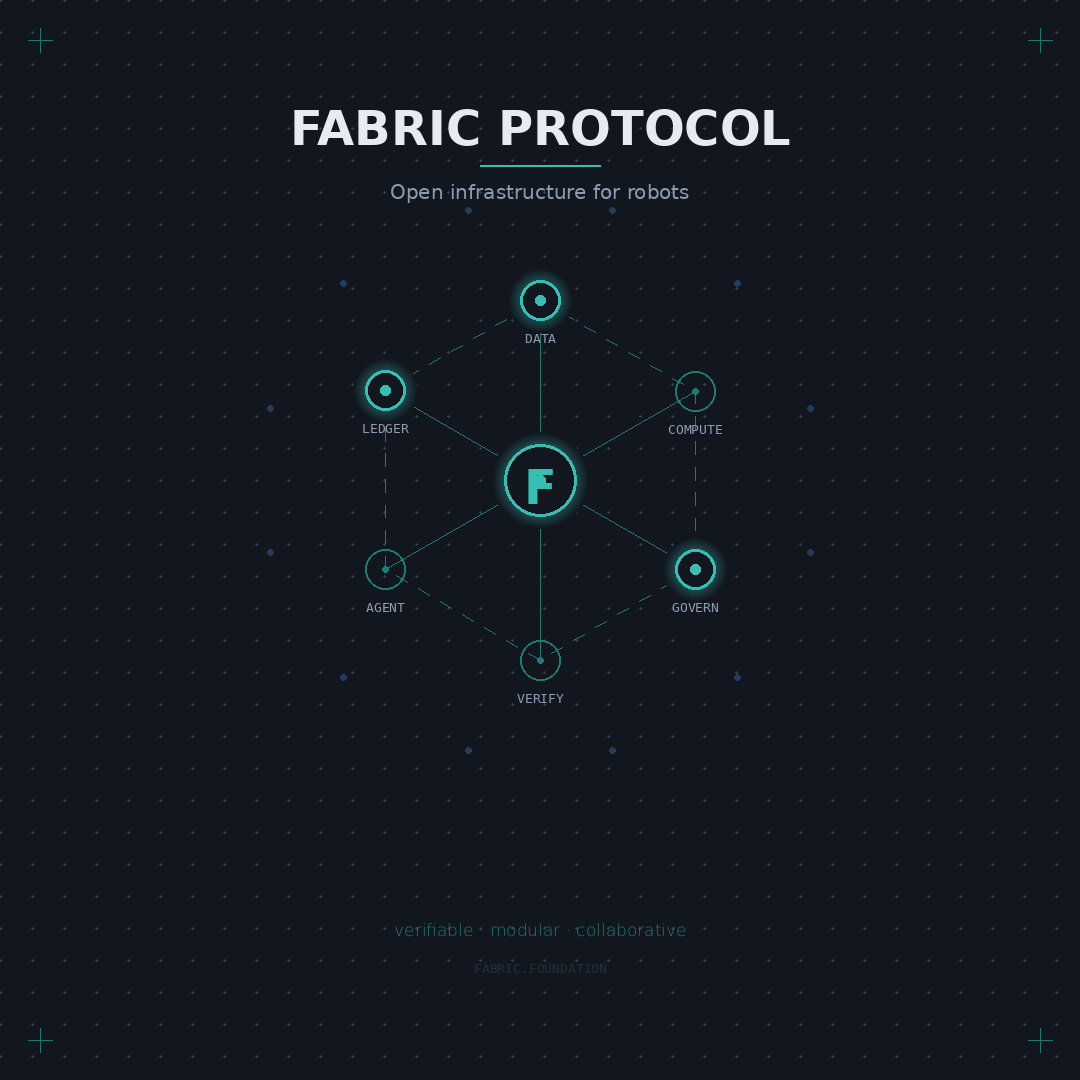
It's a global open network, backed by a non-profit called the Fabric Foundation. The basic idea is that general-purpose robots — the kind that don't just do one task on one factory floor — need a shared layer underneath them. Something that handles the messy parts. Data, computation, governance. The stuff nobody wants to think about until it breaks.
And you can usually tell when a project is trying to solve a real problem versus when it's just adding complexity for the sake of it. Fabric feels like the former, mostly because the problem it's pointing at is genuinely hard. When you have robots built by different teams, trained on different data, operating in different countries with different regulations — how do you get any of that to work together? Not in theory. In practice.
The answer they've landed on involves a public ledger. Which, okay, that phrase carries some baggage these days. But the point here isn't speculation or tokens. It's verifiability. If a robot makes a decision based on certain data and certain computations, there needs to be a way to check that. Not after something goes wrong. Continuously. That's where the ledger comes in — it creates a record that's transparent and auditable, so you're not just trusting that things are working correctly. You can actually verify it.
That matters more than it sounds like it does.
Think about it this way. Right now, if a company builds a robot and deploys it, the accountability chain is pretty short. One company, one system, their rules. But the moment you're talking about robots that pull from shared data pools, use distributed computing resources, and operate across jurisdictions — the question changes from "does this work" to "can we prove this works, and who's responsible when it doesn't."
@Fabric Foundation tries to make that second question answerable.
The infrastructure is modular, which is one of those words that gets thrown around a lot but here it actually matters. Different pieces can be swapped, updated, or governed independently. So if regulations change in one region, you don't have to rebuild the whole stack. You adjust the relevant module. If a better computation method comes along, it slots in without breaking everything else. It's designed to evolve, which — if you've spent any time around rigid systems — you know is harder to build than it sounds.
There's also this collaborative element that's worth noticing. The protocol isn't meant to be owned or controlled by one entity. The Fabric Foundation exists specifically to prevent that. The idea is that the people building robots, the people regulating them, and the people affected by them all have some say in how the underlying infrastructure develops. Whether that actually plays out that way is an open question. Governance is always messier in reality than on paper. But the intent is there, and the structure at least makes it possible.
What's interesting to me — and this is more of an observation than a conclusion — is that Fabric seems less focused on making robots smarter and more focused on making it safe for smart robots to exist alongside people. Those are really different problems. The first one gets all the attention. The second one is the one that actually determines whether any of this works at scale.
It becomes obvious after a while that the hardest part of robotics isn't the robotics. It's the coordination. Getting systems to talk to each other honestly. Making sure the data feeding a decision is clean and traceable. Ensuring that when something goes wrong, you can actually trace back through the chain and understand why. None of that is glamorous. But it's the foundation — literally, in this case — that everything else depends on.
So Fabric is building that layer. Quietly, from what I can tell. Not promising revolution. Just trying to make the plumbing work so that when general-purpose robots do become common, there's something underneath holding it all together.
Whether it succeeds is a different conversation. But the thing they're pointing at — the need for shared, verifiable, governable infrastructure — that part feels right. Like something that was always going to need solving, and somebody finally started working on it.
The thought doesn't really end there, though. It just keeps going.
#ROBO $ROBO