
There's something a little off about the way most blockchains work, and you can usually tell once you've spent enough time looking at them. Everything is open. Every transaction, every interaction, every piece of data — just sitting there, readable by anyone. People celebrate that as transparency, and sure, it is. But it's also exposure. And at some point, those two things stop being the same.
That's where Midnight starts to make sense.
@MidnightNetwork is a blockchain built around privacy, but not in the way that word usually gets thrown around. It's not about hiding things. It's about choosing what you reveal and what you don't. Which sounds obvious when you say it out loud, but in the blockchain world, that kind of control has been surprisingly hard to find.
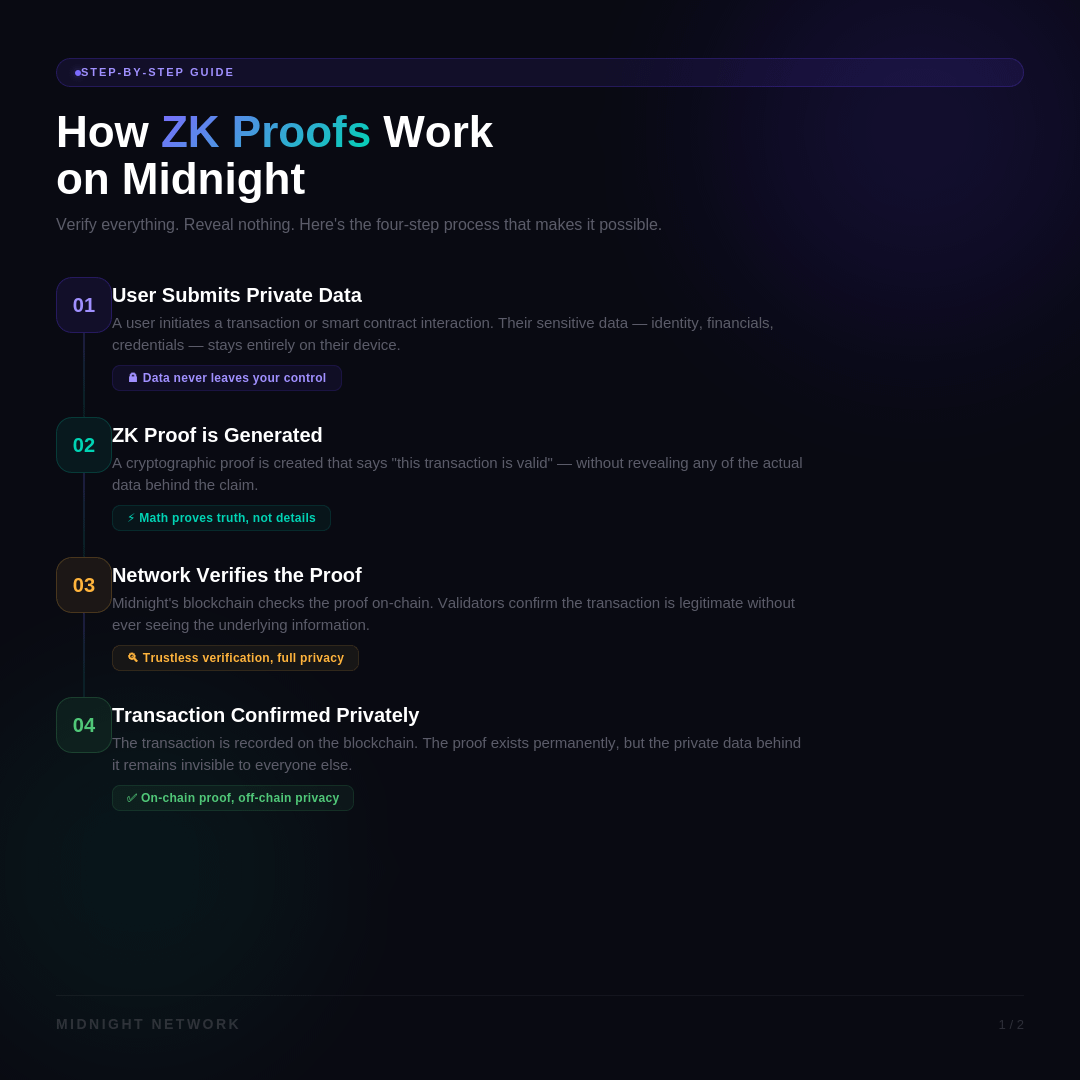
The core of how it works comes down to zero-knowledge proofs. That's a cryptographic technique where one party can prove something is true — like that a transaction is valid — without actually showing the underlying details. So the network can verify that everything checks out, without anyone needing to see the raw data behind it.
It's a strange concept the first time you run into it. You're basically saying, "trust the math, not the data." And that flips a lot of assumptions people carry around about how blockchains should function.
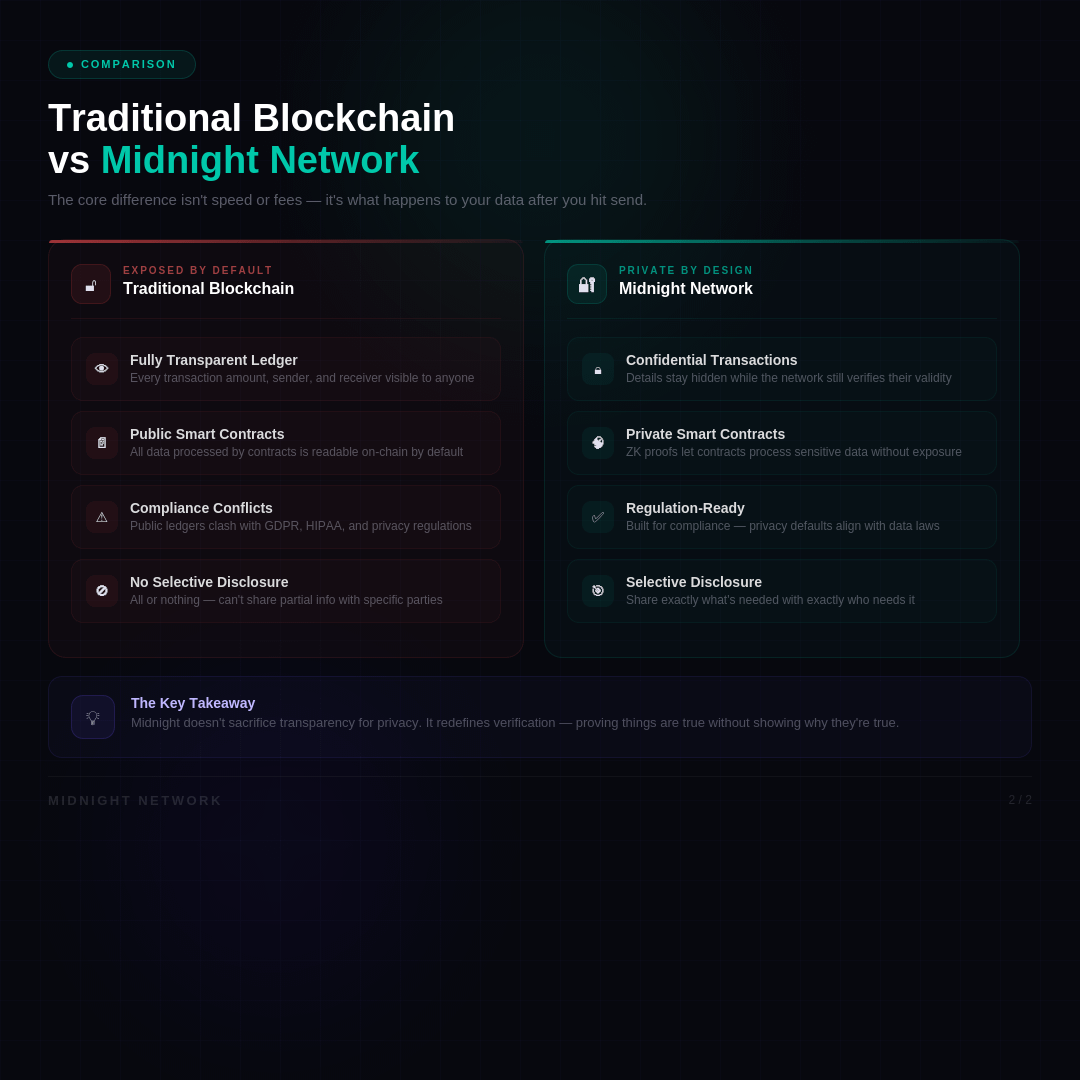
What gets interesting is what this opens up. Smart contracts on Midnight can process private information without that information ever being exposed on-chain. Think about that for a second. You could build applications that handle sensitive data — identity, medical, financial, whatever — and none of it has to be publicly visible to be trustworthy. The verification still happens. The proof still exists. But the details stay where they should.
That's where things get interesting, actually. Because most blockchain projects have treated privacy as a feature you bolt on later, maybe through a mixer or a secondary layer. Midnight treats it as the foundation. Everything else is built on top of that assumption, not squeezed in after the fact.
And this matters more than people think. Not just for individual users, although it obviously matters there. It matters for businesses, for institutions, for anyone who operates in a world where data regulation exists. You can't put sensitive customer information on a public ledger and then hand-wave about decentralization. That's not how the real world works. Compliance exists. Privacy laws exist. And until recently, most blockchain infrastructure just kind of ignored that.
Midnight doesn't ignore it. It sits in that gap between decentralization and practical privacy, and it tries to do both without compromising either one. Whether it fully succeeds is something that'll play out over time, but the intent is clear.
There's also a scalability angle here, though that's harder to evaluate in the abstract. Zero-knowledge proofs can be computationally heavy, and the challenge is always making them efficient enough to not slow everything down. Midnight is working on that balance — making the privacy layer functional without turning it into a bottleneck. It becomes obvious after a while that this is where most of the engineering effort goes. Not in the concept, but in the execution.
The question changes from "can we make private blockchains?" to "can we make them fast and usable enough that people actually build on them?" That's the harder question. And it's the one that Midnight is really trying to answer.
What I keep coming back to is how the framing shifts when privacy is baked in from the start. You stop thinking about what to hide and start thinking about what to selectively share. That's a different posture. A more human one, honestly. In the physical world, privacy is the default. You choose what to make public. Blockchain flipped that, and Midnight is trying to flip it back.
Whether this becomes the model that others follow, or whether it stays a niche approach — that's still unclear. The technology is sound, the reasoning is solid, but adoption depends on more than good architecture. It depends on developers choosing to build there, on users choosing to care about privacy beyond just saying they do, and on the ecosystem growing enough to sustain itself.
But at the very least, it raises the right questions. And sometimes that matters more than having all the answers right away.
The thought stays with you, though. The idea that you shouldn't have to give up your privacy just to participate in something decentralized. That maybe the next version of the web doesn't have to be as exposed as the current one.