
@MidnightNetwork I was up after 11 p.m. with a mug cooling by my keyboard and the hum of the air-conditioner filling the room when I opened a thread about Midnight Network. I care about this now because privacy in crypto keeps sounding necessary and slippery. Can a chain protect data without asking me to trust shadows?
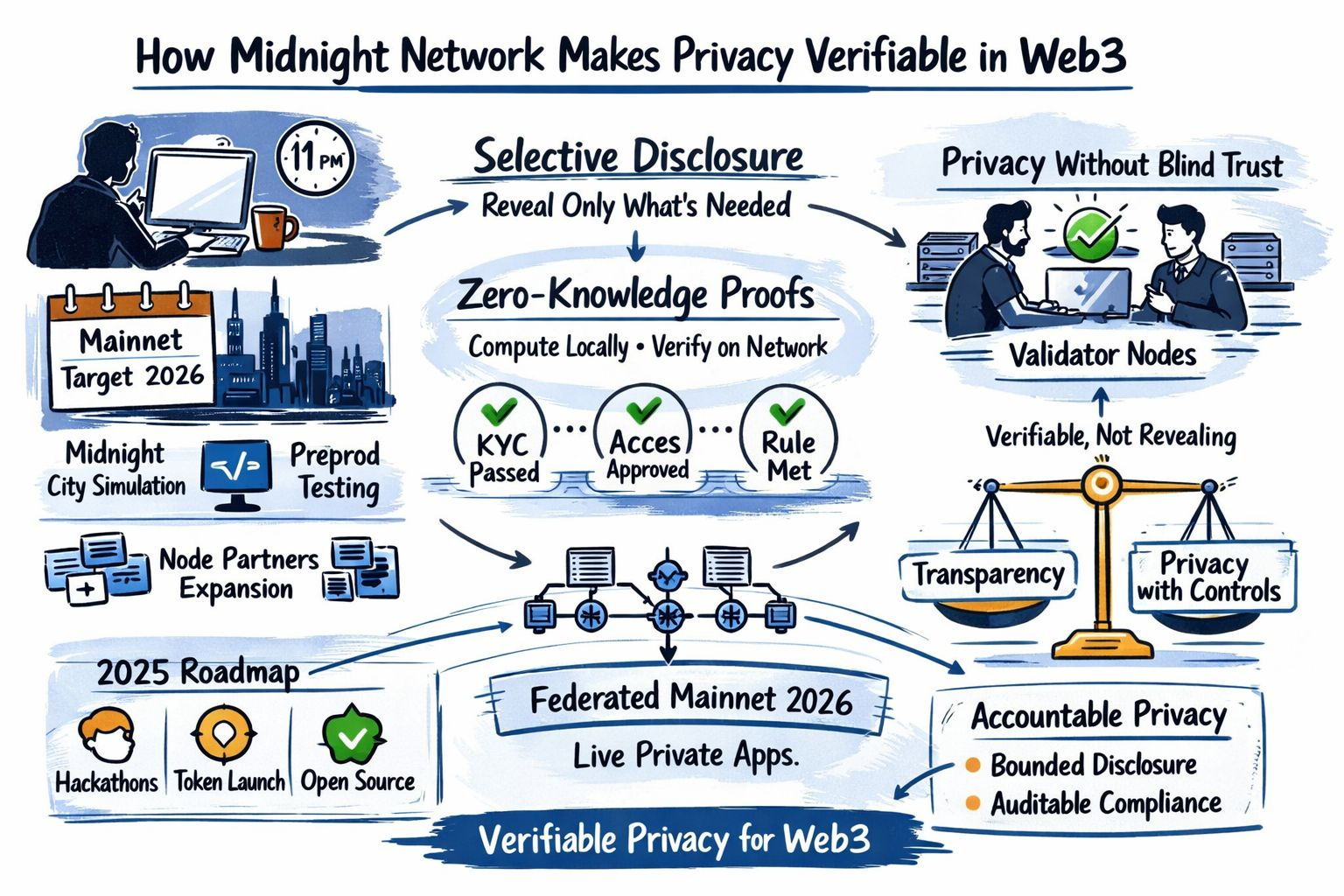
What catches my attention is that Midnight is trending for concrete reasons and not just a new slogan. In February the project said mainnet is set for late March 2026 and the weeks since have been filled with signs that it is moving from concept to a live network. The team has pushed developers toward preprod, shown a simulation called Midnight City, and expanded its network of federated node partners. That makes people look twice. I can feel that shift now.
I think this is getting attention now because Web3 is hitting a more mature phase. The old assumption was that full transparency was always a strength. But that often leaves balances, transaction records, business connections, and identity signals sitting in public view for no real reason. The closer I look at it the less reasonable that feels. Midnight lands because it starts from a simpler idea. Some facts should be provable without being fully visible. That sounds obvious outside crypto. Inside crypto it still feels like unfinished work.
When I read the technical material the core mechanism feels surprisingly clear. Midnight says private computation happens locally on the user side and the network receives a zero-knowledge proof instead of the raw private inputs. Validators check that proof and accept or reject the transaction without learning the underlying data. That is the part I find important. Privacy here is not based on blind faith or private agreements between insiders. It is meant to be verifiable by the network itself.
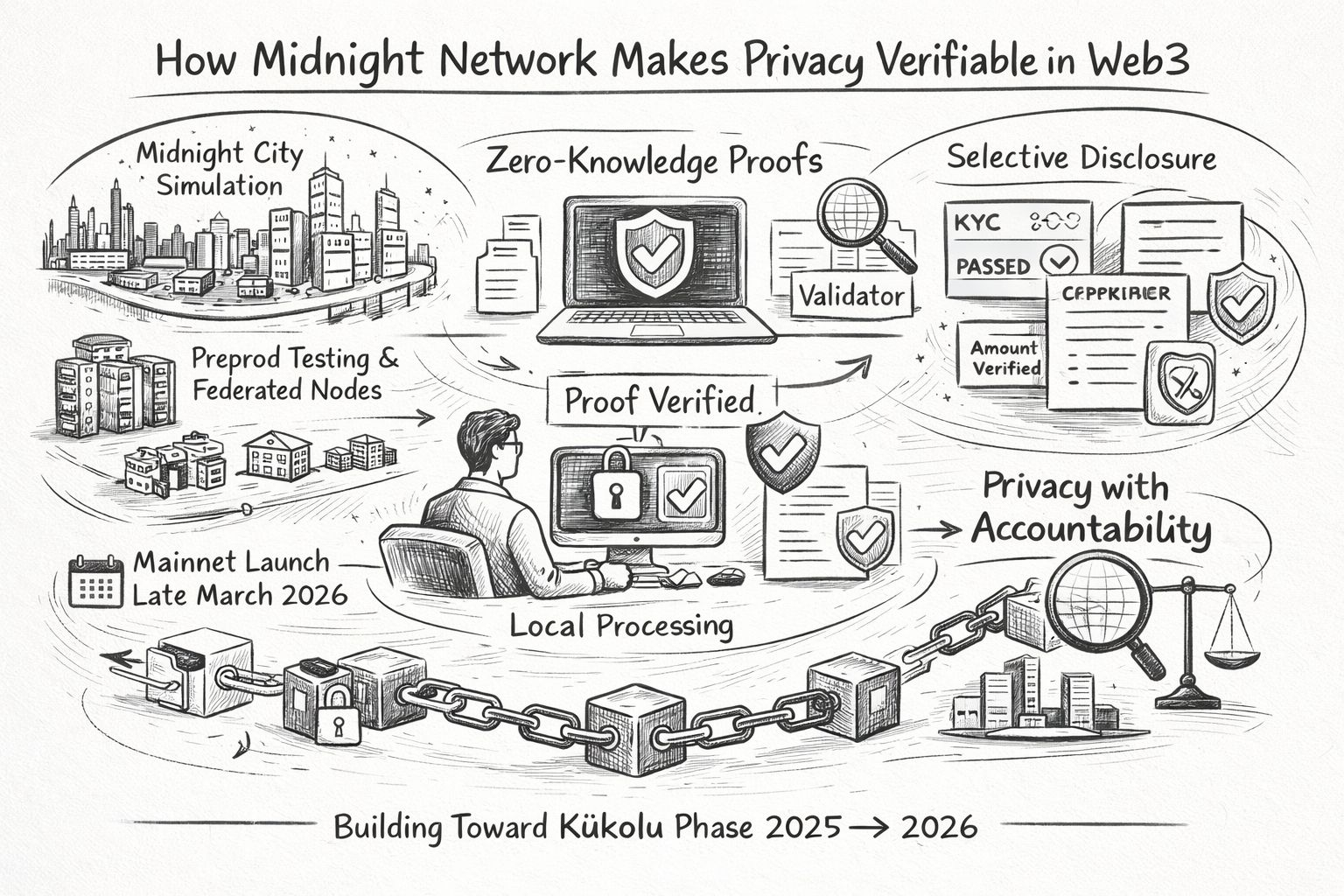
I also find Midnight’s language around selective disclosure more useful than the usual privacy talk. The point is not to hide everything. The point is to reveal only what a situation actually requires. I might need to prove that I passed a KYC check, that I am allowed to access a service, or that a payment met a rule without handing over my identity file or transaction history. Midnight’s tooling follows that idea. Its Compact language is built for zero-knowledge smart contracts and its architecture includes local off-chain components that work with the proof system instead of pushing sensitive data across the network.
That design choice matters because privacy in Web3 usually breaks down when institutions enter the picture. Compliance teams need evidence. Users need dignity. Builders need something they can explain without pretending the hard parts do not exist. Midnight is trying to sit in that uncomfortable middle. I do not read that as a perfect answer. I read it as a serious attempt to make privacy operational where a transaction can stay confidential while its correctness remains open to verification.
The recent progress gives that argument more weight. Midnight’s own updates frame 2025 as a period of hackathons, token distribution, open source work, and movement toward the Kūkolu phase where a federated mainnet is meant to support live privacy-focused applications. More recently the project has pointed to preprod tooling, documentation updates, and a broader operator network. I do not take that as proof by itself. I do take it as a sign that privacy infrastructure is being discussed as real infrastructure and not as a side feature.
What keeps me interested is that Midnight does not claim privacy should erase accountability. It claims privacy can be programmed with boundaries. That is a narrower promise and to me it is more believable. The network still has to prove that this model works under real demand with real applications and public scrutiny. Even so as Web3 moves toward Midnight’s planned late March 2026 mainnet I can see why the idea of verifiable privacy has moved from theory into the center of the conversation.