
Smart contracts today operate like open books. Every transaction, condition, and interaction is visible on-chain. While this transparency strengthens verification, it creates a structural limitation: real-world applications often require controlled privacy. Midnight positions itself as an answer to this contradiction not by removing transparency, but by redefining what needs to be visible and to whom.
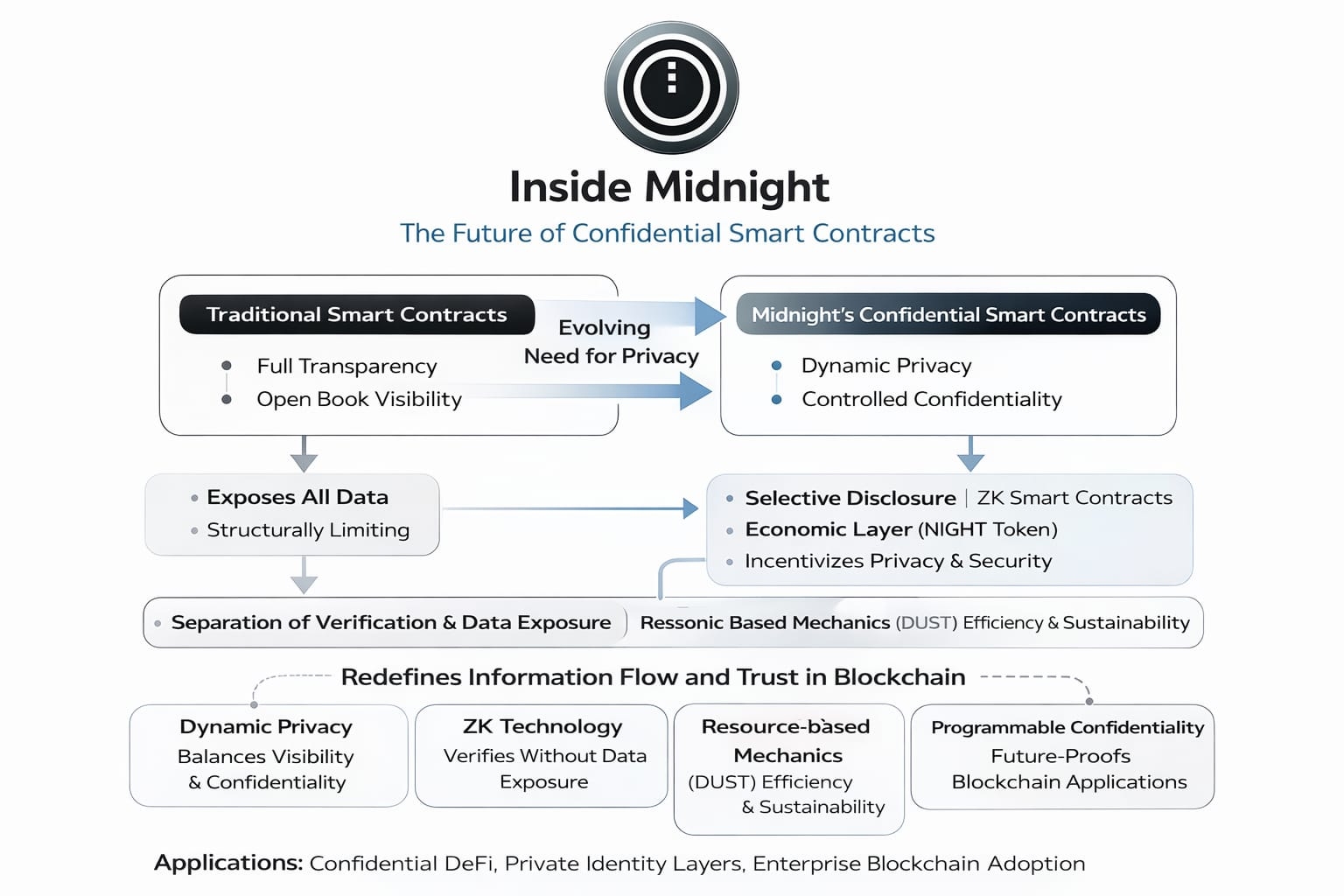
At its core, Midnight introduces a selective disclosure model using zero-knowledge (ZK) smart contracts. Instead of broadcasting all data, computations can be verified without exposing inputs. Think of it less like encrypting everything, and more like proving outcomes without revealing the process. This shift transforms how trust is constructed in blockchain systems.
From a systems perspective, Midnight separates verification from data exposure. Traditional chains bundle both together, which works for simple financial transfers but breaks down for use cases like identity, healthcare, or enterprise workflows. Midnight’s architecture allows developers to design contracts where compliance and privacy coexist something increasingly relevant as regulatory pressure rises globally.
The economic layer reinforces this design. The NIGHT token is not just a transactional asset; it aligns incentives between privacy-preserving computation and network security. By introducing resource-based mechanics (like DUST), Midnight effectively prices computational privacy. This is important because privacy is not free it consumes bandwidth, compute, and verification resources. Pricing it correctly prevents spam and ensures sustainability.
From a market lens, Midnight fits into a broader shift toward programmable confidentiality. Similar to how modular blockchains separated execution and data availability, Midnight separates visibility and validation. This positions it alongside emerging narratives like confidential DeFi, private identity layers, and enterprise blockchain adoption.
However, risks remain. ZK systems are computationally heavy, which can limit scalability if not optimized. Developer adoption is another hurdle writing privacy-aware smart contracts requires a different mindset compared to traditional Solidity development. There’s also the question of liquidity: private ecosystems often struggle to integrate with open DeFi markets without compromising their core principles.
Conceptually, if you imagine a spectrum where Ethereum represents full transparency and privacy coins represent full opacity, Midnight sits in the middle dynamic privacy. That middle ground is where most real-world applications likely exist.
Takeaway:
Midnight isn’t just improving smart contracts it’s redefining how information flows through them. For traders and investors, the key insight is this: the next wave of blockchain adoption may not come from more transparency, but from better-controlled privacy. Understanding that shift helps you evaluate which projects are building for real-world integration and which are still optimizing for a purely open, but limited, paradigm.
@MidnightNetwork #night $NIGHT
