
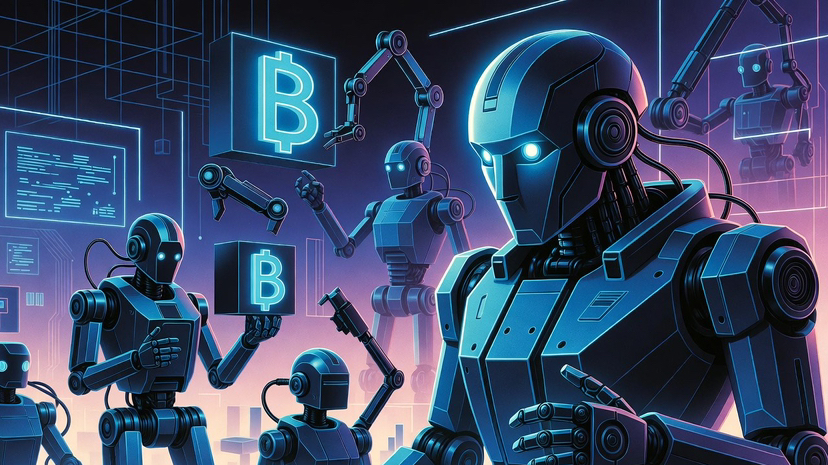
Picture this: It's 2026, and your local hospital, warehouse, or even neighborhood cleanup crew isn't short-staffed anymore. Instead, fleets of general-purpose robots handle repetitive, dangerous, or precision tasks around the clock — but here's the twist: these machines aren't owned or controlled by a single mega-corporation. They operate as independent economic agents in a decentralized, open network.
That's the ambitious vision @Fabric Foundation is turning into reality through the Fabric Protocol.
As a non-profit foundation, Fabric Foundation isn't just building another blockchain project — it's laying the rails for what they call the "Robot Economy." Robots get on-chain identities, verifiable wallets, skill registries, and the ability to earn, spend, and coordinate autonomously. No more siloed fleets locked behind closed APIs. Instead, anyone — developers, operators, or everyday contributors — can supply robotic labor, coordinate tasks, validate completions, and get rewarded transparently on-chain.
At the heart of this ecosystem beats $ROBO , the native utility and governance token.
ROBO isn’t hype fuel; it's actual infrastructure money:
- Every robotic task payment flows through $ROBO
- Staking secures coordination nodes and network consensus
- Fees for identity verification, skill sharing, and proof-of-work burn or redistribute value
- Governance lets the community steer protocol upgrades as robotics tech evolves
With a fixed 10 billion supply and real demand drivers (not just speculation), ROBO captures value from the exploding intersection of AI, robotics, and Web3. Early 2026 has already seen massive momentum: high-profile funding, public sales, airdrops rewarding community builders, and listings that put it on radars worldwide.
Why does this matter now?
Labor shortages are chronic in healthcare, logistics, manufacturing, and elder care. Meanwhile, AI models are getting scarily good at physical reasoning, and robot hardware is dropping in price fast. The missing piece? Economic plumbing that lets machines participate fairly without central gatekeepers.
@FabricFND is solving exactly that — creating an open marketplace where robotic productivity benefits everyone, not just Big Tech shareholders.
If you're bullish on DePIN, autonomous agents, or the next wave after AI crypto narratives, ROBO feels like positioned right at the convergence point. Robots aren't coming for our jobs — they're coming to build a new economy, and this time, we can all own a piece of it.
Are you ready to join the machine uprising (the good kind)? 🚀🤖
What are your thoughts on robots earning crypto — game-changer or sci-fi pipe dream?