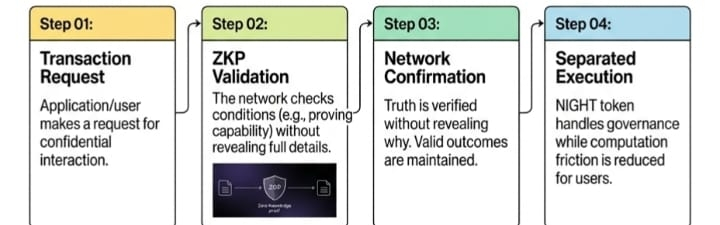
There’s a quiet shift happening in crypto that doesn’t get as much attention as price charts or memecoins but it keeps coming back in conversations if you stick around long enough. It’s this tension between transparency and privacy. Blockchains were built to be open almost radically so yet most people don’t actually want their entire financial life sitting out in the open forever. I noticed that the more the space matures the less this feels like a niche concern and more like something fundamental that hasn’t been fully solved yet.
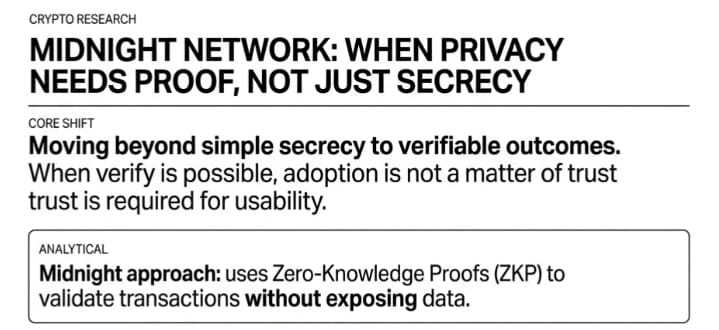
For a long time privacy in crypto has mostly meant hiding. Different tools different chains different techniques all trying to obscure transactions or identities. And while that works to some extent it always feels like a tradeoff. The more hidden something is the harder it becomes to trust it. That tension never really disappears it just shifts depending on who’s looking.
What stood out to me about Midnight Network is that it’s trying to approach the problem from a slightly different angle. Instead of just focusing on secrecy it leans into the idea that privacy should still be provable. That’s a subtle but important distinction. It’s not about disappearing completely it’s about revealing only what needs to be revealed and nothing more.
From what I’ve seen this idea of selective disclosure keeps popping up across different projects but it rarely feels cohesive. Midnight seems to frame it more clearly like privacy and compliance don’t have to sit on opposite ends of the spectrum. You can have systems where information stays hidden by default but proofs can be generated when necessary to show that rules are being followed.
That matters more than people might think. Right now a lot of institutions are hesitant around fully private systems because they can’t verify what’s happening inside them. Total opacity creates friction. But on the other side full transparency pushes individuals away because it removes any sense of personal control. There’s a gap there and it feels like Midnight is trying to sit right in the middle of it.
I keep thinking about how this could play out in real world use. Imagine interacting with a financial app where your data isn’t exposed to everyone but you can still prove things like compliance identity or eligibility without handing over raw information. That’s a very different experience compared to what most blockchains offer today where everything is either fully public or awkwardly hidden behind layers of complexity.
There’s also something interesting about how this approach changes the narrative around privacy. It stops being something that sounds defensive or suspicious and starts to feel more like a standard feature. Like encryption on the internet something that’s just expected rather than questioned. That shift in perception might end up being just as important as the technology itself.
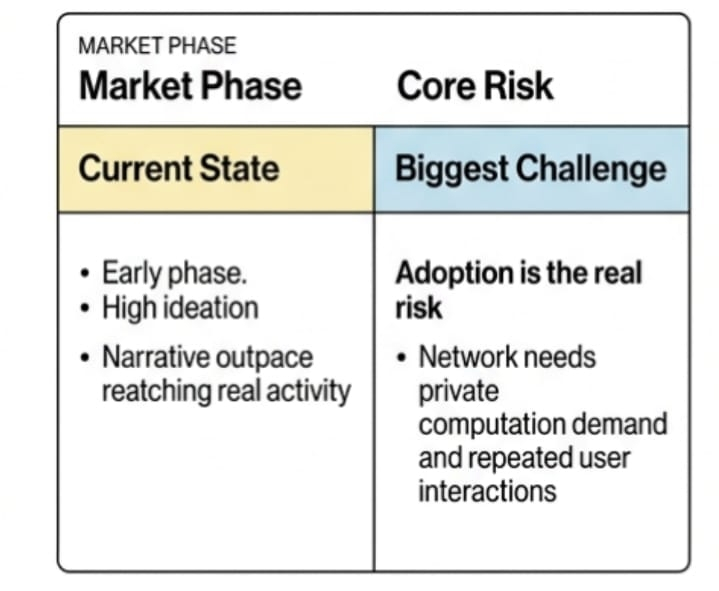
Of course none of this is happening in isolation. The broader ecosystem is already moving toward zero knowledge proofs modular designs and more nuanced data handling. Midnight feels like part of that wave but with a clearer focus on making privacy usable rather than just technically impressive. That distinction is easy to miss but it shows up quickly when you try to imagine actual users interacting with these systems.
I’ve also noticed that conversations around regulation tend to get stuck in extremes. Either crypto needs to be fully transparent to be acceptable or it needs to stay completely private to remain true to its roots. In reality neither extreme feels sustainable. Systems that can prove compliance without exposing everything might end up being the only practical path forward.
There’s a subtle psychological layer to this as well. When people feel like they have control over what they reveal they’re more willing to participate. That’s true outside of crypto too. Midnight’s approach seems to acknowledge that trust isn’t just about visibility it’s about agency. Who decides what gets shared and when.
At the same time there’s still a lot of uncertainty. Building something that balances privacy and verifiability is not trivial. It introduces complexity and complexity has a way of creating new risks if it’s not handled carefully. So while the idea is compelling the execution will matter more than anything else.
Another thing that stood out to me is how this could influence developer behavior. If tools for selective disclosure become easier to use developers might start designing applications differently from the ground up. Instead of assuming everything is public and working around that they might start with privacy as the default and layer in proofs where needed.
That shift could quietly change what crypto apps look like in a few years. Less emphasis on pseudonymous transparency more emphasis on controlled data flow. It’s a different design philosophy and it feels closer to how people actually expect digital systems to behave.
Still it’s early. A lot of these ideas sound clean in theory but get messy in practice. Adoption tooling user experience all of that will shape whether something like Midnight becomes foundational or just another experiment that didn’t quite stick.
Sitting with it the bigger takeaway for me isn’t about one network or one solution. It’s the direction this points toward. Privacy in crypto is evolving from something binary into something more flexible more contextual. Not just hidden or visible but adjustable.
And maybe that’s where things start to click. Not when everything is perfectly private or perfectly transparent but when people can move between those states without friction. It feels like Midnight is trying to explore that space and even if it’s not the final answer it’s asking a question that’s been hanging around for a while.
What does privacy look like when it doesn’t have to fight against trust but actually works with it.