
Sovereign infrastructure only matters if it can coordinate trust without depending on a single authority. That is the core problem both documents address. One side describes a world where nations need durable infrastructure for money, identity, and capital. The other side shows why that infrastructure must be built on verifiable attestations rather than assumptions, manual checks, or centralized approval.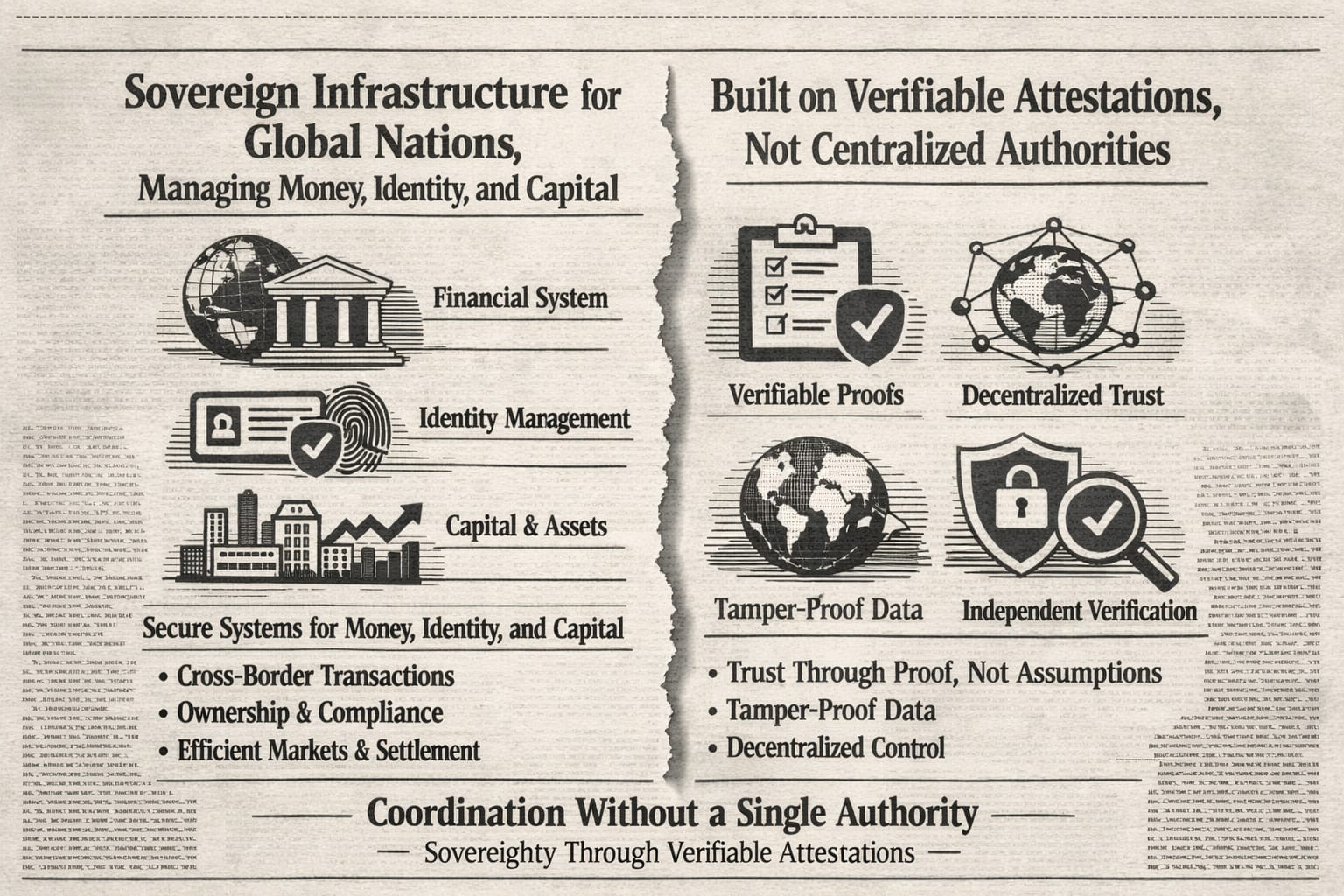
The value of attestations is that they turn claims into something that can be checked. A statement about identity, ownership, access, or transaction history becomes more useful once it can be verified independently. In a sovereign system, that matters because global coordination breaks when every participant has to trust a separate intermediary. Attestations reduce that friction by creating a shared proof layer.
This becomes especially important when money and identity overlap. A financial system is not only a payment rail; it is also a rule system. It decides who can move value, under what conditions, and with what level of certainty. If identity is weak, money becomes easier to misuse. If capital ownership is unclear, markets become slower and less reliable. Verifiable attestations solve this by linking claims to proof without exposing more data than necessary.
The same logic applies to capital. Ownership, compliance, eligibility, and settlement can all be structured around attestable information. That creates a system where capital can move more cleanly across borders and between participants, while still preserving control and verification. The result is not less structure, but better structure.
What makes sovereign infrastructure different is that it does not ask participants to surrender control in exchange for trust. It creates trust through design. That is a stronger model because it scales across jurisdictions, organizations, and economic systems. Instead of relying on one institution to maintain certainty, the system itself carries the proof.
The deeper implication is that infrastructure is no longer just technical plumbing. It becomes the layer where identity, money, and capital are made interoperable through proof. That is what turns a fragmented environment into a coordinated one. In this model, sovereignty is not isolation. It is the ability to participate in global systems without giving up verifiable control.
@SignOfficial #SignDigitalSovereignInfra #Sign $SIGN
