
@MidnightNetwork I was staring at a browser tab at 6:40 a.m., coffee cooling beside my keyboard, when I realized why Midnight keeps pulling my attention back. Mainnet is close, the conversation around privacy has sharpened, and I can’t stop wondering whether one chain is enough.
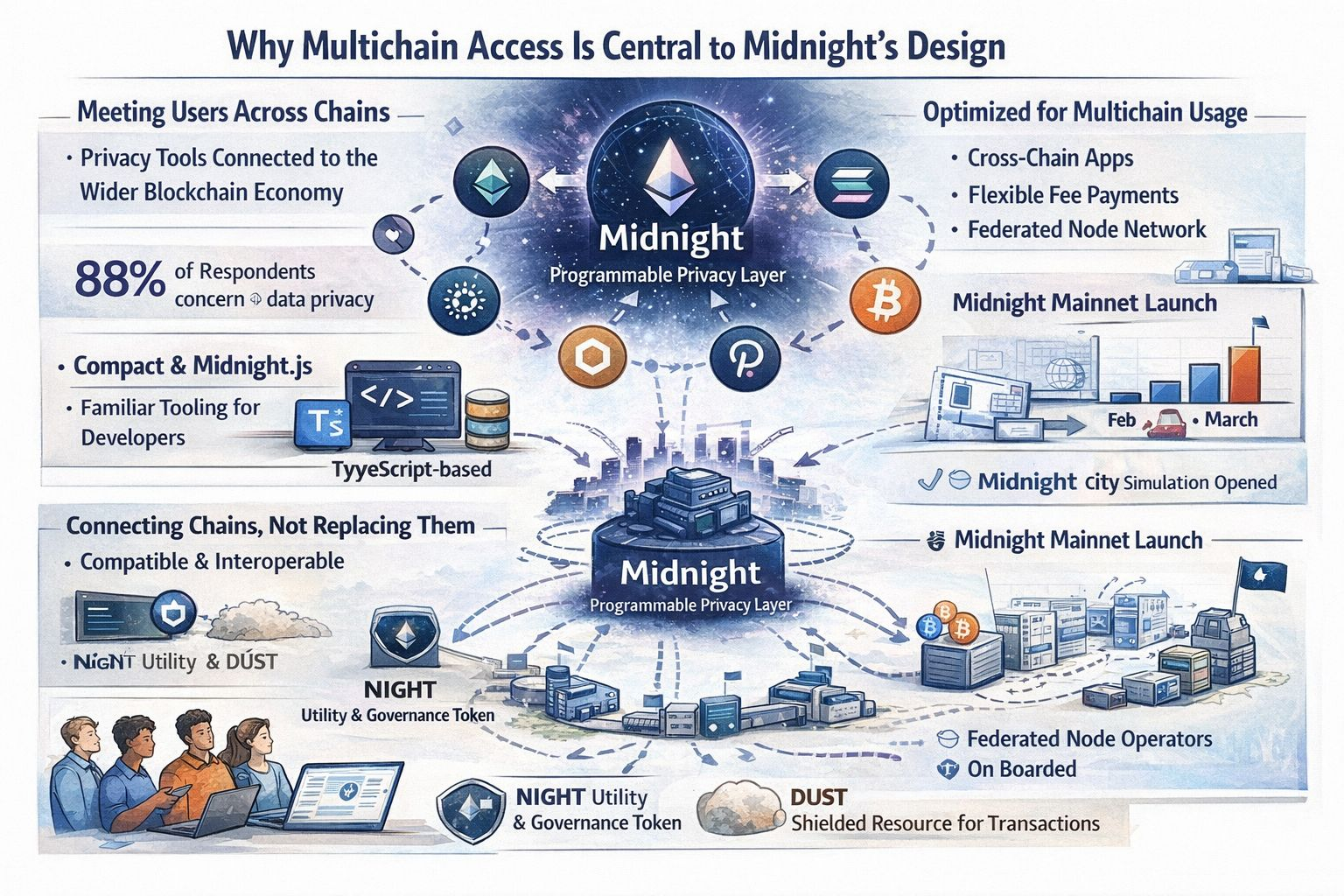
What makes Midnight interesting to me is not simply that it wants to add privacy to blockchain. A lot of projects say that. What stands out is the decision to treat multichain access as part of the core design rather than as an accessory added later. When I read material, I keep coming back to the same point: Midnight does not assume that users, capital, developers, or institutions will abandon the chains they already use. It assumes the opposite. People live across ecosystems, and privacy tools that demand a full migration usually ask too much.
That feels relevant right now because Midnight is no longer talking in abstract future tense. In February, the project said mainnet is scheduled for late March 2026, opened access to its Midnight City simulation, and kept adding federated node operators ahead of launch. I read that as progress, but also as a clue about audience. Midnight is building for a world where firms, developers, and users need to meet in the same room, even if they arrive from different networks.
That is where multichain access stops looking like a feature list item and starts looking structural. Midnight’s own descriptions are direct about it. The team says the network is designed as a programmable privacy layer, not a closed privacy island. It wants developers to build core applications on other networks and use Midnight where privacy, selective disclosure, or shielded execution are needed. Its tooling is framed the same way. Compact is built with TypeScript patterns, and Midnight.js is a TypeScript-based framework, which tells me the project is trying to reduce the friction that usually comes with zero-knowledge systems. If the practical goal is to connect chains rather than replace them, familiar tooling matters.
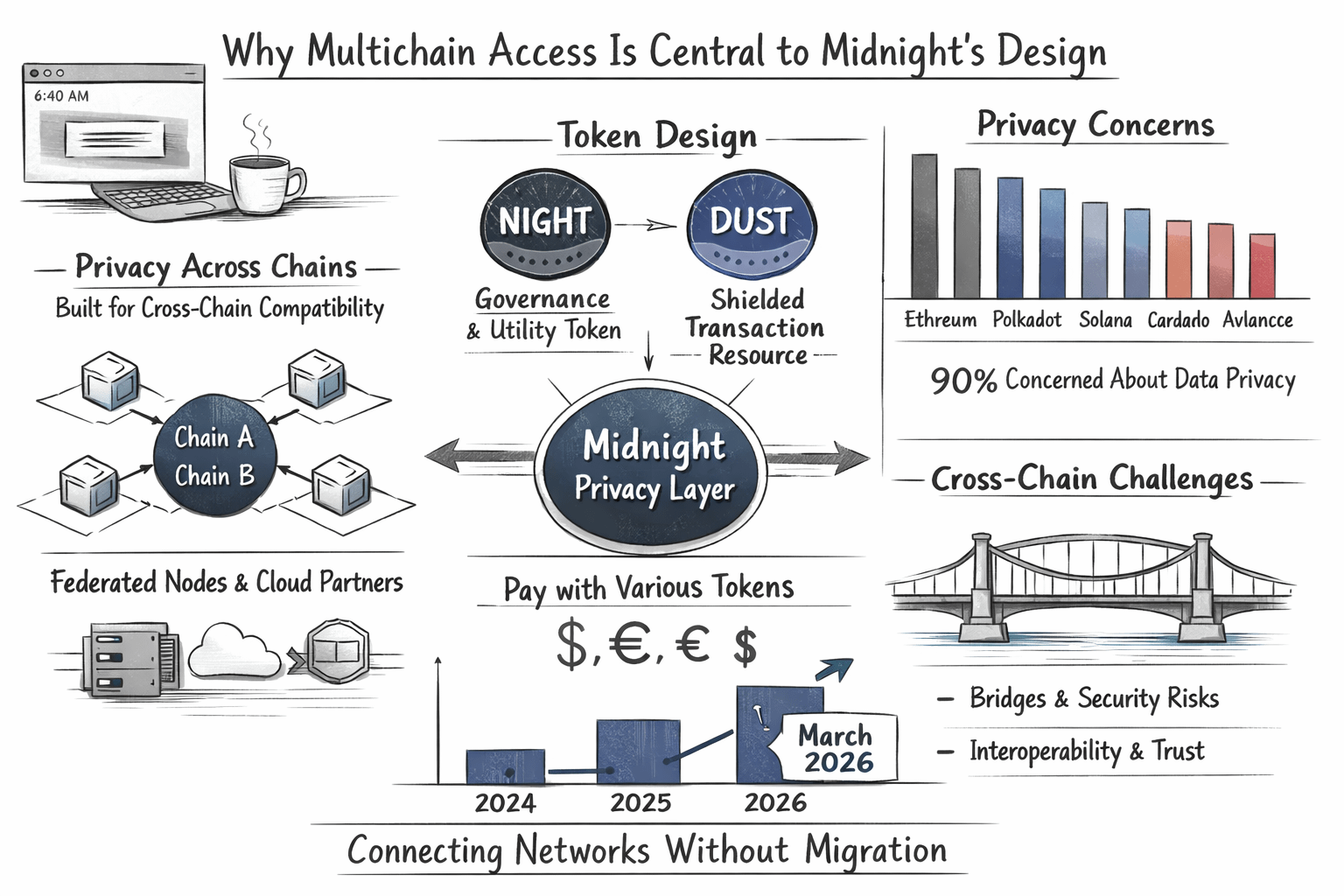
I also think the token design makes more sense when I view it through that multichain lens. Midnight separates NIGHT, the utility and governance token, from DUST, the shielded resource used for transaction capacity. On paper, that looks like a technical choice about fees. In practice, it supports a broader ambition. Midnight says its cooperative tokenomics are meant to enable multichain architecture, and later materials go further, saying users should be able to pay through other tokens or fiat while application operators can sponsor fees. I find that detail important. If a privacy network wants adoption beyond its home community, it cannot insist that every participant learn a new economic ritual before doing anything useful.
There is a social reason this matters too. Midnight’s recent survey work argues that privacy concerns are broadly shared across eight ecosystems, with no meaningful difference in concern from one community to another. Nearly 90 percent of respondents said they were concerned about the privacy of their data and that rings true to me. People may disagree about execution environments, governance models, or market culture, but they rarely disagree about not wanting every wallet movement, credential, or commercial action exposed by default. Multichain access fits that reality because privacy is one of the few demands that travels well.
I’m careful not to romanticize this. Cross-chain design carries baggage. Bridges have been exploited, coordination is hard, and every extra layer can widen the trust surface. Even Midnight’s early mainnet approach, with federated node operators and major cloud partners, has triggered debate about how decentralization should be sequenced. I think that criticism is healthy but I would rather see the tension discussed openly than ignored. Midnight seems to be betting that usable privacy will arrive through staged interoperability and institutional-grade operations, not through purity.
That is why multichain access feels central to Midnight’s design, not decorative. Without it, Midnight would be another chain asking the market for loyalty before offering utility. With it, the project has a clearer answer to a harder question: how do you add privacy to the networks people already use, in forms they can actually adopt? Right now, as launch approaches and the industry keeps circling back to privacy, compliance, and fragmented liquidity, that answer sounds timely to me precisely because it is so unromantic. It starts with the admission that the future was never going to fit on one chain.