
Trust has always been an invisible layer in digital systems. From login credentials to financial transactions, users rely on intermediaries to validate actions. But this model is breaking down under scale and complexity.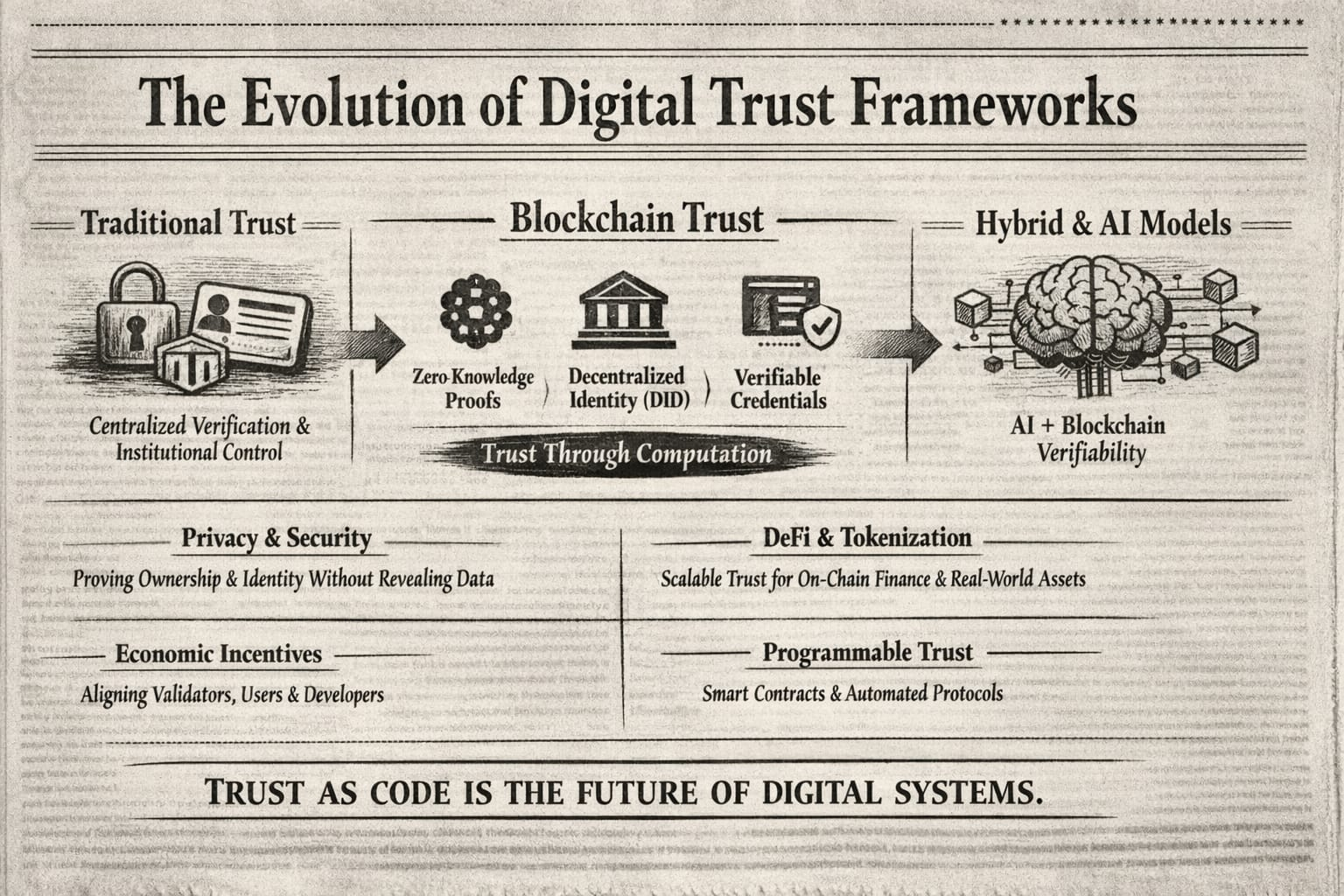
Traditional trust frameworks are permission-based. They require identity verification, institutional backing, and centralized databases. While effective in controlled environments, they fail in global, permissionless ecosystems like crypto.
Blockchain introduces a new paradigm: trust as a function of computation. Instead of asking “who do you trust?”, the system asks “can this be verified mathematically?”
Zero-knowledge proofs, decentralized identity (DID), and verifiable credentials are at the forefront of this shift. These technologies allow users to prove attributes ownership, identity, eligibility without revealing underlying data. This reduces both privacy risks and reliance on intermediaries.
From a market standpoint, this evolution is critical. As DeFi, on-chain derivatives, and tokenized real-world assets grow, the need for robust trust frameworks increases. Without reliable verification, these systems cannot scale beyond speculative use cases.
However, trust frameworks are not purely technical they are economic. Incentives must align for validators, users, and developers. Poorly designed systems can lead to manipulation, false verification, or governance attacks.
One emerging trend is the integration of AI with blockchain-based trust systems. AI can generate insights and decisions, but blockchain provides verifiable audit trails. Together, they form a hybrid model: intelligence + verifiability.
The risk lies in overengineering. Not all systems require full decentralization or cryptographic complexity. In some cases, hybrid models combining centralized efficiency with decentralized verification offer better outcomes.
The broader implication is that trust is becoming programmable infrastructure. It can be embedded into protocols, automated through smart contracts, and scaled globally without intermediaries.
The key insight for builders and investors is this: the future of digital systems will not be defined by who controls them, but by how trust is encoded within them. Understanding these frameworks is essential to navigating the next phase of crypto adoption.
@SignOfficial #Sign #signDigitalSovereignlnfra $SIGN
