Midnight didn’t grab me right away.
At first, it felt easy to dismiss. Another privacy chain. Another project talking about confidentiality, selective disclosure, and a better version of digital privacy. I’ve seen enough of those to know how that story usually goes. It sounds important, it sounds timely, and then somewhere along the way it starts feeling abstract.
But Midnight didn’t stay abstract for me.
The more I looked into it, the less it felt like a fresh narrative built for this cycle and the more it felt like something that had been quietly taking shape for years. That was the part I didn’t expect. It stopped feeling like a project trying to invent urgency, and started feeling like the result of a much longer process finally becoming visible.
That changes how you read it.
Because when I looked at Midnight from that angle, it stopped feeling like just another privacy play and started feeling more like an attempt to fix some of the parts of crypto that still don’t really work.
One of the first things that stood out to me was how practical the setup feels.
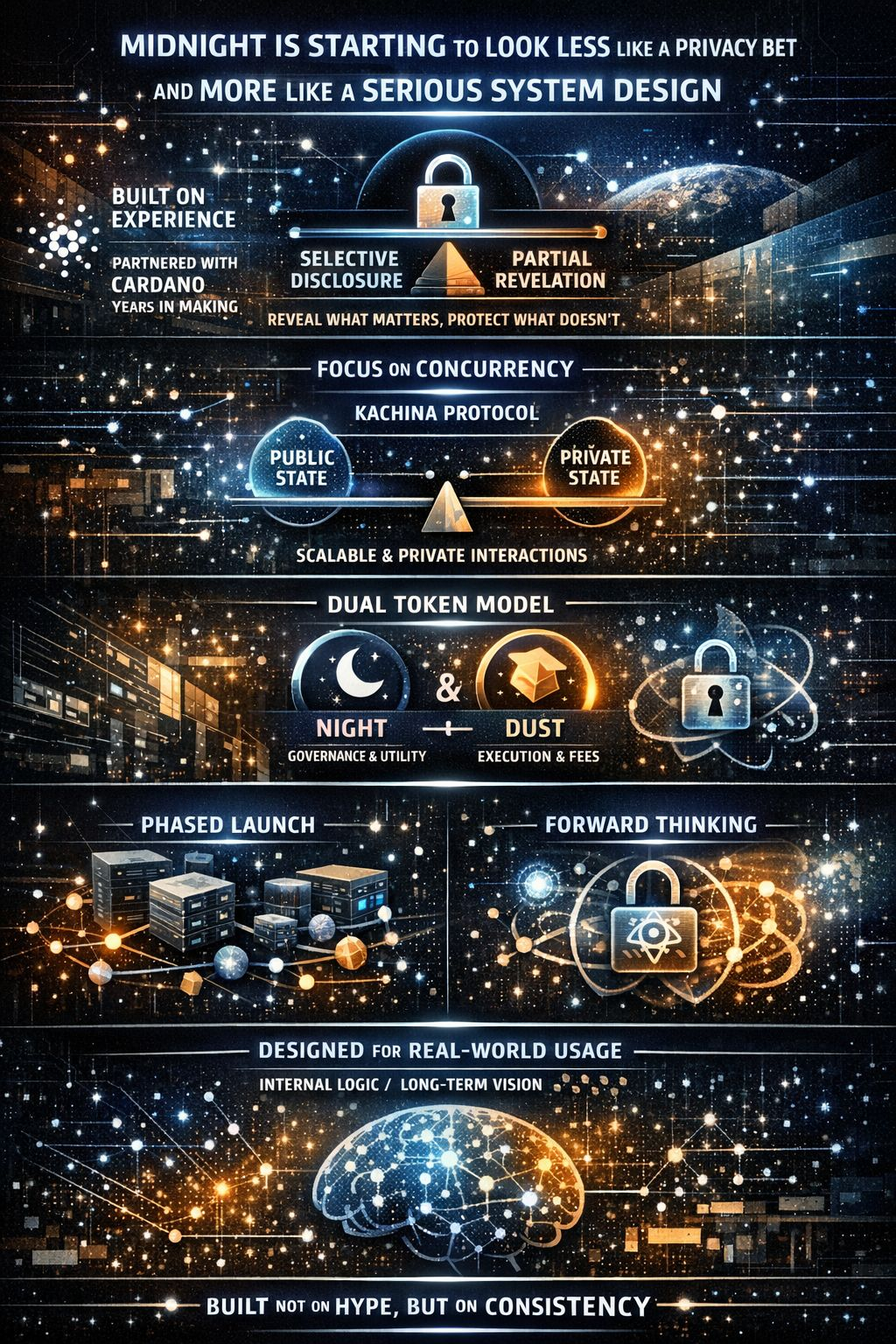
Midnight isn’t trying to appear out of nowhere and pretend it can solve every hard problem on day one. It’s closely tied to Cardano as a partner chain, and that matters more than people might think. A lot of new networks make the same mistake: they try to launch a token, bootstrap security, attract builders, build trust, and prove utility all at the same time.
That’s an enormous ask.
Most of them make it sound easy until reality reminds everyone it isn’t.
Midnight seems more aware of that.
Instead of trying to conjure a whole security model from thin air, it leans on existing infrastructure while building itself out in phases. That’s not flashy, but honestly, it made me take it more seriously. It feels like the kind of decision you make when you care more about whether a system can survive than whether it can generate hype.
That same feeling shows up in the way Midnight approaches privacy.
A lot of privacy projects tend to think in extremes. Either everything should be hidden, or the whole design starts sounding more like an ideal than something people would actually use. Midnight feels different.
Its direction seems much closer to this idea of revealing what matters and protecting what doesn’t.
Not total invisibility.
Not radical transparency.
Just enough disclosure to make systems function without giving away more than they need to.
That feels a lot closer to real life.
Because that’s already how most of the world works. We prove things all the time without revealing everything behind them. We verify identity without handing over our entire life story. We confirm payments without exposing every financial detail. We show eligibility, compliance, or ownership without opening every document underneath it.
Most real systems are built on partial disclosure, not complete exposure.
That’s why Midnight started feeling less like a privacy product and more like privacy infrastructure.
It isn’t asking people to believe in secrecy for its own sake. It’s trying to make disclosure more intentional. And honestly, that makes a lot more sense to me than the usual hide-everything pitch.
What really made me stop and pay attention, though, was the part people don’t talk about enough: concurrency.
It’s one of those technical words that can sound dry until you realize how important it is. It’s easy to imagine a private transaction in isolation. It’s much harder to design a system where lots of users are interacting with the same applications at the same time without privacy starting to fall apart.
That’s usually where elegant ideas run into ugly reality.
That’s why Midnight’s approach around Kachina stood out.
It doesn’t seem to pretend that privacy and shared interaction fit together neatly. It treats that tension like a real problem. Public state and private state aren’t handled the same way. Proofs are used to validate changes without exposing the private information underneath.
That may sound technical, but what it really told me was simple:
Midnight knows where the hard part is.
And that matters.
Too many projects sound brilliant until actual usage begins. Midnight feels like it was designed by people who understand that systems don’t break in theory. They break when real users show up at the same time and start doing real things.
Even the UTXO foundation feels more meaningful in that context. Usually people talk about UTXO like it’s just a design choice or an ideological preference, but here it feels tied to something bigger. Parallelism matters more when privacy is involved. So does the ability to manage state in a cleaner, more predictable way.
Midnight doesn’t feel like it picked these parts at random. It feels like the architecture is trying to support the privacy model instead of just decorate it.
That same coherence shows up in the economics too.
This is actually one of the more interesting parts of Midnight to me, because most chains still force one asset to do everything. It’s the thing people speculate on, the thing that secures the network, and the thing you burn just to use the chain.
That creates the same mess over and over again.
As the token moves, fees move.
As speculation rises, usability gets distorted.
The chain becomes harder to plan around precisely when activity matters most.
Midnight seems to be trying to step outside of that pattern.
Instead of letting one token carry every role, it splits the system between NIGHT and DUST. NIGHT handles utility and governance, while DUST acts as the resource used for execution. That may sound like a technical distinction, but it changes the feel of the model. It suggests the network is trying to separate long-term value from day-to-day usage.
That’s a smart instinct.
Whether it works under real conditions is another question. Crypto always looks cleaner on paper than it does in the wild. But the idea itself makes sense. It shows Midnight isn’t just asking how to create a token people can trade.
It’s asking how a network can remain usable when speculation inevitably enters the picture.
That is a much better question.
And the more I looked, the more I noticed that Midnight keeps returning to the same deeper instinct: separate what should be separate, expose only what needs to be exposed, and design around the way real systems actually behave.
That’s rare.
A lot of projects have strong ideas. Fewer have internal consistency. Midnight’s sidechain roots, its privacy model, its handling of concurrency, and its economic design don’t feel like disconnected bullet points.
They feel like pieces of the same worldview.
The recent rollout makes all of this more interesting because Midnight is no longer sitting safely in the world of ideas. NIGHT is already live in its current phase. Distribution has already happened across multiple ecosystems. The project has been moving toward mainnet through a federated launch model with named operators and infrastructure partners.
That means Midnight is getting closer to the part where design has to stop sounding convincing and start proving itself.
And I actually think the federated launch says a lot.
Some people won’t like it, and I get why. It’s not the purest version of decentralization. But crypto has a habit of pretending things are decentralized long before they actually are. Midnight’s staged approach may be less romantic, but it feels more honest.
It’s basically saying:
This is how we get the system live, stable, and operational first.
Then we widen participation over time.
That doesn’t make it perfect. It just makes it easier to judge without illusions.
If the network never moves beyond that stage, that will become a real weakness. But as a launch strategy, it feels more realistic than a lot of projects that sell purity while quietly depending on concentration anyway.
Another reason Midnight keeps staying with me is that it doesn’t feel like it’s being built only for privacy diehards.
It feels like it’s being built for the much bigger group of people and institutions that need privacy but can’t operate in total darkness. Finance works that way. Identity works that way. Business systems work that way.
You often need confidentiality, but you also need proof.
You need protection, but you also need accountability.
That balance is hard, and Midnight seems more interested in that balance than in ideology.
That’s probably why it feels more grown-up than a lot of privacy narratives.
It isn’t trying to turn privacy into a slogan. It’s trying to make it usable.
Even the post-quantum conversation around the project stood out to me for that reason. Not because it proves anything today, but because it shows the team seems willing to think beyond immediate narratives. Most projects barely think past the next cycle. Midnight at least appears to be asking what privacy infrastructure might need to look like over a much longer horizon.
That doesn’t guarantee anything, but it tells you something about the way the project is being imagined.
Stepping back, I think that’s the real reason Midnight feels different.
It has an unusual amount of internal logic.
The sidechain background makes sense.
The selective disclosure model makes sense.
The attention to concurrency makes sense.
The split between NIGHT and DUST makes sense.
Even the phased route toward mainnet makes sense.
Whether or not someone agrees with every decision, the system feels like it was thought through as a system.
And that’s what keeps pulling me back to it.
Not because it’s loud. Not because it’s trying to overwhelm people with buzzwords. But because it feels like something that has been building for a long time, piece by piece, and is only now reaching the point where the outside world gets to see what all that thinking actually leads to.
Of course, none of that guarantees success.
Crypto has no shortage of projects that sounded intelligent before they met real conditions. Midnight still has to prove it can hold up under actual usage. It still has to prove developers build meaningful applications on top of it. It still has to prove the economics behave the way they’re meant to. It still has to prove that selective disclosure becomes something useful in practice and not just attractive in theory.
But even with all that uncertainty, Midnight doesn’t feel disposable to me.
It feels like one of those rare projects that might actually be trying to solve the hard parts instead of talking around them.
And maybe that’s why it lingers.
Because underneath all the privacy language, token design, and technical architecture, Midnight doesn’t really feel like a new idea at all.
It feels like something that’s been building for years.
#night @MidnightNetwork $NIGHT