
@MidnightNetwork I was at my desk just after 11 p.m. listening to the hum of my laptop fan and refreshing a cluster of tabs on Midnight when the same question kept bothering me. If privacy is the point, why is the token called NIGHT still public at all?
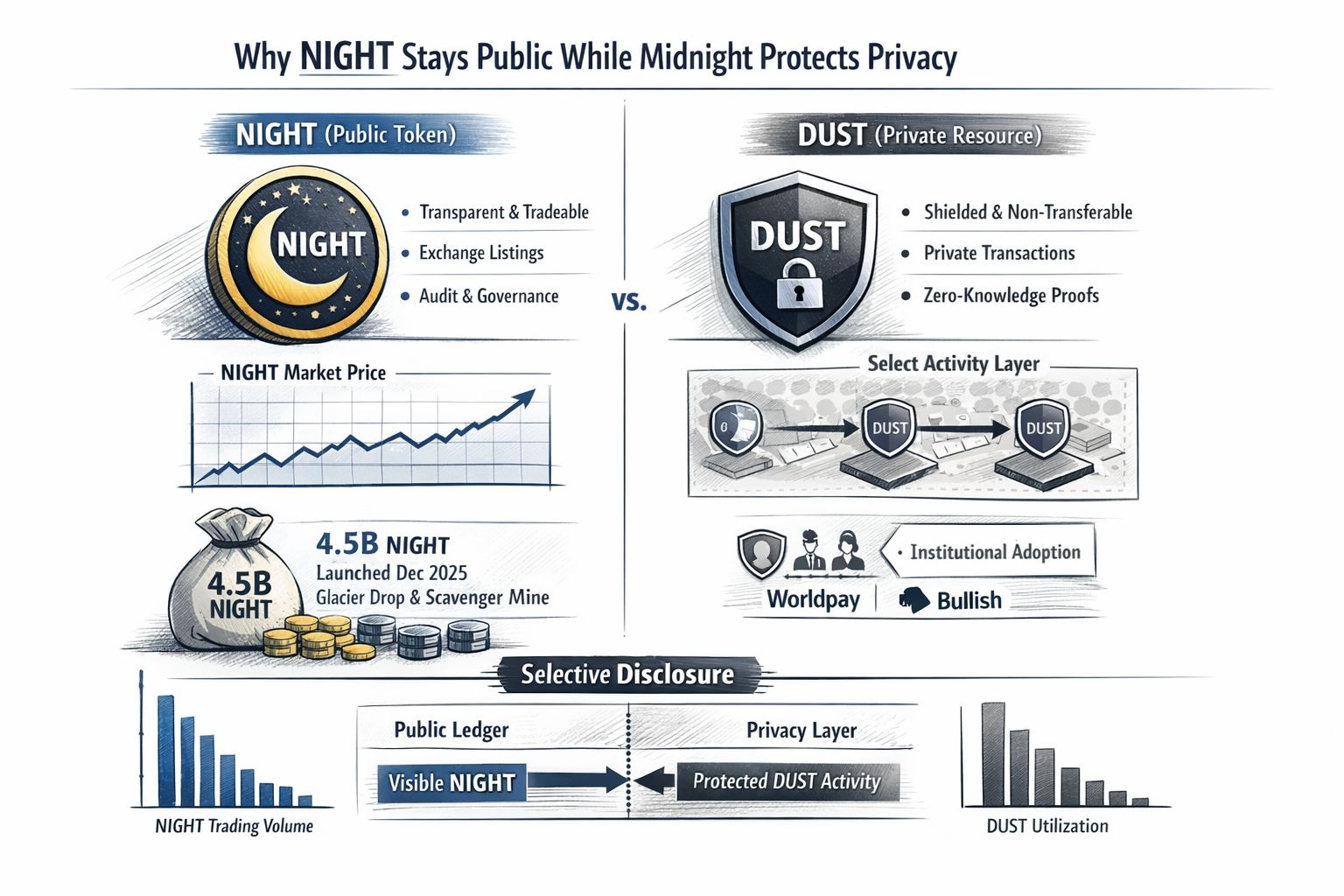
I care about that question now because Midnight is no longer an abstract privacy project sitting in a white paper. Over the past few months it has moved from token distribution into the run up to mainnet. The network has said mainnet is coming at the end of March 2026. It has also continued to add federated node operators while its developer tooling shifts closer to a live production environment. That makes the design choice around NIGHT feel less theoretical and more practical to me. It affects how people might use the network in real conditions, how exchanges can list it, and how businesses decide whether they can trust it.
What I find most interesting is that Midnight is not trying to make every part of blockchain invisible. It is doing something more selective. NIGHT is the public and unshielded native token. DUST is the private network resource created by holding NIGHT. Midnight’s own material presents NIGHT as transparent and better suited to exchange listings, public treasuries, and other settings where auditability matters. DUST works differently. It is shielded, non transferable, renewable, and used to power transactions on the network. That split is really the core of the model.
When I first read that it felt almost backward. Most people hear the phrase privacy chain and assume the main asset itself will be hidden. Midnight takes another route. The project’s logic is that a spendable gas asset that is both shielded and freely transferable can create compliance and monitoring problems. So the tradable token stays public while privacy moves to the layer where activity actually happens. In plain terms NIGHT remains visible on the ledger while the details tied to usage, contract execution, and business logic can stay protected through DUST and zero knowledge tooling.
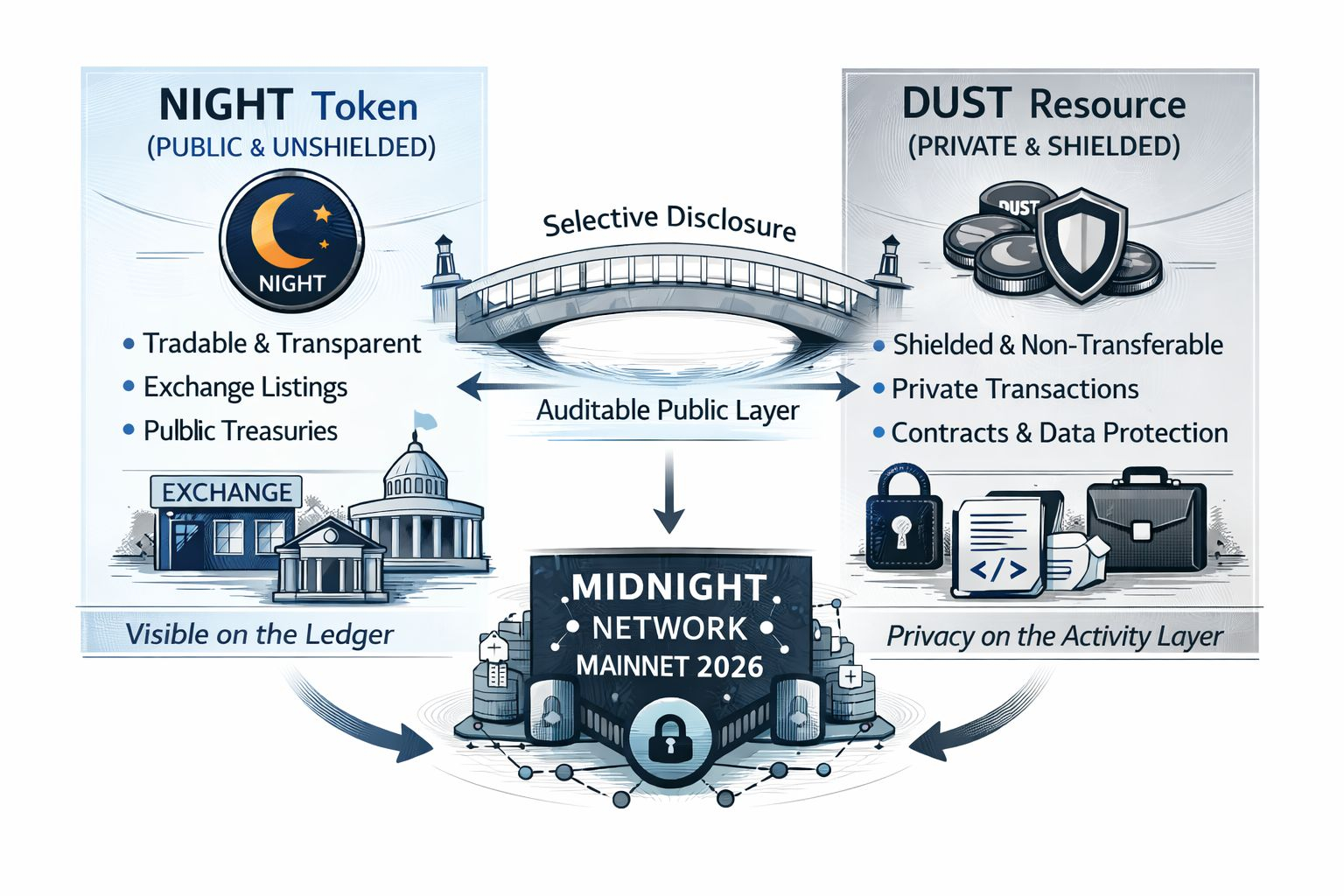
I think that’s a big part of why the project is getting more attention right now. In crypto, privacy usually gets treated like an all-or-nothing tradeoff, either everything is visible or everything is hidden. Midnight is pushing a middle ground that feels a lot more practical. It calls that selective disclosure. The basic idea is that a user or a business should be able to prove something is valid without exposing every underlying detail. That lands differently in 2026 because more institutions want on chain systems but still cannot place customer data, treasury strategy, deal terms, or internal workflows on a fully transparent rail.
There is also real progress behind the pitch. NIGHT officially launched in December 2025 and Midnight says more than 4.5 billion NIGHT was allocated through Glacier Drop and Scavenger Mine before the redemption phase continued. The documentation and developer stack have also kept moving. Recent docs show wallet support for shielded and unshielded balances as well as DUST operations. I pay more attention when a privacy idea starts showing up in infrastructure instead of staying trapped in slogans. I also notice that the network is trying to show what privacy at scale might look like before asking people to simply believe it. Recent operator announcements including Worldpay and Bullish point in that direction as Midnight approaches launch.
The fresh angle for me is that Midnight seems to treat privacy less like a disappearing act and more like systems design. NIGHT stays public because public assets are easier to price, list, audit, and govern. Midnight protects privacy because actual usage is where people and firms are exposed. That division may frustrate people who want full opacity, and it may still be hard to explain to a market that prefers simpler categories. Even so I can see the logic in it. Public capital and private activity can exist side by side when the proof layer is designed with some care. For once that sounds less like a contradiction and more like an adult answer to an old blockchain problem.