
I folded Sign as the shared evidence layer inside the wider $SIGN framework, the three national systems — New Money System, New ID System, New Capital System — the trust registry and its role in sovereign credential issuance, the hybrid data placement model, the omni-chain verification layer using decentralized TEEs and threshold signatures, and TokenTable as the distribution and capital execution surface sitting above the evidence layer.
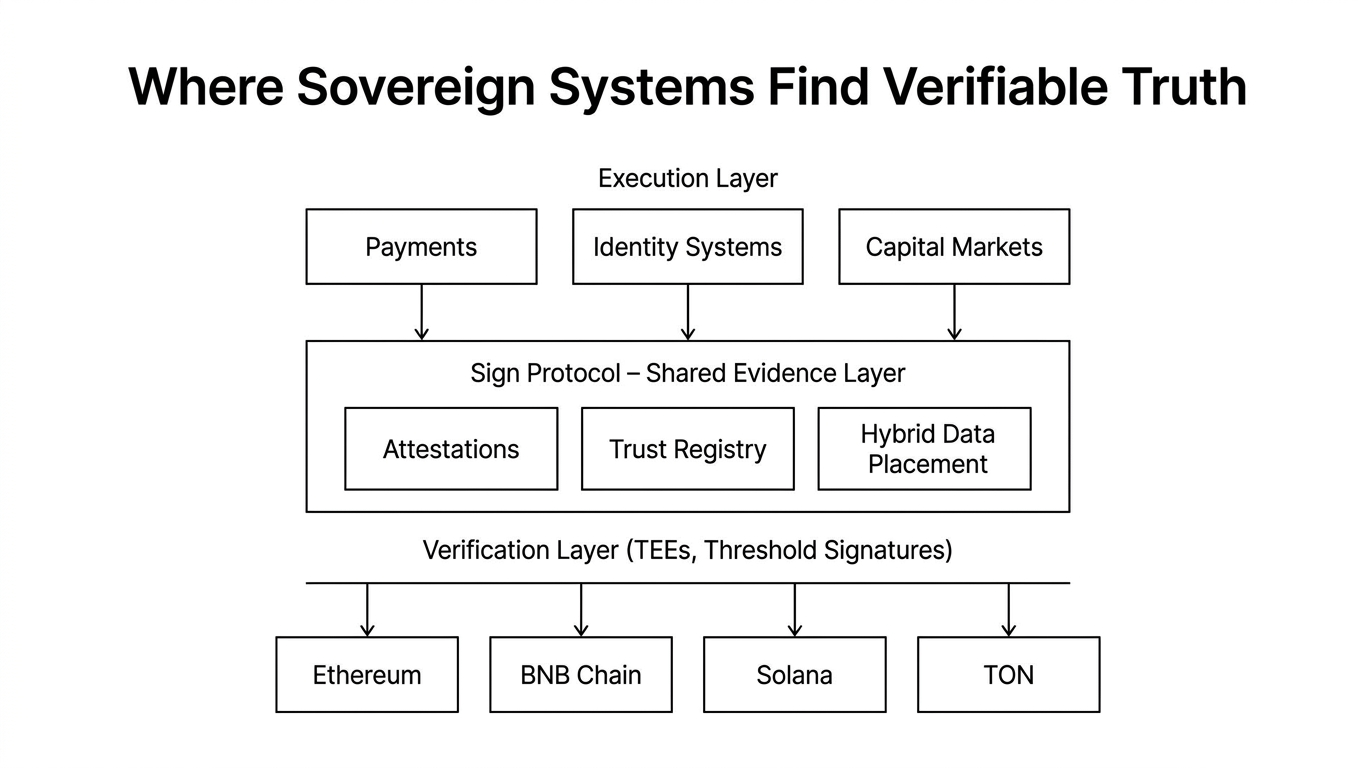
@SignOfficial keeps appearing in places that do not look like crypto conversations. not in trading rooms or token forums, but inside government digital agendas, sovereign procurement frameworks, and national infrastructure roadmaps. and every time it appears there, it fits in a way that feels less like a pitch and more like a structural match that was already waiting to be named.
why does Sign keep landing in sovereign contexts instead of staying inside the protocol layer where most people first encounter it?
it is because the architecture was never really built for one chain. Sign sits as a shared evidence layer above execution, identity, and capital flows, and that positioning changes everything about which problems it is actually sized to solve. the S.I.G.N. framework — Sovereign Infrastructure for Global Nations — is not a marketing rename. it is a description of three national systems that governments are actively trying to upgrade at once: money, identity, and capital. and those three systems are exactly what the Middle East's largest economies are in the middle of rebuilding right now.
"Sign is not entering the Middle East. the Middle East built the conditions Sign was designed for."
on the trading side, SIGN/USDT is currently priced at $0.04790, up 4.72% over the last 24 hours, with an intraday high of $0.04884 and a low of $0.04500. volume across the session reached 123.69 million SIGN tokens, translating to approximately $5.74 million USDT in notional value. the chart holds a fuller story — Sign moved from a low of $0.02376 in early March to a peak near $0.055 around March 9, more than doubling in under two weeks. since then the price has been consolidating, with the MA(7) sitting at 0.04677, MA(25) at 0.04410, and the EMA(99) curling upward at 0.04287. the moving averages are beginning to converge from below. the longer-term structure has not broken. what followed the peak reads less like distribution and more like a market finding the floor it intends to build from.
but the price is almost the least interesting thing about Sign right now.
what is more interesting is the shape of what the architecture is being built to carry. Saudi Vision 2030, the UAE's national digital identity agenda, Bahrain's open banking framework — these are not experiments. they are sovereign commitments with procurement cycles, compliance requirements, and cross-border interoperability problems that need infrastructure answers, not protocol demonstrations. Sign's New Money System covers CBDC rails and regulated stablecoins. the New ID System covers verifiable credentials built on W3C standards with ICAO 9303 ePassport compatibility and offline verification through NFC and QR. the New Capital System covers RWA tokenization with inspection-ready audit trails and ISO 20022 aligned payment messaging. none of these are features. they are the architecture of a functioning digital state.
"the evidence layer does not replace sovereign authority. it makes sovereign authority portable."
and that is the distinction that keeps mattering. governments evaluating digital infrastructure are not asking whether the cryptography is elegant. they are asking whether the audit trail holds under regulatory inspection, whether the identity layer travels across borders without losing its authority, whether the capital system can run at national scale without leaking compliance gaps. Sign's architecture answers those questions structurally — through separation of duties, role-based access control, hybrid data placement, and a trust registry that keeps issuer authority outside the protocol while making it legible everywhere else.
so when i try to understand where Sign is going, i stop looking at the token and start looking at the procurement cycle.
the Middle East is not a use case Sign is being applied to. it is the structural environment the S.I.G.N. architecture was quietly shaped around — where economic growth is a policy decision, where digital sovereignty is already being written into national law, and where the gap between what governments need and what blockchain usually offers is exactly the shape of what Sign built.
"the architecture arrived before the announcement. that is usually how infrastructure works."
and maybe that is the thing that keeps making Sign feel larger than its current price suggests. the token moves. the architecture does not. one of them is describing something that takes years to fully land, and it is not the candle on the four-hour chart.
#signDigitalSovereignlnfra @SignOfficial $SIGN
