while scanning the chain last night
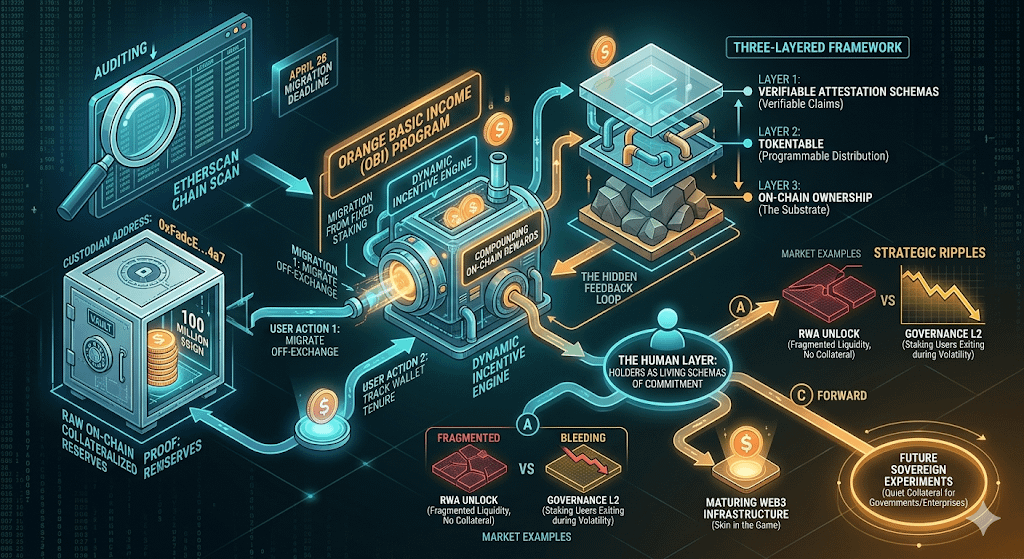
While I was deep into the contract details last night, something about Sign Protocol ($SIGN) and the way @Sign is wiring incentives clicked in a way the whitepaper never quite captured. I had the Etherscan tab open, staring at the dedicated onchain custodian contract holding the full 100 million $SIGN earmarked for the Orange Basic Income program. It was March 23, just days after the initial move of 9 million into the OBI contract itself, and the numbers sat there, plain and immutable. No hype reel, no tweet thread explaining the vision. Just raw on-chain proof that the foundation had collateralized the whole thing from strategic reserves.
The first actionable insight hit me then: if you're holding sign ff-exchange already, migrate the rest and track your wallet balance against the seasonal milestones—rewards compound visibly through on-chain data, not off-chain promises. Second, watch how the program quietly folds self-custody into the protocol's attestation layer; every qualified holder becomes a living schema of commitment. I caught myself pausing over the transfer logs, wondering why this felt more foundational than the usual schema deployments I've audited before.
Back in early 2025, I remember staking a small bag in the old program just to test the flows—nothing dramatic, just routine diligence after a few projects burned me on vague vesting. This time around, reviewing that custodian contract felt different. It wasn't abstract infrastructure anymore. It was a quiet signal that Sign Protocol was betting on holders who actually sit with the tokens on-chain, turning passive ownership into verifiable participation. The shift from fixed staking to this dynamic, collateralized model left a mark; I even double-checked the details twice, half-expecting some hidden clawback clause that wasn't there.
the contrast that stuck with me
The contrast that stuck with me is how Sign Protocol positions itself less as a flashy attestation playground and more as a subtle infrastructure layer that rewards the unglamorous act of holding on-chain. Hype circles talk endlessly about omni-chain schemas and verifiable credentials, yet the real mechanics—visible in that March 20-23 deployment—center on aligning sign tth long-term self-custody. It's not that attestations don't matter; they do. But the OBI contract reveals a deeper layer: token flows now double as proof of ecosystem skin-in-the-game, creating a feedback loop where holder behavior strengthens the trust primitives the protocol sells to devs and, increasingly, sovereign setups.
Take the on-chain behavior itself. When the foundation moved those initial 9 million sign o the OBI program contract, it wasn't a marketing stunt—it locked real value in public view, quarterly releases tied to collective milestones like TVL growth in self-custodied wallets. I watched similar patterns play out in two recent market examples. First, a major RWA project last month pushed similar self-custody incentives after their token unlock, only to see fragmented liquidity because the rewards weren't fully collateralized up front. Sign's approach avoids that trap; the 100 million sits there in full view, backing every season. Second, a governance-heavy Layer-2 saw its staking program bleed users to exchanges during volatility—exactly the opposite of what OBI seems engineered to counter.
Actually—hmm, this is where my own expectations shifted. I went in assuming the protocol's edge was purely technical: schemas bridging Ethereum, Solana, TON without friction. What lingered instead was the human layer, the way OBI turns every wallet holding sign an implicit attestation of alignment. No extra gas for fancy proofs, just balance snapshots feeding reward calculations. It feels almost too straightforward for infrastructure talk, yet that's the point. The mechanics enforce what marketing only gestures toward: real positioning happens when incentives make holding feel like building.
hmm... this mechanic in practice
Hmm... this mechanic in practice exposes a three-layered framework I hadn't fully internalized until the late dive. Layer one is the public attestation schema everyone talks about—verifiable claims flowing across chains. Layer two is TokenTable, quietly handling programmable distributions at scale. But layer three, the one the OBI contract illuminates, is the hidden feedback loop: on-chain ownership as the substrate that makes the first two credible at infrastructure scale. Without holders willing to custody long-term, the trust layer risks staying theoretical. The March deployment makes that loop explicit, with rewards scaling not on hype metrics but on verifiable wallet tenure.
I found myself reevaluating here, honestly. Part of me still wonders if tying so much to self-custody underestimates how many users prefer the convenience of centralized rails, especially in volatile windows. The program ends the old staking on April 28, forcing a migration that could surface friction I haven't stress-tested yet in my own flows. Yet the collateralization is ironclad—no promises without the contract to back it. That skepticism doesn't erase the elegance; it just tempers the optimism I usually carry into these audits.
Two introspective stretches followed that night. First, I realized how rare it is for a protocol to make its token economics feel like an extension of its core product rather than a bolted-on incentive. Sign Protocol isn't shouting about being the next big thing in credentials; it's letting the on-chain record do the positioning. Second, sitting there with coffee gone cold, it struck me that this might be how real Web3 infrastructure matures—not through viral schemas alone, but through mechanics that quietly demand skin in the game from its own community.
still pondering the ripple
Still pondering the ripple, I keep coming back to how this positions Sign in the broader stack. Forward-looking, it suggests a path where $SIGN es the quiet collateral for larger sovereign experiments—governments or enterprises using the same attestation primitives but now backed by a holder base that's already practiced verifiable commitment. No grand predictions, just the observation that incentives like OBI could compound into stickier network effects than pure tech alone.
Another reflection: the market examples I mentioned earlier show how quickly these loops can fray without full transparency. Sign's choice to lock everything publicly feels like a deliberate counter-signal, one that might influence how other infrastructure projects structure their own alignments in the quarters ahead. It nudges the conversation from "how many schemas can we deploy" toward "how many holders will actually stay the course."
The whole session left me with more questions than closures, which is usually the sign of something worth watching. What happens when the first season's milestones hit and the on-chain data starts flowing into reward distributions—does it reinforce the protocol's infrastructure claim, or expose where the real user behavior diverges?