while scanning the chain last night
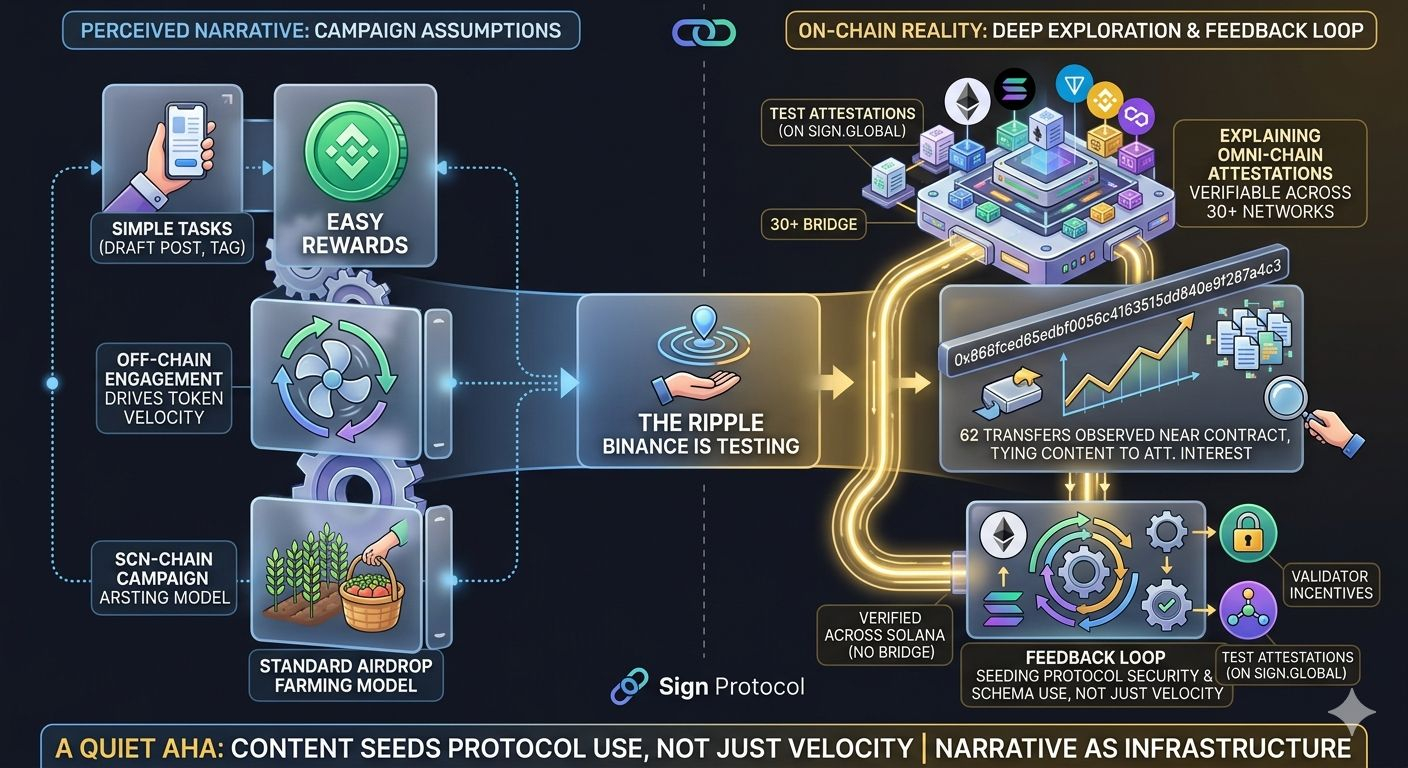
While digging into the SIGN Campaign on Binance CreatorPad last night, the tasks felt almost too straightforward at first — draft a post on Sign Protocol, break down sign mechanics, tag the ecosystem. Yet the 1,968,000 sign reward pool, announced March 19, 2026, kept pulling me back. I had the $SIGN token contract open and noticed those 62 transfers ticking in the window following the announcement, nothing massive but steady, the kind of quiet on-chain pulse that usually follows real interest rather than hype. It was a small thing, but it shifted how I saw the whole campaign.
I’d spent the earlier part of the evening actually issuing a test attestation on sign.global, then verifying it instantly across Solana — no bridge, no extra steps. That hands-on moment made the CreatorPad tasks click differently. Here was Binance handing out $SIGN not for mindless shilling but for creators to unpack the exact infrastructure that makes those cross-chain attestations possible. It felt less like a marketing stunt and more like a quiet experiment in feeding narrative into on-chain utility.
The contrast that stuck with me wasn’t the reward size. It was how the campaign sits at the intersection of off-chain storytelling and the protocol’s native design. Sign Protocol never pretended to be single-chain; its schema registry and attestation logic deploy natively wherever volume moves. Yet most infra campaigns chase liquidity on one L1. This one rewards anyone who explains why that matters — portable trust for RWAs, sovereign identity pilots, anything that can’t afford fragmentation.
the contrast that stuck with me
Actually — and this is the part I kept mulling over — the campaign surfaces a hidden feedback loop most projects miss. Creators post thoughtful breakdowns, readers dig deeper, a few end up issuing their own attestations or staking $SIGN for verification security. The on-chain behavior I spotted (those incremental transfers around the March 19 launch) hints at exactly that loop starting to turn. Not explosive volume, just the early signal that content can seed genuine protocol use rather than just token velocity.
I remember sitting there at 2 a.m., coffee gone cold, comparing it to the usual Launchpool frenzy. Those feel like sprint incentives. This one feels slower, more deliberate — Binance essentially saying, “Help the community understand a multi-chain attestation layer, and we’ll pay you in the token that secures it.” It’s subtle positioning, and it made me reevaluate my initial skepticism. I’d assumed CreatorPad was pure engagement farming. Turns out it might be Binance quietly aligning its creator base with protocols that solve real coordination problems across chains.
Two timely examples kept echoing in my head. First, the sovereign digital infrastructure push Sign Global highlighted earlier this month — nations exploring on-chain attestations for resilient systems when traditional rails fail. Second, the March 25 tokenization hearing in Congress, where lawmakers basically admitted tokenized assets are already moving billions and need portable compliance layers. In both cases, you need exactly what Sign Protocol ships: attestations that stay native and verifiable anywhere. The campaign isn’t ignoring that reality; it’s trying to onboard creators who can translate it.
hmm... this mechanic in practice
Hmm… the mechanic in practice reveals something about incentive layers I hadn’t fully appreciated before. Sign isn’t just a governance or fee token here. Through the campaign, it becomes a bridge between Binance’s massive audience and the protocol’s validator-like participants who keep the attestation graph coherent. The deeper you look at the on-chain flows — even the modest transfer uptick post-announcement — the clearer it gets that Binance is testing a model where community education directly supports protocol security and liquidity.
I caught myself pausing over one particular transfer cluster. Nothing whale-sized, but distributed enough to suggest real users moving tokens after reading campaign posts. That’s the kind of behavior most dashboards miss because it’s not a single headline event. It’s the slow accumulation of attention turning into actual on-chain participation.
Still, I had to sit with the honest reevaluation. Part of me wondered if rewarding content this way scales when attestation volume hits enterprise pressure — governments or RWAs don’t care about Twitter threads, they care about uptime and zero-trust verification. Does the campaign risk attracting surface-level creators who never touch the schema registry? I adjusted my own view there; the proof would be in whether those 62 transfers (and whatever follows) lead to sustained schema creation rather than one-off claims.
still pondering the ripple
Still pondering the ripple, I keep coming back to what this says about Binance’s direction. They’re not just listing another token or running a standard farm. They’re allocating real rewards to creators who explain omni-chain mechanics, which feels like a bet on narrative as infrastructure. In a market still fragmented by L1 wars, this positions Binance as the platform that can actually surface protocols capable of stitching chains together without forced bridges.
It’s not flashy. No moon talk, no guarantees. Just a measured step toward an ecosystem where education compounds into adoption. I found myself thinking about the three layers that seem to connect here: creator content as the entry point, $SIGN incentives as the alignment mechanism, and the attestation graph as the durable backbone. When all three fire together, the whole thing starts to feel less experimental and more foundational.
Forward-looking, it makes me wonder how Binance might expand this approach — perhaps deeper integrations where CreatorPad tasks unlock not just tokens but direct attestation credits or governance weight. Or maybe tighter ties between Square content and on-chain dashboards so readers can verify claims in real time. Either way, it points to a platform evolving beyond trading into something that actively shapes how users experience multi-chain reality.
The quiet aha for me was realizing this isn’t about hyping $SIGN. It’s about Binance recognizing that the next wave of adoption won’t come from isolated airdrops but from protocols whose mechanics are understood well enough to be used at scale. I’m still sitting with that.
What does it mean if the most effective way to grow a truly omni-chain protocol turns out to be letting creators explain it in their own words?