@SignOfficial Small businesses in developing economies don’t collapse because their products are weak.
They don’t fail because demand doesn’t exist.
They fail because of one overlooked reason:
Paperwork.
A manufacturer in Vietnam is ready to export goods.
A buyer in Germany wants those goods.
The deal makes sense. Demand exists. Supply is ready.
But between agreement and shipment, an invisible wall appears.
Documents.
Certificates of origin.
Export licenses.
Quality certifications.
Customs approvals.
Regulatory clearances.
Each issued by a different authority.
Each requiring manual verification.
Each taking days — sometimes weeks.
And the business waits. #Sign @SignOfficial $SIGN
This Isn’t a Demand Problem — It’s a Speed Problem
On paper, global trade looks efficient.
In reality, it’s full of friction.
Deals are ready.
Products are ready.
Execution is not.
And in business, delays aren’t neutral —
they’re expensive.
Cash flow slows down.
Inventory gets stuck.
Buyer confidence weakens.
Sometimes, the deal dies completely.
The $3.5 Trillion Gap — And the Real Reason Behind It
According to the Asian Development Bank,
the global trade finance gap exceeds $3.5 trillion.
That’s not a small inefficiency.
That’s a structural failure.
Small and medium-sized businesses carry the heaviest burden.
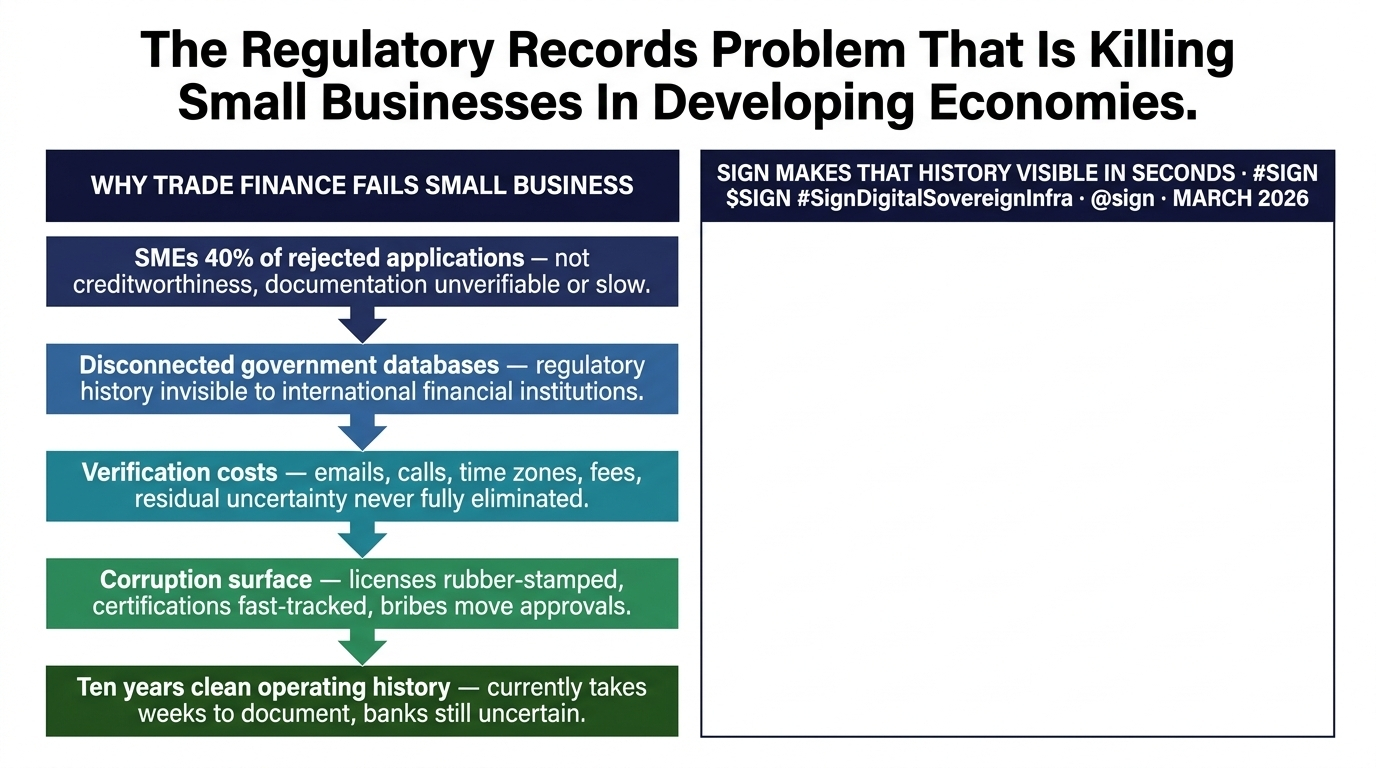
Nearly 40% of their trade finance applications are rejected.
And here’s the part most people misunderstand:
It’s not about credit risk.
It’s about documentation.
Incomplete records.
Unverifiable data.
Slow-moving approvals.
This isn’t a capital problem.
It’s a trust problem.
Slow Trust Means Slow Capital
Banks and international buyers don’t operate on assumptions.
They operate on verification.
They need to confirm:
The business is legally registered
The product meets required standards
The export is properly licensed
The documents are authentic
The problem is how this verification happens.
Information is scattered across disconnected systems.
Government databases don’t communicate.
Cross-border access is limited.
Verification is manual.
The result?
Trust takes time.
And when trust is slow,
capital is slow.
A Simple Trade, A Complicated Process
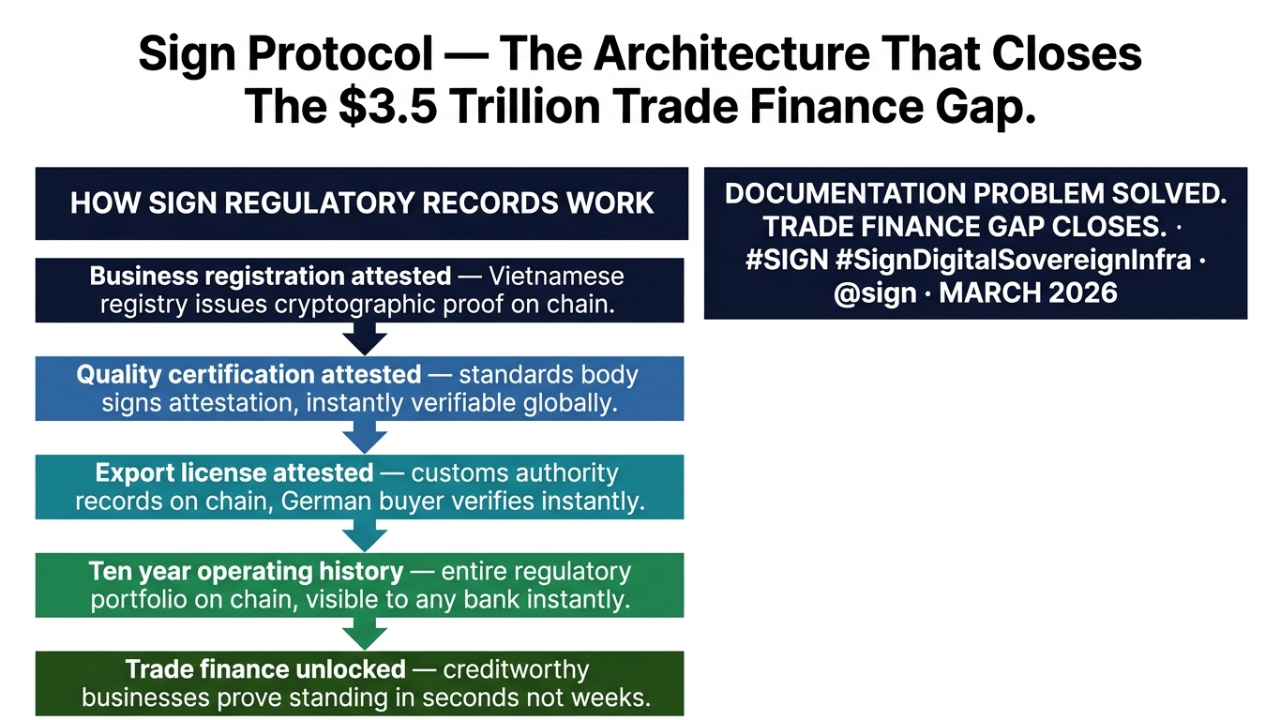
Take a German buyer working with a Vietnamese exporter.
To complete one transaction, the buyer must verify:
Business registration
Quality certification
Export license
Customs documentation
Each step involves:
Emails across time zones
Calls to authorities
Third-party intermediaries
Verification fees
And even after all that,
uncertainty remains.
This isn’t just inefficient.
It’s outdated.
The Real Problem Has a Name
This is the regulatory records problem.
The data exists —
but it’s not usable in real time.
Verification is possible —
but not efficient.
Trust can be built —
but only slowly.
And modern global trade cannot run on slow systems.
What Happens When the System Changes
Now imagine a different model.
Where regulatory records aren’t static documents —
but verifiable digital proofs.
Where certifications aren’t papers —
but cryptographic attestations.
Where every record can be verified instantly,
from anywhere in the world.
No emails.
No waiting.
No intermediaries.
That’s where the shift begins.
From Documents to Proof
When regulatory records move on-chain,
their nature changes completely.
They are no longer just records.
They become proofs.
Immutable
Tamper-proof
Globally accessible
Instantly verifiable
And that changes everything.
From Weeks to Seconds
Now the same German buyer can verify a Vietnamese exporter in seconds.
Business registration — verified.
Quality certification — verified.
Export license — verified.
All instantly.
No back-and-forth.
No delays.
No uncertainty.
This Isn’t Just Speed — It’s a Trust Upgrade
In the traditional system, trust is built through process.
In the new system, trust is built into the infrastructure.
Verification becomes automatic.
And when trust moves faster,
capital follows.
The Real Unlock for SMEs
Small businesses face a specific challenge.
They are often creditworthy —
but unable to prove it efficiently.
They may have:
Years of operational history
Consistent tax records
Clean compliance
But that information lives in disconnected systems.
For banks, verifying it is slow and expensive.
So they default to rejection.
Invisible Credibility
This creates a critical issue:
Credibility exists — but it’s invisible.
And if the system cannot see it,
it cannot act on it.
This is one of the biggest hidden barriers to growth.
Making Credibility Visible
Now imagine a different scenario.
A business has its full regulatory history available on-chain:
Registration
Certifications
Licenses
Compliance records
Audit history
All structured.
All verifiable.
All instantly accessible.
Now, evaluation doesn’t take weeks.
It takes seconds.
This Is What Real Financial Inclusion Looks Like
This isn’t just a technology upgrade.
This is structural inclusion.
Businesses that were previously locked out
can now participate.
Not because rules changed —
but because verification became efficient.
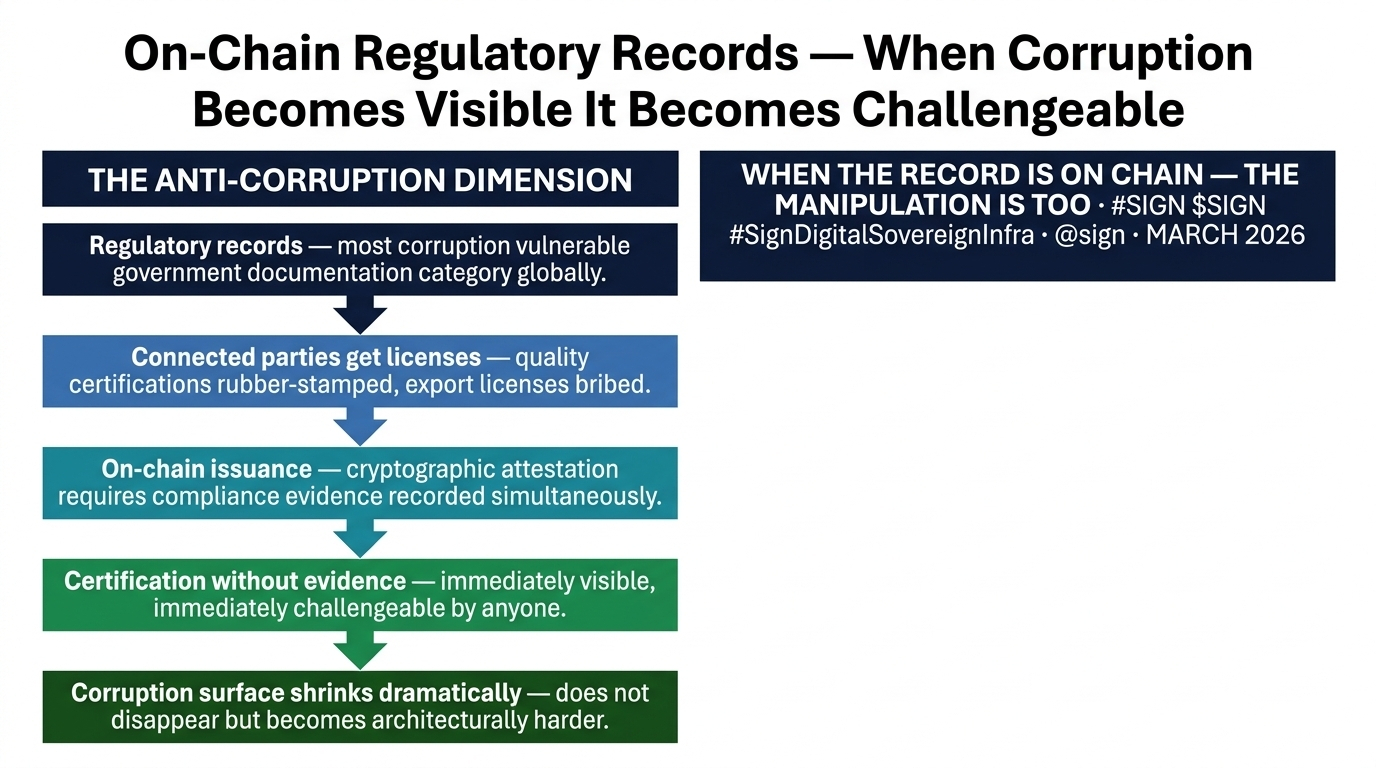
The Corruption Layer
There’s another dimension to this.
Regulatory records are highly vulnerable to manipulation.
Licenses can be influenced.
Certifications can be rushed.
Approvals can be bypassed.
When records move on-chain:
Issuance becomes traceable
Authorities become visible
Verification becomes transparent
Corruption doesn’t disappear —
but the surface area shrinks significantly.
The Real Challenge — Adoption
There is one honest constraint:
Government participation.
On-chain records only work if issuing authorities are part of the system.
A record is only as strong as the institution behind it.
Building that trust network takes time.
Network Effects Take Time — Then Move Fast
Adoption in government systems is never instant.
It requires:
Institutional alignment
Technical integration
Trust building
But once the network forms,
momentum builds quickly.
The Reality Today
The $3.5 trillion trade finance gap already exists.
SMEs are already being rejected.
Deals are already being delayed.
This is not a future problem.
It’s happening now.
And Businesses Are Still Waiting
They are not waiting for better products.
They are not waiting for more customers.
They are not even waiting for more capital.
They are waiting for one thing:
Their documents to be verified.
The Bottom Line
As long as verification is slow,
trade will remain slow.
And as long as trade is slow,
growth will stay limited.
The problem is massive.
But the solution is simple:
Speed up trust. Upgrade the infrastructure.
Everything else follows. 🔥