
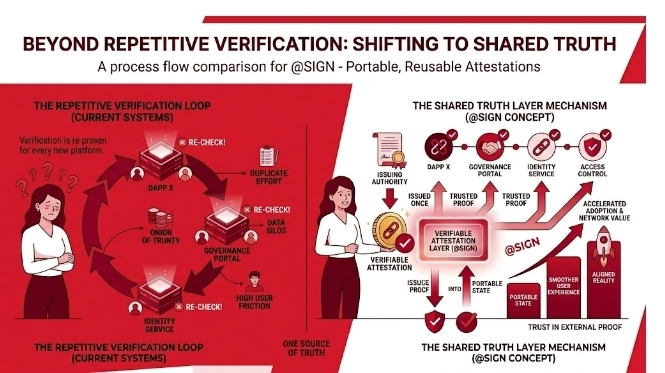
I’ve noticed how often I end up re-checking things that should already be settled. You complete an action on one platform, then move somewhere else and get asked to prove the same thing again. Sometimes it’s identity, sometimes eligibility, sometimes just confirming a condition that hasn’t actually changed.
It’s not difficult, just repetitive. And after a while, it starts to feel like each system is operating in its own closed loop, unable to recognize anything that happened outside of it.
At first, I assumed this was just a limitation of how platforms are built. Each one verifies its own data, keeps its own records, and that’s how consistency is maintained.
But the more I see it, the more it feels inefficient.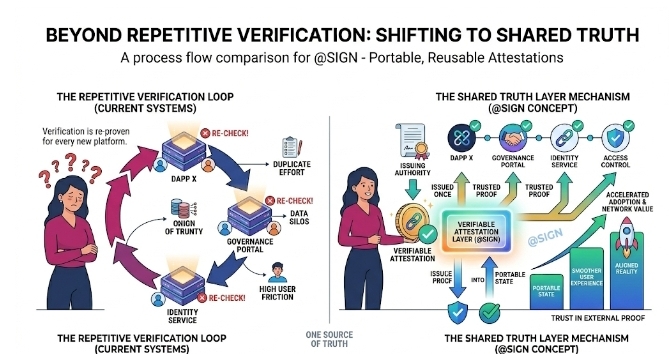
At that moment, I realized the issue isn’t verification itself. It’s that systems don’t share a common source of truth. Every platform acts as if it has to define reality on its own, even when that reality has already been established somewhere else.
That’s where something like @SIGN starts to feel relevant. Not as a replacement for individual systems, but as a layer that sits outside them, holding verifiable claims that multiple platforms can reference.
If I try to break it down simply, the idea is that truth doesn’t have to live inside each application. Instead, it can exist as attestations issued once and then reused. A condition gets verified, turned into a structured proof, and other systems can read that proof without redoing the process.
Initially, I thought this was just another abstraction. Another layer trying to organize something that already functions, even if imperfectly. Most platforms manage by keeping their own internal logic, and users adapt to the repetition.
But I don’t think that approach scales cleanly. At least not as systems become more interconnected.
What I find interesting is the shift from internal validation to external reference. Instead of asking “can I verify this myself,” systems start asking “can I trust this existing proof.” That’s a different model entirely.
Upon reflection, it starts to look less like duplication and more like dependency. Systems begin to rely on external truth layers rather than rebuilding everything internally.
If that works, a few things change quietly.
Verification becomes portable. Actions taken in one place carry meaning elsewhere. Cross-chain interactions feel less like starting from zero and more like continuing from an established state. The user experience becomes smoother, not because there are fewer conditions, but because those conditions don’t need to be constantly re-proven.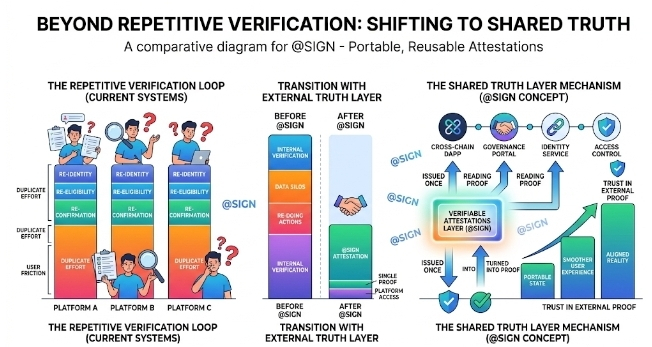
It also affects coordination. Different applications can align around the same set of truths without needing direct integration at every level. They just need to understand and accept the same proofs.
But I don’t think this transition is simple. At least not yet.
Because relying on an external truth layer introduces a different kind of risk. Systems have to agree on what counts as valid, and more importantly, who they trust to issue those attestations. Without that alignment, the layer fragments instead of unifying.
There’s also the question of control. Some platforms may prefer to keep verification internal rather than depend on something outside their boundary. Trust, in practice, is often tied to ownership of the process.
Right now, I’m mostly observing how this plays out. I hold a small amount of $SIGN, not as a strong position, but as a way to stay engaged with the idea. The structure makes sense, but real-world adoption tends to introduce complications that aren’t obvious at first.
But I keep coming back to a simple condition.
The shift works when I stop noticing where verification happens. When I move across platforms and don’t get asked to repeat the same proofs, because the system already recognizes them through a shared layer.
No redundant checks, no rebuilding context.
If that becomes normal, then systems aren’t just connected at the surface. They’re aligned at the level of truth.
Until then, it still feels like each platform is carrying its own version of reality, even when they’re all describing the same thing.