
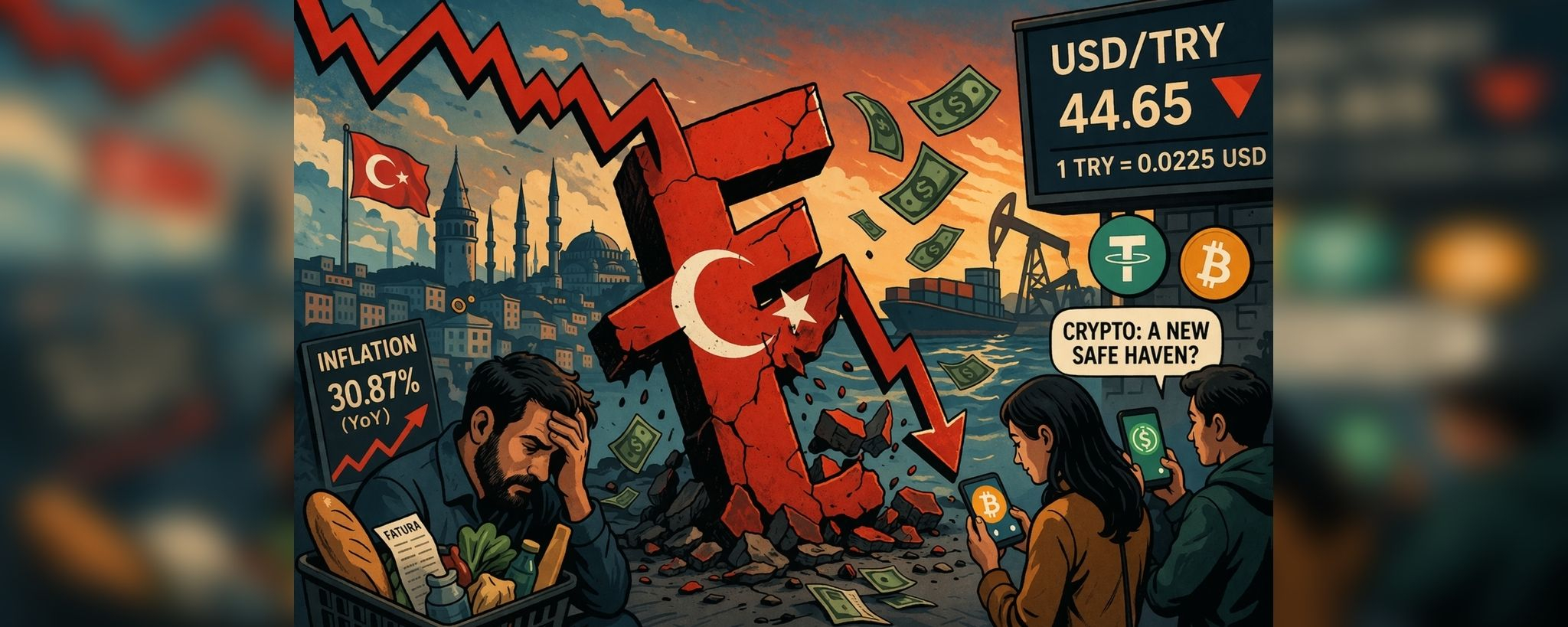
When I first looked at the viral claim that the Turkish lira has collapsed almost 99.99% against the dollar, what struck me was not only the loss itself but the way people like to flatten it into a shock graphic. The damage is real, but the slogan usually cheats a little. Turkey removed six zeros from the currency in 2005, after the old lira had already become so devalued that it traded at roughly 1.65 million to the dollar in late 2001, so any neat comparison between the early 1990s and today can blur old and new currency units into one dramatic but messy line.
That matters because the common misconception is that a currency collapse is just a story of bad leaders or one reckless central bank. My view is narrower and more structural. A currency weakens for years when the state loses the steady coordination that makes money believable, meaning households, firms, lenders, and foreign investors stop treating the local unit as a reliable bridge between today’s effort and tomorrow’s purchasing power.
On the surface, the lira now trades around 44.65 to the dollar, which means one lira buys roughly 2.25 U.S. cents. That is not just an ugly quote on a screen. Underneath, it means Turkey needs far more local currency to pay for imported energy, protect domestic balance sheets from dollar pressure, and keep prices anchored in an economy where the dollar still acts as the hidden measuring stick for trust.
Inflation shows the same texture. Turkey’s consumer prices rose 1.94% month on month in March and 30.87% year on year. A monthly number matters because it shows how quickly purchasing power is eroding right now, while the annual number matters because it tells you the system still has not returned to a quiet, low-inflation equilibrium where contracts, wages, and savings can settle down.
What people often miss is that a weak currency is not only an outcome. It becomes an input. When residents expect further weakness, they behave differently. They front-load purchases, shorten the time they are willing to hold cash, price defensively, and search for escape valves. Surface, that looks like panic or speculation. Underneath, it is rational self-protection inside a unit of account that no longer feels steady.
That momentum creates another effect. Policymakers end up defending not just the exchange rate but the social meaning of money itself. Reuters reported that Turkey halted its easing cycle at 37%, pushed the overnight rate toward 40%, and sold and swapped tens of billions of dollars and gold reserves to support the lira, with total reserves down about $55 billion over a month in one account and down $48.7 billion since the regional war shock in another, though officials still say about $162 billion remains. Those numbers matter because high rates buy time, reserve sales buy stability, and neither automatically rebuilds trust once residents have learned to think in exit routes.
Recent geopolitics made that harder, but they did not create the whole problem. Turkey is energy import heavy, so a war-driven jump in oil and gas prices feeds directly into inflation, current account pressure, and foreign exchange demand. Surface, the latest Middle East shock looks like an external hit. Underneath, it exposes how fragile a currency becomes when too much of domestic stability depends on imported necessities priced in someone else’s money.
Understanding that helps explain why crypto keeps appearing in the Turkish story. Turkey ranks among the world’s leaders in crypto adoption, and Reuters cited Chainalysis saying annual crypto transaction volumes reached nearly $200 billion in 2025. That number matters not because it proves crypto “won,” but because it shows how quickly people move toward parallel monetary rails when the local currency stops feeling like a dependable store of short-term value.
The mechanism is fairly simple once you strip away the ideology. Surface, a household buys bitcoin or a dollar-linked stablecoin. Underneath, it is outsourcing monetary credibility to a different system. Enables, it gives savers a faster way to leave the lira without opening a foreign bank account. Risk, it can deepen informal dollarization, weaken local monetary control, and push activity toward whichever platform or token feels most liquid in the moment, not necessarily the safest. Reuters noted Turkey’s earlier crypto boom was fueled by years of double-digit inflation that hit 85% in 2022, while a new draft bill would impose a 10% withholding tax on crypto gains and a 0.03% levy on service providers. That is the state trying to regulate the exit without fully shutting it.
Meanwhile, crypto itself is no longer a clean outside option. Bitcoin is around $72,982 today, but Reuters reported in February that the broader crypto market was still about $2 trillion below its October peak, and U.S. spot bitcoin ETFs had seen more than $3 billion of outflows in January after about $2 billion in December and $7 billion in November. Reuters also noted that bitcoin’s fortunes have become tied to the broader tech trade and especially enthusiasm around AI. That matters because even the escape hatch now sits inside global liquidity cycles. Crypto may offer an exit from local currency risk, but it does not offer an exit from risk itself.
Still, the broader direction is hard to ignore. The regulatory perimeter around digital dollars is getting firmer, not weaker. Hong Kong issued its first fiat-backed stablecoin licences on April 10, and the U.S. Treasury secretary called again this week for Congress to pass federal digital-asset market rules; at the same time, Reuters Breakingviews noted that Tether’s USDT has grown to $184 billion, making it the dominant dollar-linked crypto token. These figures matter because they show that the competition weak currencies face is changing. They are no longer only competing with the Federal Reserve or with hard cash. They are competing with software-based dollar claims that move instantly and increasingly sit inside formal policy frameworks.
A fair counterargument is that this may be too fatalistic. Turkey still has policy tools, still has reserves, and officials say inflows began reversing positively after the ceasefire. That may be true if the truce holds and energy pressure eases. But a defended currency is not the same as an earned currency. The real test is whether people choose the lira when they are free to choose something else.
So the deeper lesson is not that the lira produced a scary chart. It is that monetary weakness now gets revealed faster and punished more quietly than before. In a world of mobile capital, exchange-traded crypto access, regulated stablecoin expansion, and emerging market funding that the IMF says is increasingly shaped by hotter, more reversible flows, the cost of losing monetary credibility is no longer just devaluation. It is irrelevance. A currency does not really break when traders mock it. It breaks when exit becomes ordinary.#PolygonFunding #FedNomineeHearingDelay #CZReleasedMemeoir #Write2Earn #altcoins


