
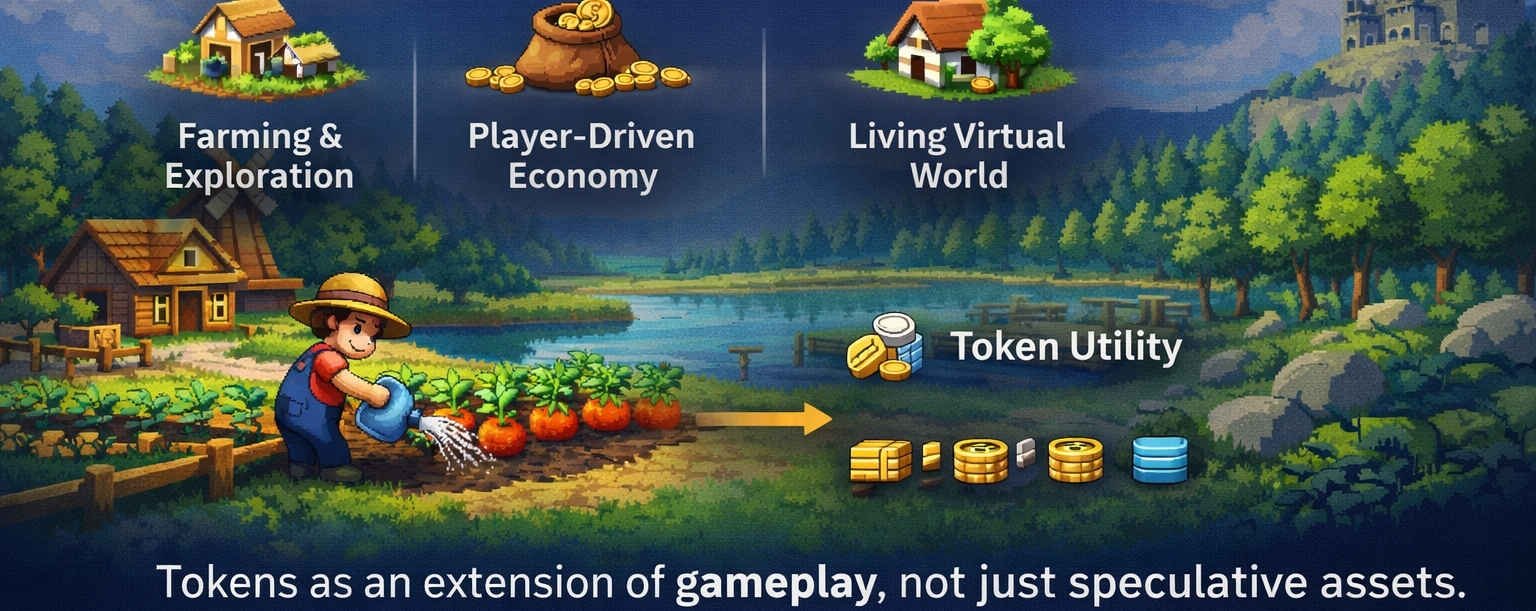

Pixels is starting to define what a sustainable onchain game loop actually looks like. Not through speculation, not through short-term incentives, but through consistent, repeatable gameplay that integrates value directly into user behavior. @Pixels is building on Ronin with a clear priority: make the game work first, and let the token layer emerge from real activity.
At a surface level, Pixels looks simple — farming, exploration, crafting. But the design depth sits underneath that simplicity. Every action, from planting crops to managing land, feeds into a player-driven economy where time, strategy, and coordination translate into value. This is where $PIXEL begins to matter — not as a speculative asset, but as a unit of participation.
The difference is structural. Most Web3 games attempt to inject tokens into gameplay. Pixels does the opposite. It builds a gameplay loop that naturally demands an economic layer. That distinction changes user behavior. Players are not entering to extract value immediately — they are participating in a system where progression, ownership, and interaction come first.
Ronin’s infrastructure plays a critical role here. Low transaction costs and high throughput remove the friction that usually breaks these loops. Micro-actions like planting, harvesting, trading, or upgrading assets can happen seamlessly. That allows Pixels to operate closer to traditional gaming standards while still maintaining onchain ownership.
Another key element is the social layer. Pixels is not designed as a solo experience. Land ownership, resource coordination, and in-game collaboration create a network effect that compounds over time. The more users engage, the more the in-game economy stabilizes. This is not just user growth — it’s system reinforcement.
The $PIXEL token sits inside this structure as a functional asset. Its relevance is tied to in-game demand rather than external narratives. That’s important. When token utility is derived from actual usage instead of artificial incentives, volatility becomes less disruptive to the core experience.
There’s also a pacing advantage. Pixels does not try to compress user progression into short cycles. It allows for gradual development — farming cycles, resource accumulation, land optimization. This slower loop aligns better with long-term retention. Instead of chasing rapid spikes in activity, it builds consistency.
From a design perspective, Pixels is closer to simulation-based economies than traditional “play-to-earn” models. It mirrors real-world systems where productivity, time investment, and coordination define outcomes. That alignment is what gives it durability.
What’s emerging here is a shift in how Web3 games are evaluated. The focus is moving away from token performance toward system design. In that context, Pixels is positioning itself as infrastructure disguised as a game — a controlled environment where economic behavior can be tested, refined, and scaled.
The question is no longer whether Web3 games can attract users. It’s whether they can retain them without relying on constant external incentives. Pixels is one of the few projects actively answering that.
If this model continues to scale, it sets a precedent: gameplay is not a wrapper around tokens — tokens are an extension of gameplay.
@Pixels is not trying to redefine gaming through complexity. It’s doing it through clarity — simple mechanics, consistent loops, and an economy that emerges from actual use.
That’s where $PIXEL gains its strength.