
I kept running into the same small friction without really noticing it at first.
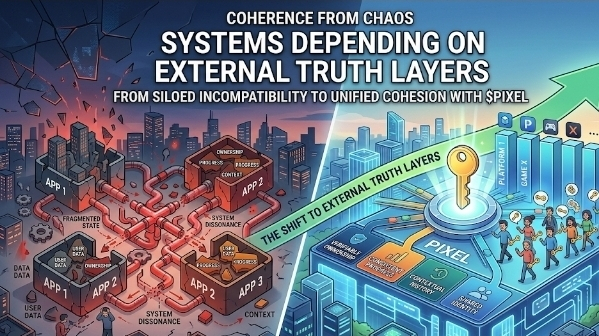
Logging into different platforms, switching between apps, trying to carry progress from one place to another—none of it ever quite lined up. A game would remember part of what I did, but not everything. A wallet would show ownership, but not context. Sometimes I’d complete something meaningful in one environment, only to realize it didn’t exist anywhere else.
At some point, it stopped feeling like separate issues and more like a pattern.
At that moment, I realized the systems themselves weren’t really built to agree on what’s true. Each one keeps its own version of events, its own records, its own idea of ownership. And when you move between them, you’re not carrying truth with you you’re starting over, or relying on fragile integrations.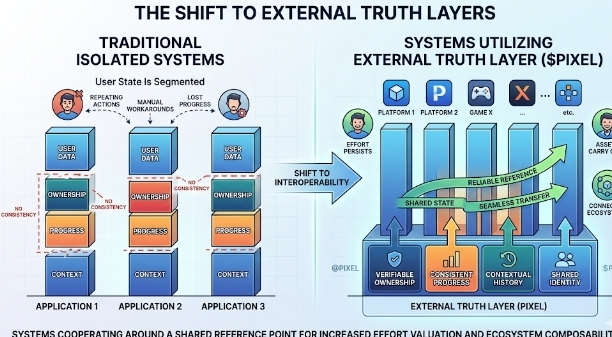
What’s missing isn’t another feature. It’s a shared layer that systems can trust without needing to fully trust each other.
That’s where something like @PIXEL started to make more sense to me. Not immediately, though. Initially, I thought it was just another attempt to formalize ownership in digital spaces—something we’ve already seen in different forms. It felt slightly overbuilt for a problem that people were already working around.
But the more I sat with it, the more the framing shifted.
Instead of asking “what does this system do,” I started asking “what does it allow other systems to rely on?”
The core idea seems simple on the surface. $PIXEL acts as a reference point—a way to anchor state, ownership, or progression outside any single platform. Not locked inside a game, not dependent on a specific application, but available as something other systems can read from and build around.
It’s less about storing everything, and more about making certain things consistent.
A character’s progress, an item’s history, a user’s participation—these can exist as verifiable states that don’t disappear when you leave one environment. And more importantly, they don’t need to be reinterpreted every time. They’re already defined somewhere external.
At first, I questioned whether that level of structure is even necessary. Most users don’t think in terms of “external truth layers.” They just want things to work. Adding another layer could easily introduce more complexity than it solves.
But then I thought about how often systems fail quietly.
Progress gets lost. Ownership becomes unclear. Interactions don’t carry over. And each time, the workaround is manual—screenshots, repeated actions, or just accepting the loss.
Upon reflection, what @PIXEL is trying to do isn’t to replace those systems, but to give them something stable to reference. A layer that doesn’t change just because the application does.
If that actually works, it changes how environments connect.
You could have separate platforms, even separate games, all reading from the same underlying state. Not by syncing databases or building direct integrations, but by agreeing on an external source of truth. That opens up a different kind of composability—one where systems don’t need to know each other deeply to interact meaningfully.
What I find interesting is how this could affect behavior over time.
If users know their actions persist beyond a single platform, they might engage differently. Effort feels less temporary. Assets feel less isolated. Identity becomes less fragmented.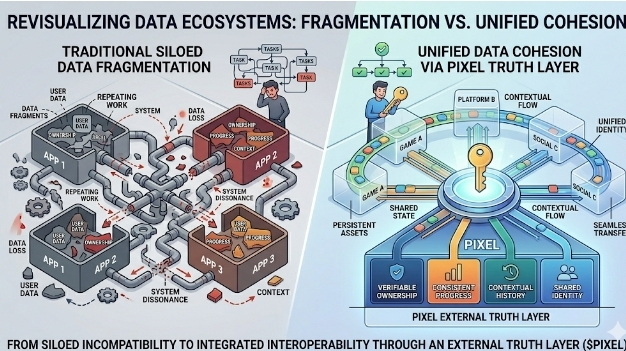
But I don’t think this shift happens automatically, at least not yet.
There’s real friction here. Adoption is uncertain. Systems are still designed to be self-contained. And relying on an external layer requires a level of coordination that doesn’t naturally emerge. It has to be intentionally built toward.
There’s also the question of demand. Do users actually feel this problem strongly enough, or have they just adapted to it?
Right now, I’m somewhere in the middle. I hold a small amount of $PIXEL, mostly as a way to stay engaged with how the system evolves. I’m not fully convinced, but I’m paying attention.
Because if this works, it won’t be obvious at first.
It will show up in behavior. In systems quietly starting to depend on something outside themselves. In users repeating actions because they know those actions persist. In environments that feel connected, even when they aren’t directly integrated.
That’s probably the real signal.
Not announcements or features, but consistent usage. Repeated reliance. Systems choosing, over time, to trust an external layer because it’s easier than maintaining their own isolated version of truth.
If that starts happening, even in small pockets, then something real is forming underneath.
