
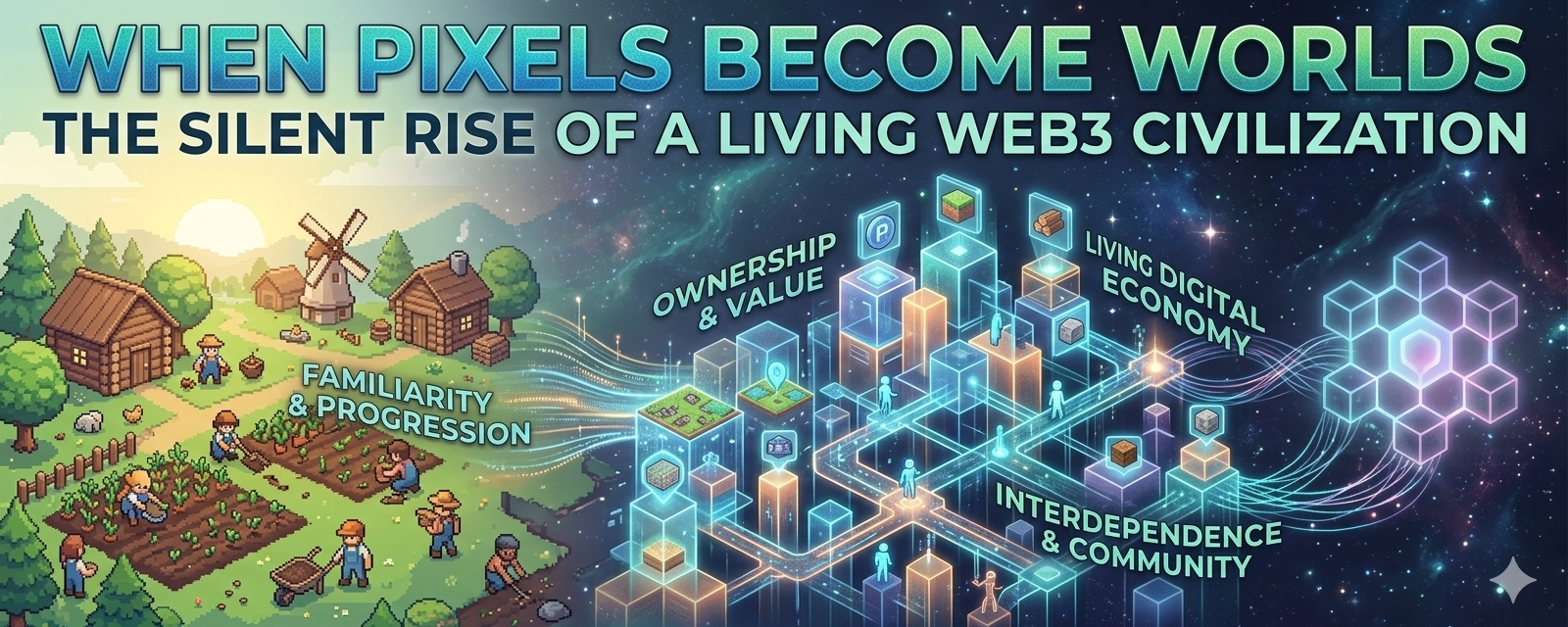
@Pixels There is something quietly unusual about Pixels that you don’t immediately notice when you first enter it. At the surface level, it feels gentle, almost nostalgic, like stepping into a world that remembers the simplicity of old farming games where the biggest concern was planting seeds on time or collecting enough wood to expand your little corner of land. The colors are soft, the pace is slow, and nothing seems designed to overwhelm you. But as you stay longer, you start realizing that this calm surface is not accidental at all. It is carefully built to hide a far more complex structure underneath, one where every small action is quietly tied to ownership, value, and a living digital economy that continues moving even when you are not paying attention.
The deeper truth of Pixels is that it was never meant to be just a game in the traditional sense. It was designed during a time when Web3 gaming was still trying to figure out what it wanted to become. Many projects in that era focused too heavily on earning mechanics, turning gameplay into something that felt mechanical and transactional. Pixels chose a different direction. Instead of starting with money, it started with familiarity. It built a world that feels like something people already understand, something that doesn’t require explanation. Farming, crafting, gathering, exploring—these are simple ideas on the surface, but inside Pixels they are quietly connected to a broader system of value and progression. That decision changed everything because it allowed people to enter the experience without feeling like they were entering a financial system first.
As the world expanded and moved onto the Ronin network, the structure behind Pixels began to reveal itself more clearly. What looked like a peaceful digital land was actually a carefully balanced ecosystem where resources, land, and time all carry meaning. Players gather materials not just for decoration or progression, but because those materials circulate through an economy shaped by demand, scarcity, and interaction between real users. Land becomes more than just a visual space—it becomes a point of production, a source of influence, and in some cases, a long-term strategic asset. And underneath it all, the PIXEL token connects everything, not by dominating the experience, but by quietly linking gameplay activity to a broader digital value system. The interesting part is that most players don’t even feel this complexity directly. They experience it as a game first, and only gradually realize they are part of something much larger.
What makes the internal design so effective is how carefully it separates simplicity from depth. On one layer, everything feels intuitive. You move, you farm, you craft, you interact. It doesn’t feel like you are performing financial actions. But on another layer, every movement contributes to structured systems like energy consumption, resource rarity, and economic circulation. Energy limits prevent over-extraction and keep activity balanced. Resource tiers ensure that not everything is equal, which creates natural scarcity and meaning. Land ownership adds another dimension where participation can evolve into long-term positioning rather than short-term activity. All of this exists quietly, almost invisibly, so the player never feels like they are dealing with a complex blockchain system. Instead, they feel like they are simply playing.
Over time, what emerges is not just a game economy but a social ecosystem. Players begin to interact not because they are forced to, but because the structure naturally encourages connection. People trade, collaborate, form groups, visit each other’s spaces, and build shared goals. The world becomes active even when individual players log off, because the system is not built around isolation but interdependence. That social layer is what gives Pixels its real stability. Without it, the economy would feel empty. With it, the world feels alive, constantly shifting based on collective behavior rather than isolated actions.
Still, beneath all this progress, there are real tensions that cannot be ignored. Any system that connects gameplay with real-world value has to deal with pressure from speculation, imbalance, and shifting motivation. When rewards exist, there is always the risk that enjoyment takes a back seat to earning. Maintaining the balance between fun and economy is not a one-time achievement but an ongoing struggle. There is also the question of dependency on its underlying infrastructure, which in this case is Ronin. While it provides speed and scalability, it also ties the future of Pixels to the health of that ecosystem. These are not small concerns, but they are part of the reality of building something at this intersection of gaming and blockchain.
Even with these challenges, the direction of Pixels suggests something larger than just a single project. It feels like a prototype for a new kind of digital environment where games are not just experiences you consume, but spaces you inhabit over time. A place where effort leaves a trace, where participation slowly builds ownership, and where value is not forced but emerges naturally from interaction. The most interesting part is that it doesn’t try to announce this vision loudly. It simply lets the world grow, one small action at a time, until the structure becomes undeniable.
In the end, Pixels is not trying to be revolutionary in a loud or dramatic way. Its transformation is quieter than that. It is built on repetition, routine, and familiarity. And yet, beneath that calm surface, something far more significant is unfolding. A shift where digital worlds stop being temporary entertainment and start becoming persistent environments shaped by their users. If that evolution continues, Pixels may not just remain a game—it may become a glimpse into how future virtual societies naturally take shape, not through force or complexity, but through simple actions that slowly accumulate into something much larger than anyone expected.
