
I was sitting at a small chai stall near the bus stop, waiting for nothing in particular, just scrolling through my phone while the evening traffic slowed into that usual mix of noise and dust. A friend next to me had his screen open, quietly harvesting crops, checking timers, moving between plots like it actually mattered.
At first, it looked like any other game.
But he wasn’t playing casually.
He was thinking ahead.
Talking about land output, timing cycles, which guild was controlling what, where resources were getting tight. It didn’t sound like someone killing time. It sounded like someone managing something that continued even when he logged off.
That’s when I started paying closer attention.
Because Pixels isn’t something people just try once and forget.
It’s something they settle into.
From the outside, it still looks simple. Pixel graphics, farming loops, basic interactions. You plant, you wait, you collect. It’s easy to assume that’s all there is.
But that’s only the surface.
Spend enough time inside, and the system starts to stretch beyond that loop. Farming turns into production. Production turns into coordination. And coordination slowly becomes dependency—not forced, just built into how things evolve.
You stop thinking in short sessions.
You start thinking in ongoing cycles.
That shift changes how you see everything.
Because what’s happening inside Pixels doesn’t behave like a typical game anymore. It behaves more like a system where time, attention, and decision-making start to carry weight.
And that’s where most people misread it.
They see a game.
But what’s actually forming is an economy.
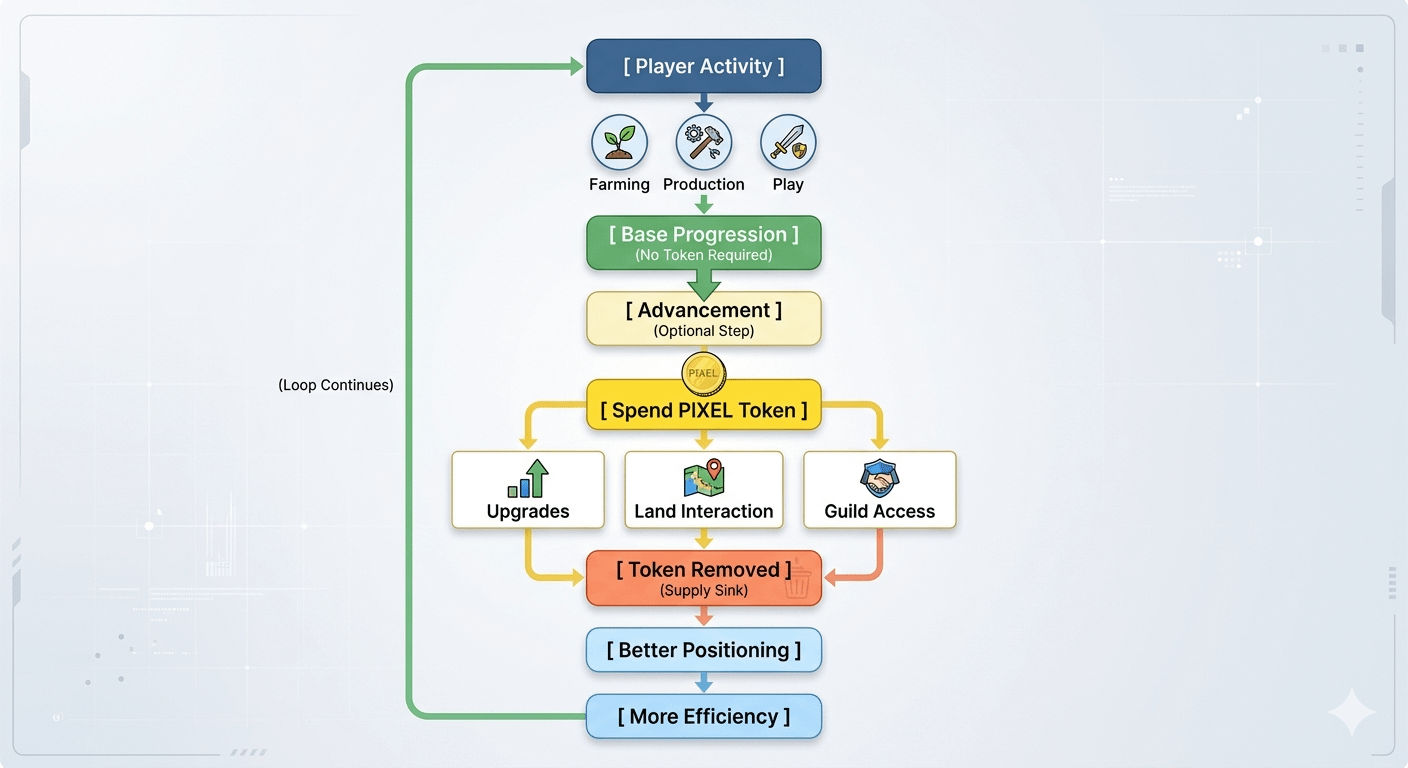
The role of the PIXEL token reflects that difference clearly. It’s not something you spend on basic actions. You don’t need it to participate in everyday gameplay. You can exist in the system without touching it at all.
Which feels unusual at first.
But it’s intentional.
PIXEL only becomes relevant when you want to move beyond the baseline—when you want better positioning, faster progress, or access to stronger layers of the system. It’s tied to advancement, not activity.
That separation matters.
Because it avoids the usual problem where a token loses value simply because it’s used everywhere, all the time. Here, it holds weight because it’s connected to decisions that actually change your position inside the system.
And when people want to improve their position, they’re willing to spend.
That’s where balance comes from.
Instead of pushing tokens out endlessly, Pixels pulls them back in. Upgrades, land interactions, guild participation—these aren’t optional if you want to compete seriously. And each of those actions removes part of the circulating value.
It’s not perfect.
But it’s controlled.
What really pushed the system forward was the shift away from individual play.
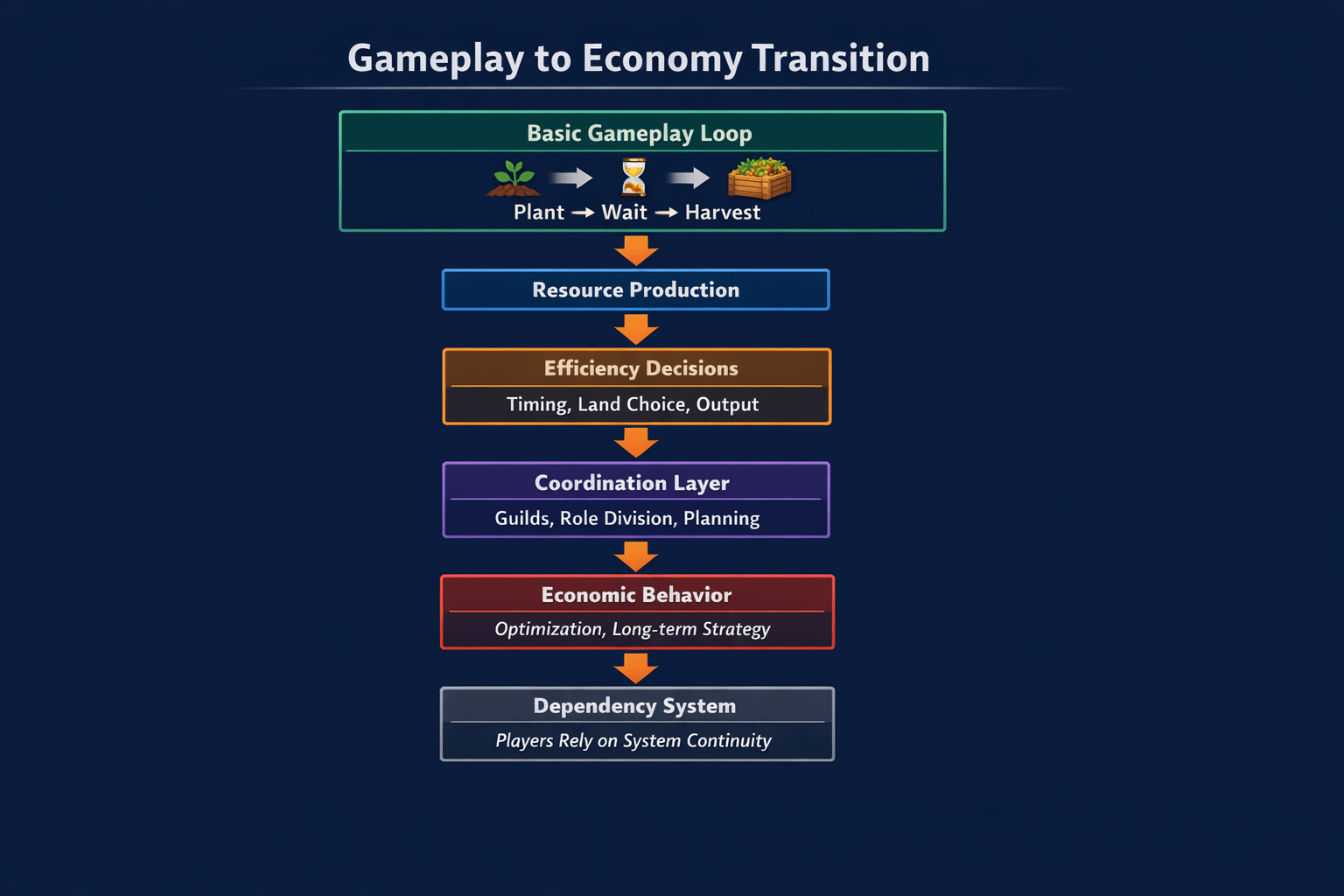
At some point, it stopped being efficient to operate alone. Resources became uneven. Some lands produced more, some less. Certain outputs required coordination across multiple players.
Without forcing it, the system nudged people toward each other.
Groups formed.
Those groups became organized.
Now, guilds operate like structured units. They manage land, coordinate production, decide roles, and plan ahead. Not loosely—deliberately.
That’s where things start to feel different.
Because once coordination becomes necessary, behavior changes. People think long-term. They plan. They invest time with intention instead of just reacting moment to moment.
And that’s when it stops feeling like a game loop.
It starts feeling like a system people are part of.
Another layer that adds to this is reputation.
Pixels doesn’t just track output—it tracks behavior. How consistent someone is, how they interact, how reliable they appear within the system.
Over time, that begins to matter.
Access improves. Opportunities expand. Friction reduces.
You’re not just building assets.
You’re building presence.
And in an environment where automation is common, that kind of signal carries real weight.
Land ownership builds on that idea.
There’s a fixed supply of land, and each piece generates value depending on how it’s used. Owners don’t always need to be active—they can benefit from activity happening within their space.
It’s a familiar concept.
But here, the underlying driver is different.
Value doesn’t come from physical output.
It comes from activity.
Time spent inside the system, decisions made, interactions formed—those become the base layer everything else builds on.
And right now, that activity is steady.
Not explosive. Not driven by hype.
Just consistent.
That kind of growth is easy to overlook, but it’s usually more durable.
Because it’s not driven by short-term attention—it’s supported by ongoing participation.
That’s what makes Pixels worth paying attention to.
It doesn’t try to present itself as something bigger than it is. It doesn’t lean heavily on narratives or promises. It focuses on keeping people engaged, and then builds structure around that engagement.
Simple idea.
Difficult to execute.
And if you only look at PIXEL as a price chart, it won’t fully make sense. The movements won’t always align with external signals or typical market behavior.
But if you look at it as a system where people are spending time, organizing themselves, and gradually building value inside it, the picture becomes clearer.
Because in the end, what holds something together isn’t just capital.
It’s whether people keep showing up.
And right now, they are.