
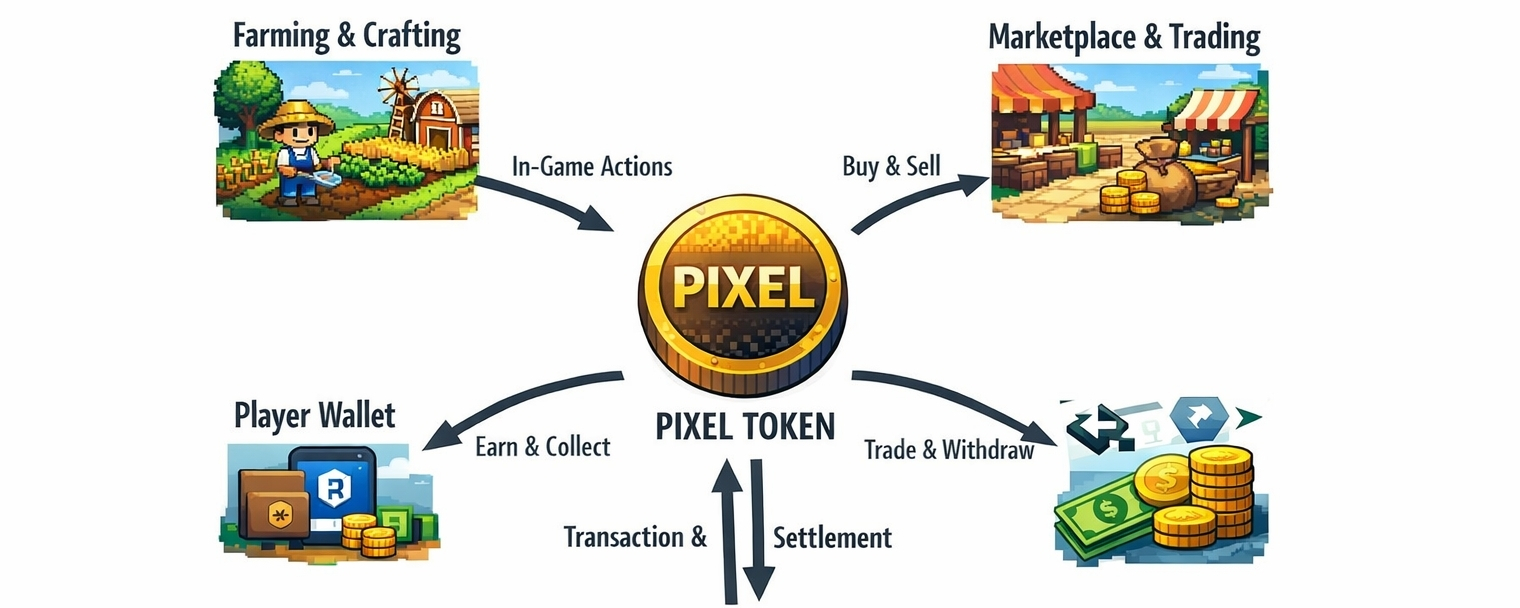
Look, I get the appeal. Pixels looks harmless. Pixel art, crops, a bit of grinding, some social interaction. It feels like something you’d play to relax after work, not something that plugs you into a token economy. That’s the hook. Make it look simple. Make it feel familiar. Then quietly wire it into a financial system running on the Ronin Network.
I’ve seen this movie before. Many times.
Let’s start with the problem they claim to fix. The pitch goes like this: traditional games are closed systems. Players put in time and money but don’t own anything. Developers control everything. Value flows one way. Web3 games, including Pixels, promise to flip that. You play, you earn, you own your assets. Sounds fair. Sounds modern.
It also sounds tidy. On paper, at least.
But here’s the part people gloss over. Traditional games are centralized for a reason. Someone has to manage the economy. Someone has to stop inflation, fix exploits, and keep things from spiraling. When you “open” that system and tie it to real money, you don’t remove control. You just shift the burden. Now the market is in charge. And markets are not designed to be fun. They’re designed to extract.
Pixels doesn’t escape that. It just hides it better.
The solution they’re selling is essentially a hybrid: keep the game simple, layer in a token economy, and hope the two don’t collide. Farming, crafting, trading. Familiar loops. Then add the PIXEL token underneath, quietly turning activity into yield. You plant crops, but you’re also farming rewards. You trade items, but you’re also participating in a liquidity system.
And that’s where the cracks start to show.
Because once money enters the system, behavior changes. It always does. Players stop asking, “Is this fun?” and start asking, “Is this profitable?” That shift is subtle at first. Then it takes over everything. Efficiency replaces curiosity. Optimization replaces play. The game becomes a job, just one with worse protections and more volatility.
I’ve seen entire ecosystems collapse under that weight.
Now let’s talk about the complexity they’ve introduced. The pitch is simplicity, but the system underneath is anything but. You’ve got wallets acting as identities, tokenized assets, off-chain and on-chain interactions, and a marketplace that depends on continuous activity. For a casual player, most of this is invisible. Until it isn’t.
Because when something breaks, and it will, that complexity surfaces fast.
Maybe the token price drops. Maybe transaction flows slow down. Maybe the network has issues. Suddenly, that “simple farming game” is tied to a stack of infrastructure problems the average player never signed up for. And unlike traditional games, there’s no central authority that can just step in and fix everything cleanly without affecting the economy.
That’s the trade-off they don’t emphasize.
Then there’s the catch. The big one. Who is actually paying for all this?
The idea of “earning while playing” sounds great, but the money has to come from somewhere. In most cases, it comes from new users entering the system. They buy tokens, they buy assets, they create demand. Early players benefit. The system looks healthy. Growth masks the underlying imbalance.
But growth doesn’t last forever.
When it slows, the math gets ugly. Rewards shrink. Token prices fall. Activity drops. And the players who came in expecting income start leaving. What’s left is a thinner, less liquid system where value is harder to extract and harder to sustain.
Pixels tries to soften this by not over-financializing every interaction. Credit where it’s due. It’s more restrained than earlier projects. But restraint doesn’t change the core dynamic. If the token matters, and it does, then the system is still exposed to speculation, volatility, and the constant need for demand.
And let’s not ignore the centralization question. Yes, it’s on a blockchain. Yes, assets can be owned and transferred. But the game itself? The rules, the updates, the reward structures? Still controlled by a small team. If they change the economics tomorrow, players adapt or leave. That’s not decentralization. That’s a managed economy with a token layer.
Different packaging. Same control points.
And when things go wrong, that’s when reality sets in. Players don’t file support tickets about “fun.” They complain about lost value. About time that no longer pays. About assets that aren’t worth what they thought. The tone shifts quickly when a game becomes a financial system.
I’ve watched this cycle repeat. The optimism. The early gains. The slow cracks. Then the quiet exit.
Pixels might last longer than most. It’s simpler. It’s more careful. It understands user behavior better than earlier attempts. But it’s still built on the same foundation: a game that doubles as an economy, where value depends less on what you create and more on who shows up next.
And that’s the part that never really changes.
