
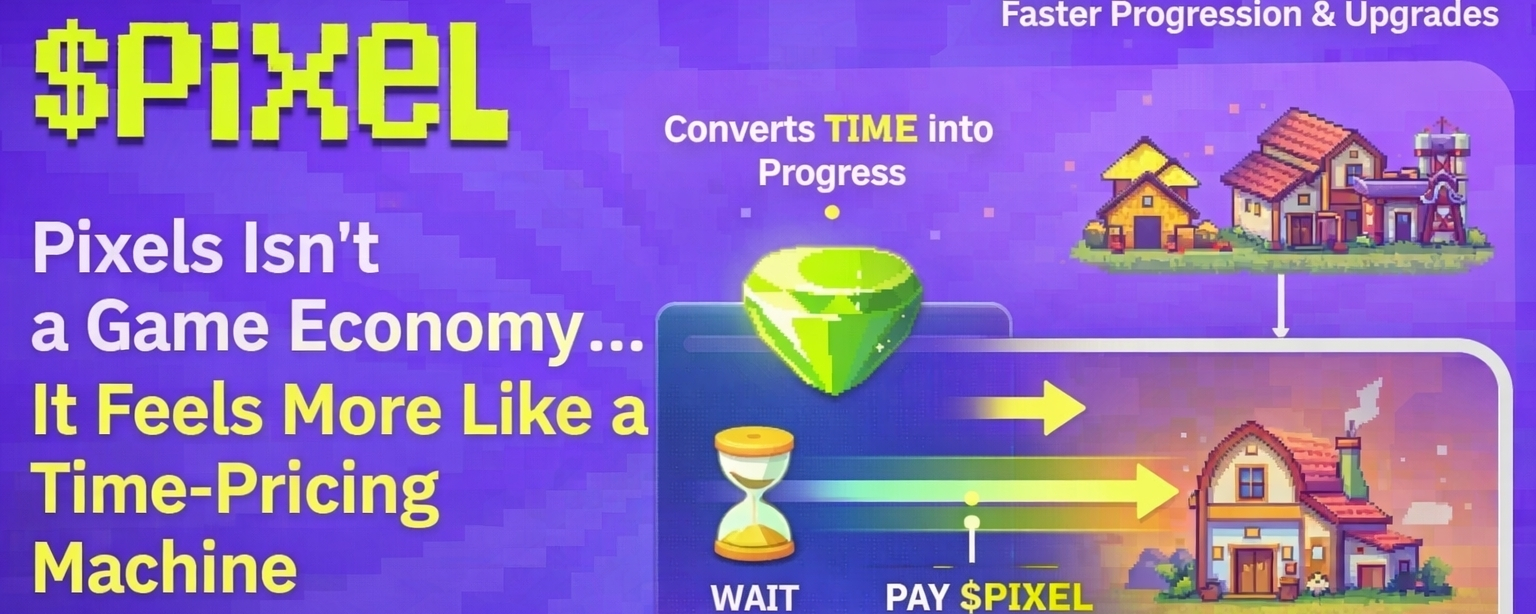

I didn’t notice it the first few times I opened Pixels. It just felt like another loop. Plant something, wait, come back, upgrade, repeat. Nothing unusual. That’s how most of these systems look at the surface. Familiar enough that you don’t question the structure too much. You assume it’s about rewards, maybe token emissions, maybe land mechanics if you stay longer.
But after a while, something starts to feel slightly off. Not broken. Just… calculated in a different way.
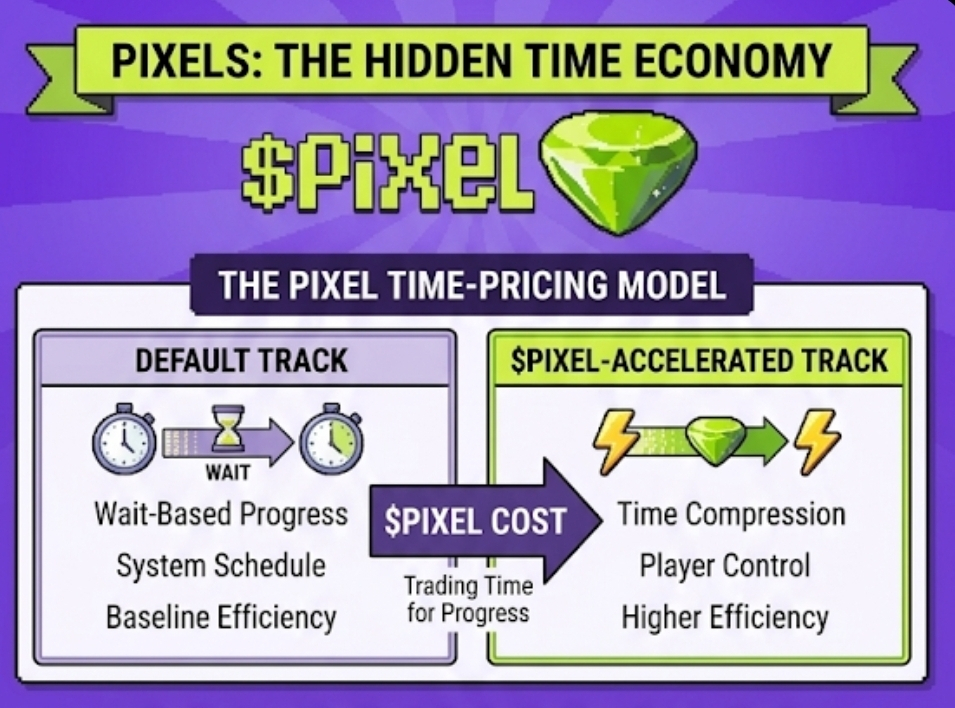
It hit me on a small decision. I was waiting on something to finish, nothing important, just part of the loop. And I had two options. Wait it out. Or speed it up using $PIXEL. That moment isn’t dramatic, but it tells you more about the system than any whitepaper ever will. Because the system isn’t asking what the item is worth. It’s asking what your time is worth right now.
And that’s where I think Pixels gets misunderstood.
Most people still talk about it like a game economy. Supply, demand, sinks, rewards. That whole framework. It’s not wrong, but it’s incomplete. The deeper layer isn’t really about items or even tokens. It’s about how the system constantly evaluates time and gives you a way to trade against it.
You start seeing it everywhere once that clicks. Farming cycles. Crafting delays. Upgrade paths. Even access to certain features. There’s always a baseline pace, and then there’s a faster version of that same path sitting right next to it. The difference between the two isn’t random. It’s structured. And $PIXEL sits right in that gap.
I don’t think the system is trying to hide this. It’s just not explicitly framed that way. But functionally, it behaves like a time-pricing layer. You’re not only progressing. You’re constantly deciding whether to accept the default speed or override it.
That’s a subtle shift, but it changes how you interpret everything else.
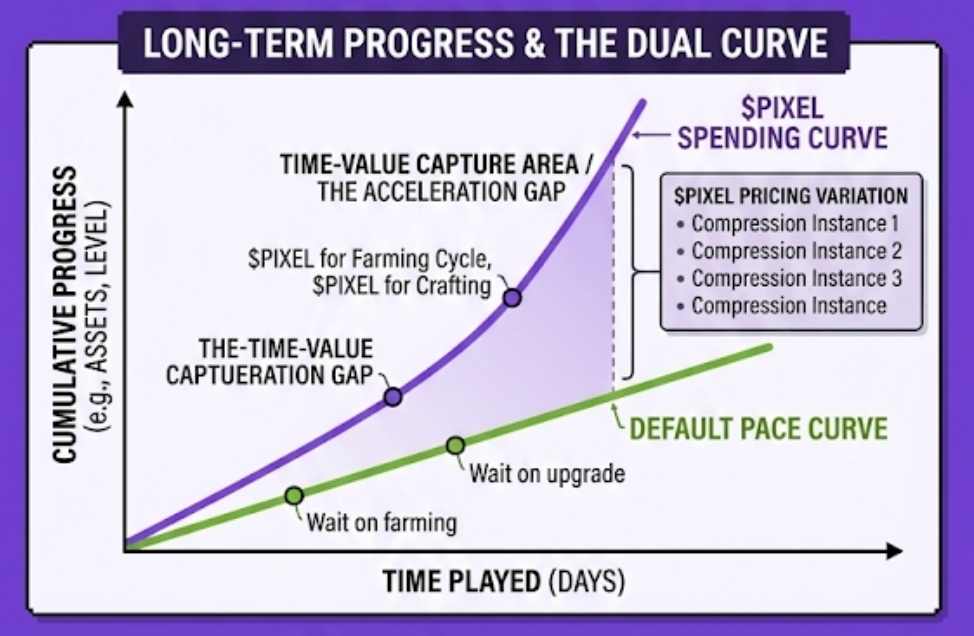
Because once time becomes the thing being priced, the token stops feeling like a reward mechanism. It starts to feel more like a tool for compression. Not to skip the game entirely, but to reshape how long things take. And that’s a very different role compared to most GameFi tokens, which usually struggle to justify why they exist beyond emissions or governance.
Here, the use case is almost uncomfortable in how clear it is. You’re paying to not wait. That’s it. No complicated narrative needed.
At first, that actually feels efficient. Even intuitive. Outside of crypto, this tradeoff exists everywhere. Faster services cost more. Priority access costs more. Time has always had a price, just not always visible. Pixels just makes that pricing continuous and interactive.
But the longer you sit with it, the more questions start to show up.
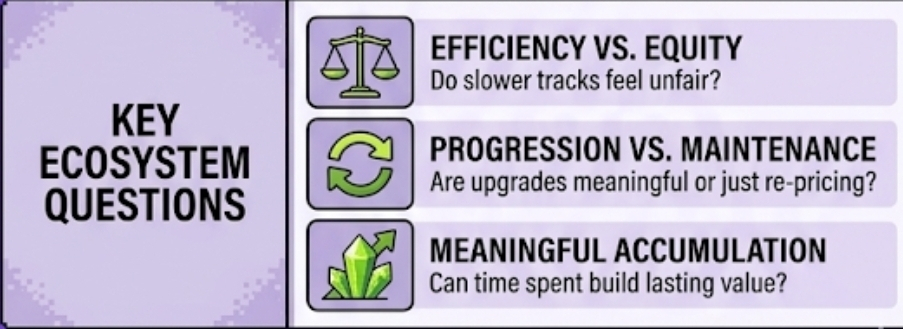
Because not everyone experiences time the same way inside the system. Some players are effectively operating on a slower track, not because they’re less skilled, but because they’re choosing, or forced, to stay on the default pace. Others are constantly compressing their timelines using $PIXEL. Both are playing the same game, technically. But the system is valuing their time differently.
That difference doesn’t always feel fair, even if it’s logical.
And then there’s another layer I keep thinking about. What actually carries forward? Not in the marketing sense of ownership, but in a more practical way. If I spend time today building something, does that reduce friction tomorrow in a meaningful way? Or do I just re-enter the same loop, slightly upgraded but fundamentally unchanged?
Because if the system keeps resetting the value of time into similar cycles, then it’s not really compounding anything. It’s just re-pricing effort again and again. And in that kind of structure, players eventually notice. Not immediately. But slowly.
I’ve seen that pattern before in other systems. At first, efficiency feels like control. You’re optimizing, making better decisions, moving faster. Then at some point, it starts to feel like maintenance. You’re not advancing, you’re just keeping up with a curve that keeps shifting.
To be fair, Pixels hasn’t fully crossed into that territory. It’s still in a phase where the system feels active, responsive, even a bit flexible. The Ronin migration, the changes in currency structure, all of that suggests the team is aware that balance isn’t static. They’re adjusting something deeper than just emissions.
Still, the core mechanism remains. Time is being priced. Quietly, consistently, everywhere.
And I don’t think that’s a bad design choice. If anything, it’s closer to how real economies function than most GameFi experiments ever got. The question is whether that mechanism can evolve beyond simple compression. Whether time spent can actually accumulate into something that changes future interactions, not just speeds them up.
Because if it doesn’t, the system risks turning into something very efficient, but not very meaningful.
Right now, Pixels sits in an interesting place. It looks like a game. It behaves like a market. And somewhere in between, it’s constantly asking players a question they don’t always realize they’re answering.
How much is your time worth… right now?
The answer changes more often than people think. And the system is always ready to price it again.